Search

Queer Rock Love

A Family Memoir

Tag

transgender

Breast/Chest

As a chronicler of queer family life, there are two topics I have studiously avoided: breastfeeding and my wife’s chest surgery.

It has not escaped my notice that both of these topics have to do with boobs.

All my life, breasts have been vexed. As a fourth grader under the influence of Judy Bloom, I waited vigilantly for signs of swelling in my chest area. My best friend, the frighteningly precocious Susie Patterson, smuggled 24AA training bras to school for me in her lunch box. She could afford to be generous; as Susie never failed to remind me, she had moved on to bigger (and implicitly better) sizes.

By the time I reached high school, I was furtively searching my health textbook for information about the outlying age range for breast development. Was it possible that I was just a late bloomer? Are you there God? It’s me, Paige. I’m not asking for a miracle. I’m just asking for a B cup. As the years passed, I hitched my hopes to any old wagon, grasping at stories of short boys who grew an inch or more after age 18.

Eventually I realized that a late-adolescent growth spurt was not going to happen. I purchased a Maidenform padded push-up bra and learned to make light of my plight. I was a budding thespian, and my signature monologue was Nora Ephron’s “A Few Words About Breasts,” which begins like this:

I have to begin with a few words about androgyny. In grammar school, in the fifth and sixth grades, we were all tyrannized by a rigid set of rules that supposedly determined whether we were boys or girls. The episode in Huckleberry Finn where Huck is disguised as a girl and gives himself away by the way he threads a needle and catches a ball — that kind of thing. We learned that the way you sit, crossed your legs, held a cigarette and looked at your nails, your wristwatch, the way you did these things instinctively was absolute proof of your sex. Now obviously most children did not take this literally, but I did. I thought that just one slip, just one incorrect cross of my legs or flick of an imaginary, cigarette ash would turn me from whatever I was into the other thing; that would be all it took, really. Even though I was outwardly a girl and had many of the
trappings generally associated with the field of girldom — a girl’s name, for example, and dresses, my own telephone, an autograph book — I spent the years of my adolescence absolutely certain that I might at any point gum it up. I did not feel at all like a girl. I was boyish. I was athletic, ambitious, outspoken, competitive, noisy, rambunctious. I had scabs on my knees and my socks slid into my loafers and I could throw a football. I wanted desperately not to be that way, not to be a mixture of both things but instead just one, a girl, a definite indisputable girl. As soft and as pink as a nursery. And nothing would do that for me, I felt, but breasts.

While my adolescent self was not particularly athletic or rambunctious, Ephron’s essay resonated more than I let on. I believed that breasts were a magical badge of femininity. My A-cup assets made me slightly uneasy–not just about my attractiveness–but about my identity.

Katy as a teenager. No doubt this picture was posed by her mother, the inimitable Donna Koonce.

My wife’s experience was quite different. Katy inherited her mother’s legendary rack. And since she refused to set foot in the lingerie department, Katy was at the mercy of her mother’s taste in bras. Thus, throughout the low-slung seventies, Katy sported Jane Mansfieldian bras that launched her boobs up and out, like minor planets orbiting her chin.

It was not a style that complemented a softball uniform. Or a basketball uniform. Or any of the other sporty ensembles that might otherwise have offered androgynous refuge for a budding butch. In the context of Katy’s broad shoulders and chiseled jawline, the bullet bras highlighted femininity as awkward and unfortunate drag.

More later…

(Special thanks to Katy for digging up this picture and letting me post it. Despite the fact that she finds it slightly mortifying. I think the transgender butch shines through, don’t you?)

The Little Zeus’s Room

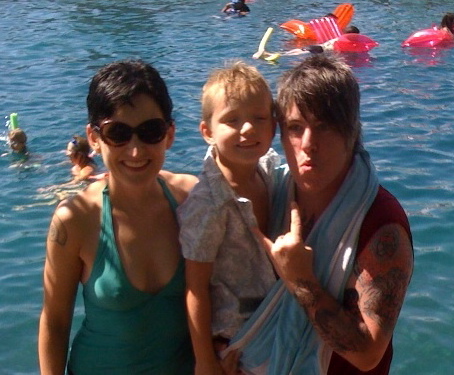
This past summer, our family vacationed in Hawaii. We spent a lot of time swimming, snorkeling, picnicking and thinking about where my wife, Katy, could use the restroom.

In our regular life in Austin, this is less of a problem. In Texas, Katy gets read as male about 50% of the time and as female about 50% of the time. Her Gender Attribution Average (GAA) is actually pretty close to her internal gender identity, which is cool – unless she needs to pee. Still, in her day-to-day routine, Katy is usually able to avoid unfamiliar public restrooms.

In Hawaii, however, Katy’s GAA was 100% male. This is not usually a problem either. When she’s in a highly gender-conforming context, it’s often easier for Katy to use the men’s restroom, because she experiences much less rubbernecking and gender policing.

The problem lay in the fact that we were on vacation with our 8-year-old son.

For the longest time, Katy and I were like the stereotypes of the overprotective lesbian parents. I took Waylon with me in the women’s restroom until…let’s just say recently.

Thus, the beginning of our vacation found me pacing anxiously outside a men’s room at LAX, possibly looking like some kind of creepy bathroom peeper, while I waited for Waylon. I was worried that this would turn out to be one of those labyrinthine airport bathrooms with multiple exits and that my baby would wander out into the wrong corridor and be swept onto the busy streets of Los Angeles.

It seemed like hour later, although I suppose it was only five minutes, when Waylon emerged, looking disturbed. “What happened?” I cried, expecting the worst.

He crinkled his nose. “It just smells like a bunch of URINE in there!”

Clearly we needed to try a littler harder to help our son adapt to the restrooms of his gender tribe.

*
Our hotel in Kauai was located on a breathtaking beach in a rocky cove. In the mornings, when mist hovered over the water, it made me think of Homer’s “rosy-fingered dawn.” Waylon was going through a Greek mythology phase – not a casual “I enjoyed The Lightning Thief” kind of thing, but more of an “I’m crying because I realized that I’m reading an abridged version of The Odyssey” kind of thing.

He’d discovered a quiz that could determine which Olympian god a person most resembled, and he’d pegged Katy as Zeus and me as Athena. I was flattered that my son considered me to be the goddess of wisdom, but I was also uncomfortably aware that I was gay married to my own mythological father.

Still, the strangeness of our mythological May/December union paled in comparison to our queer presence at a swanky beachside resort. Katy’s cousin had generously given us a weeklong stay at her timeshare, which turned out to be Honeymoon Central. There were honeymooners in the hot tub, newlyweds at the bar, and humongous wedding parties posing for group photos next to the koi pond.

Perhaps it was the overwhelming heterosexuality of all those honeymooners that predisposed people to read Katy as male. Whatever the cause, Katy’s Gender Attribution Average seemed impervious to the fact that Waylon called her “Mommy” every few seconds.

On our first full day in Hawaii, Katy and I lounged around the hotel’s enormous, flower-shaped pool while Waylon demonstrated 500 variations on the basic cannonball. “Hey, Mommy, Mommy, watch this! Did you see that one Mommy? Watch! Mommy, how big was my splash? Mommy!”

A polo-clad waiter appeared to check on Katy’s drink.

“Can I get you another beer, sir?”

“Mommy, Mommy, look at this!”

Katy had the deer-in-the-headlights look that means she’s afraid someone will revise their gender attribution in the middle of an interaction. It’s not that she cares so much how they read her; she just dreads the rollercoaster of confusion, embarrassment, and hostility that sometimes ensues. I decided to try to help her out.

“What is it, Waylon?” I asked, lowering my sunglasses.

“Not you! I’m talking to Mommy!”

Despite the fact that Waylon had blown Katy’s cover, the waiter continued to address Katy as “sir” for the remainder of our stay.

*
The highlight of our trip was a day spent snorkeling at a secluded hike-in beach on the north side of the island. At first Waylon was hesitant to swim out to the reef, so Katy wrapped her arm around him, and he clung to her like a happy submarine sidecar. As we approached the reef together, the sun burst through the morning clouds, illuminating brightly colored fish in all kinds of fantastic sizes and shapes.

By the time we hiked back to our car, afternoon rain clouds were beginning to gather, and Katy really needed to pee.

I think that there’s something particularly ominous about state park bathrooms. Maybe it’s the polished metal “mirrors,” which hint at violent acts of vandalism that the state has foreseen and precluded. Maybe it’s the latrine smell, which reminds me of Girl Scout camp and mandatory sports. Or maybe, as the partner of a transperson, I’ve begun to develop a sixth sense for locations where gender policing is likely to take place.

Whatever the reason, I could tell that Katy was not going to use the crowded bathrooms at Ha´ena State Park.

Later, I learned that Ha´ena is also referred to as the “end of the road” in Kauai. We were about as far as we could possibly be from our hotel, on an island where the average speed limit is 35 miles per hour. Katy got in the car with a grim look on her face.

As we passed through tiny towns, I could see Katy scanning for something. Each time we passed another unsuitable option, she grew a little bit quieter and grimmer. Waylon was in the back seat, loudly recounting one-liners from all the cartoons he had watched the day before. Katy gritted her teeth and turned up the radio.

“For god’s sake,” I wanted to cry, “just pull over and go behind a tree!” But I knew it was no use. My modest, pee-shy partner would never, ever be able to pee in the open.

Finally, just as I began to fear irreparable damage to Katy’s bladder, she spotted what she was looking for: a rundown gas station with single stall bathrooms that were accessible from the parking lot. She pulled the car over so fast it made my heart race, slammed it into park and jumped out without bothering to close the door.

Our perfect day was saved.

*
For the last night of our trip, we decided to splurge on the poolside buffet. In addition to his Greek mythology phase, Waylon was also going through a sushi phase. He’d been starring longingly all week at hotel posters touting an amazing variety of delicious-looking maki.

We all dressed up for the grand occasion. Even Waylon was wearing one of the preppy outfits that his gay grandpa likes to buy him at TJ Maxx. In his polo shirt and khaki shorts, he looked just like one of the waiters.

As soon as we had placed our orders, Waylon got a stricken look on his face.

“I have to go pee,” he said. I could tell it was urgent.

“I kind of need to go too,” Katy admitted.

“Let’s go together!” Waylon said.

Katy looked around at the other diners. Drunken honeymooners seemed completely oblivious to her plight. For the past seven days, every single stranger we’d met had read Katy as male. “Waylon,” she said, “if we go in the men’s room together, you can’t call me ‘Mommy’ all the time.”

“I know! I’ll call you Zeus!”

For the next five minutes, Waylon proceeded to say “Zeus” as often as he usually says “Mommy.”

“Come on, Zeus,” he said, shepherding her into the men’s bathroom like an old pro. “You take the stall, Zeus,” he added as he graciously headed to the urinal.

*
It was kind of hard to readjust to regular life after our glamorous vacation in Kauai, but I was glad to settle into our regular bedtime routine again. Katy and I usually spend a few minutes lying down with Waylon before he goes to sleep. It’s a time for us to talk about whatever’s on our minds, and I had a question that I needed to ask.

“Waylon, what did you think about using the men’s room with Mommy?”

“Good.”

“I mean, how did it feel to call her another name besides Mommy?” I asked, trying to dig a little deeper.

“It was okay.” he said, elliptically. “But I wouldn’t want to do it all of the time!”

Photo from yukihiro m.’s flickrstream. Shared under the terms of a Creative Commons license.

Uncle Stacey

Sometimes I start thinking I’m an expert. I get to feeling like I’ve got things all figured out. And then, inevitably, parenthood brings me right back down to earth.landino.jpg

Take the time we told our son, Waylon, that his friend Stacey was embarking on a transition.

Waylon has spent much of his life around trans people. His genderqueer mommy had chest surgery when he was 18 months old. We’ve always spoken openly about the surgery and how it helped Mommy feel more comfortable in her body. As a toddler, Waylon developed his own four-coordinate gender system (boy, girl, boygirl, girlboy) to describe the gender diversity that he observed around him.

His experience wasn’t just limited to genderqueer people. Because my wife, Katy, is a therapist and activist in trans communities, Waylon has grown up around all kinds of trans folk. He can explain gender dysphoria and gender confirmation surgery in seven-year-old layman’s terms. He’s been to Gender Spectrum kids camp. He uses “hir” and “ze” as pronouns for God and certain stuffed animals.

So perhaps I can be forgiven for being a bit cavalier when I introduced Stacey’s transition as dinnertime conversation.

Stacey is my sister’s long-time partner. A talented artist with a low-key demeanor and a childlike capacity for silliness, Stacey has always been a favorite with Waylon. When Waylon developed a fondness for new wave music, Stacey made him mix CDs from his extensive music collection. When Waylon lost his first tooth, Stacey made him a stuffed animal shaped like an anthropomorphic incisor. And Stacey taught Waylon to play Plants vs. Zombies, a delightful video game that is only slightly less addictive than crack cocaine. So there was no question that Waylon would be interested when we told him over dinner that we had news about Stacey.

“You know how Stacey’s kind of like a boygirl?” I asked, using Waylon’s term for butches and masculine genderqueer types. He shook his head yes.

“Well,” Katy continued, “he’s realized that he feels all the way like a boy inside. He’s going to start taking medicine and changing his body so that he can make his body match the way he feels inside.”

Waylon paused for a moment. Then his face twisted into a tortured grimace and he began to sob. This wasn’t the phony cry he uses when he wants to be tucked in for the 27th time at night. This wasn’t the medium cry he uses when he’s scraped his knee or stubbed his toe. This was an anguished wail that made me gather him in my arms and hold his head against my cheek.

“I don’t want her to change, I don’t want her to change,” he bleated between sobs that shook us both.

My eyes met Katy’s across the table. She looked as scared and guilty as I felt. What had we done?

We tried to reassure Waylon by telling him that Stacey’s personality was not going to change. “He’ll still play with you,” I said. “He’ll still like stuffed animals and Plants vs. Zombies,” Katy added. “He’ll still be the same person.”

“No,” Waylon cried into my shoulder. “I don’t want her to change.” The tears showed no sign of stopping.

I tried a different tactic. “This is good for Stacey. This will make him happier.”

But every “him” was like fuel on flames. The crying just got louder and harder. Finally, Katy couldn’t stand it anymore. She reached for Waylon, and I transferred him to her arms. “Shhh shh shh,” she whispered as he rocked him. “It’s going to be okay.”

***

In retrospect, our biggest mistake was not realizing what a big shock this would be. As adults, we’d been able to read certain signs. But Waylon wasn’t picking up on the same clues. He wasn’t getting periodic updates from Stacey and my sister. He felt broadsided.

And while it’s true that Waylon has known quite a few trans people, they’ve mostly been post-transition or genderqueer. He’s never accompanied a friend through the journey of transition. He knew, theoretically, about the idea of transition, but he had no idea what to expect from his friend.

I can see, in hindsight, why I failed to anticipate his fears. As a feminist academic and a lover of complexly gendered people, I can be guilty of seeing gender as the most salient factor in almost any situation. From my perspective, Stacey was changing his outward position on a fluid gender spectrum. But Waylon wasn’t crying about gender. He was crying about losing a buddy. If I had it to do over again, I would speak to those feelings of loss and abandonment first and foremost.

***

After that first night, we hovered in an impasse. Waylon’s response to the whole topic was just plain “no.” I was teaching the short film No Dumb Questions in my class that semester, and I asked several times if he wanted to watch it with me. Waylon pointedly declined. I decided to let time work its magic.

At Christmastime, we all met up at my dad’s house. Stacey had sewn Waylon a giant pillow shaped like a fried egg. Waylon didn’t seem hesitant or shy. He followed Stacey around just like usual, talking a mile a minute, his speech liberally peppered with Stacey’s name: “Stacey, guess what? Stacey, look! Hey, Stacey…Stacey, watch this! Stacey!”

Stacey had started T just before Christmas. Now the whole extended family was trying their best to shift pronouns. We all made our share of slips. (Perhaps this is a blatant self-justification, but I swear it’s harder to shift pronouns when someone keeps the same name.) I tried to correct myself right away when I forgot. Occasionally I gently corrected Waylon too. He looked at me doubtfully, said “he,” and then moved on.

After Christmas, I asked Waylon about his experience of spending time with Stacey. He didn’t have much to say, which was unprecedented. Waylon is a chatterbox. He tends to talk nonstop about everything from the arcane plots of video games to the social dynamics of the lunch line. I was a little worried, but it wasn’t like he was avoiding Stacey. He just didn’t really want to talk about the transition yet.

Then, last spring, Stacey and my sis came to Austin for a brief visit. Stacey was recovering from chest surgery, but he and Waylon were still able to make a quick run to the store in search of the small bunny-shaped action figures that they both collect. Afterward, I asked if Stacey seemed different. Waylon thought for a moment. “Well,” he said, “I think maybe he seemed shorter.”

This was progress! Waylon had used a masculine pronoun without coaching. And, apparently, he had turned the corner from seeing Stacey as an average-sized woman to seeing him as a short man.

***

This summer, my sister and Stacey agreed to keep Waylon for a week while Katy and I took our first solo vacation in seven years. We were a bit anxious about being apart from our baby for so many days, but Waylon was pumped about his independent vacation plans. My sweet sis, Waylon’s doting “Auntie,” had planned an action-packed week of theme parks, aquariums, and museums. She and Stacey stocked up on mac-n-cheese. They moved an air mattress into the bedroom of their loft and researched kid movies on cable. They bought sticker books and Sponge Bob snacks.

The night before we left, the four of us had dinner at a restaurant near their house in Chicago. Waylon asked to sit between Auntie and Stacey. As we waited for our food, Waylon and Stacey were amusing themselves with Waylon’s brand new book of Lego stickers. I was talking to my sister when I heard Waylon engaging Stacey in conversation.

“Stacey?”

“Yes?”

“Well…how did your surgery feel? Did it hurt?”

Stacey assured Waylon that the surgery hadn’t hurt too badly because he had been asleep. And then, in the blink of an eye, Waylon’s talk switched back to Legos.

The next morning, Katy and I said our nervous goodbyes and hit the road. In the evening, we called to say goodnight and to tell Waylon that we missed him already. “Mom,” Waylon said, “you and Mommy are my best friends. You and Mommy and Auntie and Stacey are my best friends.”

***

For useful resources about talking to a child about a transition, check out COLAGE’s Kids of Trans resource guide.

Photo credit: Amanda Fulk. You can see a short film and more images of Stacey’s transition at http://www.lamiscelanea.org/ (Enter the site and scroll all the way to the right.)

A Road Trip, Told as a Series of Pit Stops

It’s the kind of truck stop where a voice on the loudspeaker calls out “Customer 47, your shower is ready.”  In the back, plywood covers a large hole in the wall, a monument to some past collision. In the front, porcelain bald eagles are arrayed next to bright yellow boxes of energy “vitamins.”

When I was a straight, white college student, I used to appreciate places like this as kitsch. That was before I traveled the U.S. with my ex–a gender non-conforming man of color, a non-citizen. Now I sense the undercurrent of violence. I can taste the ambient terror.

My six-year-old son, Waylon, has to pee. I take him with me to the women’s bathroom, then begrudgingly allow him to choose a candy treat. “Those are two for one,” drawls the white woman behind the counter. I just want to get out of this place, but Waylon’s already made a beeline back to the candy aisle.

Just then, Katy walks up. “Do you have your phone on you?”

“You want to make a phone call right now?” I ask, incredulously. I have cash in hand. My eyes are fixed to the spot where I’m waiting for Waylon to reappear with a second pack of Skittles.

“No,” she says, sounding only slightly exasperated. “I need to do the phone trick.”

Duh. I’ve been focused on my own freaked out feelings and shepherding Waylon out of this place. I’ve forgotten to think about how Katy is going to pee.

“The phone trick” is something Katy came up with over our last summer road trip. It’s a survival strategy for places where an ambiguously gendered body is likely to run into trouble in public restrooms.

It’s simple. She holds the phone to her ear as she enters, pretending to be engrossed in conversation. She speaks in a high voice, so that people who might be confused by her appearance can assign a gender category that allows her to use the women’s restroom. She never puts the phone down or stops talking, leaving no opening for strangers to engage her.

A few minutes later, I’m sitting in the front seat with my eyes on the door of the truck stop. When Katy finally emerges, she slides into the driver’s seat and hands me back my phone. “How did it work?” I ask, relieved that we’re all safely in the car.

“I needed it,” she says. “It worked.”

We’re not the most vulnerable to violence in a truck stop in a place like Van Horn, Texas. I’m well aware that our travels are protected by the buffer of our race and class and citizenship privilege. No economic dislocation launched this voyage. We’re on vacation. We chose to come to West Texas. We’re driving a Prius with a Would Jesus Discriminate? bumper sticker. From far away, all people can read is “Jesus.”

Katy slows down when she sees a white car in the distance, but speeds up again when she sees the green stripe that signifies border patrol, not state trooper.

I’m remembering what it was like to go through checkpoints with my ex, how he tensed up miles ahead of time. The agent leaned into the window and said “U.S. citizens?” out of the corner of his mouth. My ex showed his driver’s license and maybe his permanent resident card. He used his deepest, dudeliest voice while the agent surveyed our belongings in the back of the truck.

Fort Davis, Texas
Katy gets pulled over for speeding. The officer makes her get out of the car before he’ll approach. I watch in the mirror. Even though she’s got driver’s license and insurance papers ready, I’m afraid. We’re in the middle of the nowhere. What if the trooper doesn’t take kindly to someone whose presentation doesn’t match her gender marker? What will he think of the two of us traveling with a child?

Waylon is watching cartoons on the iPod, oblivious to all around him. Later, when we’re safely on the road again, Katy teases him: “You didn’t even bat an eye when Mommy got pulled over by that cop!”

“You mean when you were talking to that cowboy?” he says, completely unalarmed.

He’s too complacent about cowboys, I decide. I’ve just been re-reading Borderlands/La Frontera, and I try to tell a six-year-old version of Anzaldua’s history: how the Cochise people moved southward, how the Aztecs dominated other tribes and the Spanish exploited those divisions, how the Treaty of Guadalupe Hidalgo robbed people of their property. We end up in a conversation about different ways of understanding humans’ relationship to land.

“I don’t think anyone can own the earth!” Waylon says, outraged. I have to smile, because–as an only child in an owning-class family, he can’t even share toys very well. Still, I’m glad that borders don’t seem natural or inevitable to him.

After all this talk about how the west was stolen, Waylon has another question: “But how do we tell them that we’re not the bad kind of white people?”

I pause. I’m trying to parse the “them” and to imagine what kind of encounter he’s imagining. We talk about the people we know who variously identify as Native American, Hispanic, Chicano/a, or Mexican. I’m trying to think of how to teach him to be just without being self-righteous. How do you inculcate reflexivity? Six-year-olds have a fairly dualistic worldview. Either you’re good or you’re bad, just like the cartoon characters he watches on the iPod.

“Maybe the answer is just not to act like a know-it-all,” I say. Waylon shakes his head eagerly. He hates know-it-alls. They are the bane of his kindergarten social landscape.

Marfa, Texas
We’re staying for the night in Marfa, the hipster capitol of west Texas. With its big sky and classic county courthouse, Marfa looks like a movie set of a western railroad town. Some of the scenes from Giant were shot in our hotel. Now the 1920s storefronts are homes for galleries and trendy restaurants, thanks to the magnetism of the nearby Chinati Foundation.

They’re used to weird white people here. bathroomguy.jpgWe don’t even stand out next to the noisy German art collectors and East Coast ArtForum types. At breakfast, we become enamored of a seventy-something woman with round, black-rimmed glasses and a helmet of silver hair. She’s a dead ringer for Edith Head. Katy waits in the vestibule outside the bathroom, hoping to capture a surreptitious iPhone picture of our crush, but ends up accidentally snapping some random dude exiting the restrooms.

Balmorhea, Texas
We make a day trip to San Solomon Springs, a natural spring-fed pool in the middle of the desert. It’s Saturday, and the place is full of middle and working class families, brown and white. There are thickets of picnic tables, and people are barbecuing, hanging out, horsing around. Everyone from middle-aged bikers to tiny kids line up to jump off the high dive, which was constructed–like the rest of the pool–in the 1930s. There are no lifeguards.

While I’m swimming with the fishes in the deep end, Waylon has to pee again. Katy escorts him to the entrance of the men’s restroom. Using the men’s room on his own is relatively new, so she attempts to give him a refresher about what to do if anyone approaches him. “I’ll just kick ’em in the balls,” he says, slipping out of her grasp and lighting out for the urinals.

After our swim, we stop at a roadside general store to stock up on chips, soda, and ice cream bars for the drive back to Marfa. As I slide into the car, I tell Katy that there are two single-stall bathrooms at the back of the store, with a gender-neutral common area for washing up. “It’s probably your best bet for miles around for a trouble-free pee,” I say. She jumps back out of the car. It’s been hours since we left our hotel this morning, and I wonder how long she’s had to go.

Las Cruces, New Mexico
We decide to spend an afternoon at the movies. Halfway through the film, I have to pee. I emerge from the dark theater, still in a cinematic dream state, and suddenly I’m confronted by a sign that says, “Restrooms for Humans Only.” Perhaps because I’ve been studying too much Traditional Values Coalition propaganda, it takes me some time to figure out that this isn’t intended as anti-trans intimidation. Because we’re in the southwest, it takes me even longer to ascertain that the cartoon alien on the sign isn’t part of some kind of anti-immigrant campaign.

I stand in front of the sign for a long minute. I realize it’s an ad for a sci-fi movie. I proceed to the bathroom, feeling oddly suspect.

Carlsbad Caverns, New Mexico
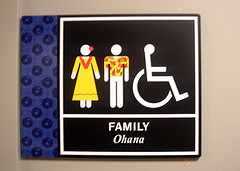
At Carlsbad Caverns National Park, we find the only gender-neutral “family” restroom on our 1000-mile road trip. That, and the spectacular caverns, make it well worth the drive.

Passing (Or Not) at the Pool

It feels like 95 degrees in the shade. We’re standing in line at the municipal pool. The mom in front of us has three kids and a tattoo on her cleavage that says “Ivan” or “Juan,” I can’t tell which. My hand moves reflexively toward the “Katy” on my own arm. Before I can solve the mystery of Ivan/Juan, the woman moves on. Now it’s our turn to pay the pasty teen behind the concrete counter.

Once inside, we walk past dilapidated metal bleachers and spread our towels under a giant oak tree. By this time in the summer, we know where to sit to avoid fire ants. This is our Sunday afternoon family ritual: I swim laps while Katy takes our six-year-old son, Waylon, to the recreational side of the pool to play with his neon orange Nerf football.

I always feel like I’m getting away with something.

Why should I get to exercise in peace while my spouse does solo parenting duty? But, despite my qualms, I’m mostly superfluous to their fun. Childhood nearsightedness has left me with a permanent fear of flying objects. Katy, on the other hand, is the child of a football coach. She’s serious about passing on her athletic heritage. Waylon can already send the football soaring in a slow, perfect spiral. Each week she expands his vocabulary to include moves like “stiff arm” and “stripping the ball.”

I try to keep an eye on them from the lap lane. They’re usually easy to spot, because Katy makes dramatic, splashy dives for the ball and then stages elaborate fumbles so that Waylon, his head bobbing a few inches above the water line, can intercept. Before each pass, she feints in seven different directions, her face a cartoon of shifting intentions.

Lots of parents use the pool as cheap day care. A fun, involved parent in the water is like an underwater kid magnet. It’s not unusual to look up and see Katy running for the ball with two or three random kids clinging to her broad back, trying in vain to tackle her.

On this particular Sunday, I was just getting used to the rhythm of my breath in the water when a flash in the shallow end caught my eye. I had to stop, mid-lap, and remove my goggles for a better look.

All her life, before and after chest surgery, Katy has worn a t-shirt in the pool. In the water, the shirt gets loose and heavy, which makes it difficult to swim. Out of the water, the shirt gets cold and clingy, which makes it difficult to relax.

Now, some four years after her surgery, Katy had decided to take off her shirt. The flash was the blinding whiteness of her heretofore unexposed skin. It created a high-contrast canvas for the tattoo across her chest, an image of Siva Shakti, the father-mother deity who represents the transcendence of dualities.

When I saw her bare chest from across the pool, I felt a surge of happiness. I hoped she was feeling comfortable, physically and emotionally.

But, of course, taking off her shirt created a whole new set of conundrums. Once she had revealed her man-chest, she was de facto male at the pool. As a genderqueer dyke, she’s used to funny looks and even belligerent bathroom confrontations, but now the women’s changing room felt completely off-limits. And this isn’t some swanky pool with a gender-neutral “family” restroom. She started changing in the car, even on days when she still wore her shirt in the water.

Last Sunday, the t-shirt was on. A sociable four-year-old named Dylan was watching Katy and Waylon play. Katy was throwing Waylon really high in the air. He shrieked with joy on the ascent and cried “again, Mommy, again,” each time he came up for air.

Before long, Dylan sidled over and asked Katy to throw her up in the air too. Katy sent her to ask her mother, who was reading in the shade. Mom gave the thumbs up, doubtless relieved that someone else was entertaining her child.

Once Dylan had been tossed in the air a few times, Waylon got jealous and wanted to play catch instead. Dylan was too tiny to handle the football, so she turned her attention to the puzzle of Katy’s gender.

“You look like a boy,” she said, smiling.

“Yep,” Katy said, smiling back at her.

“You look like a boy because of your hair…and because you have so many tattoos.”

“Yeah, I do,” Katy answered, still smiling.

“Mommy, Mommy, throw it to me,” Waylon shouted. Katy threw it to him.

When I swam up and Waylon started calling me “Mom” too, Dylan looked like her head was going to explode. Still, she couldn’t tear herself away. She kept swimming to the side and then swimming back and asking to be tossed in the air again. I checked to see if her mother was alarmed that she had attached herself like a barnacle to a tattooed and gender ambiguous personage, but mom appeared to be completely absorbed in her book.

Finally, after several rounds of “just one more time” in the air, it was time for us to leave. We said goodbye to Dylan and told her maybe we’d see her next weekend. Katy and Waylon headed to the car to change. I went to the women’s changing room to rinse my hair in the shower.

Dylan followed me in, her mother close on her heels.

“I just want to see if she’s a boy or a girl!” she shouted.

My immediate thought was thank god Katy’s in the car. This is the kind of scene she dreads. My next thought was what’s going to happen now? I was fascinated that Katy’s illegibility had rendered me illegible as well.

Dylan’s mother, looking mortified, scooped her up just as she reached the showers.

“Oh, she has nail polish, she’s a girl,” Dylan concluded.

I had to smile that my 34A bust is apparently not the most salient aspect of my gender presentation.

Later, I would realize the extent to which privilege was shielding me from fear and shame. I sometimes feel a bit queer in the changing room, but, as a gender-conforming cis woman, I still feel a sense of unconscious entitlement.

Perhaps because I felt safe, and because the whole interaction seemed curious rather than hostile, I wasn’t quite ready to be read. As Dylan’s mother dragged her reluctantly away, I couldn’t help troubling the waters one more time.

“Boys can wear nail polish too!” I said, in my friendliest singsong voice.

Thomas Beatie Bedtime Story

The other night, my 5-year-old son, Waylon, was sitting on the toilet and reading Us Weekly. (Normally I would not confess that our home harbors such toxic tabloid sludge–much less that we expose our child to it–but since it is pivotal to my tale, I will just clarify that it is all my spouse’s fault.)

“Mom!” Waylon shouted from the bathroom. “Come here! You gotta see this cute baby.”

I marched into the bathroom, prepared to deliver my “stop stalling and get in bed” speech. Then my gaze met the baby in question. It was Thomas Beatie’s daughter, Susan. She really is a cute baby.

Amazed that Waylon, a child with a trans parent, had somehow managed to pick out the only trans family in the whole magazine, I sat down on the side of the tub. “Look at her cheeks,” Waylon cooed.

“Waylon,” I said, “did you know that the daddy in that family was born with a woman’s body and he had to change his body to match how he felt inside?”* My son studied the picture, raising the page to within a centimeter from his nose. I assured him that Thomas Beattie looks just like any other man, but Waylon persisted in his examination.

“Hmmm. Let me see….I think he looks–I think he looks French,” pronounced Waylon, who is also the child of Francophile parents.

To say that transgender families are underrepresented in children’s literature would be the understatement of the century. At our house, we create lots of stories with characters that mirror the diversity of the people whom Waylon knows and loves. But sometimes he still complains that the families in books are so different than ours. So I have to admit that–for one brief, bedtime moment–I was actually grateful for Us Weekly and the unexpected opportunity to show Waylon a family with a story like his own.

*(This is the five-year-old version, not necessarily the language I’d use with an adult.)

My Family Gender Odyssey

Lesbian and gay family events are not always comfortable spaces for me and my fam.

That’s partly because some folks don’t know what to make of my genderqueer sweetie, with her man-chest and her female pronouns. It’s partly because the “same-gender parenting” paradigm may or may not describe us, depending on the situation, our moods, and the alignment of the planets. But it’s mostly because there aren’t always other trans parents and partners at gay family events, and the programming doesn’t always reflect our interests and needs.

So I was ecstatic last year when I read the Gender Odyssey program and saw a workshop titled “Fierce Dyke Seen Doing Husband’s Laundry.” Here, finally, I would find folks whose passions and preoccupations were–if not exactly the same as mine–at least in the same neighborhood. While I processed with other partners about identity and inference, Katy found her niche in sessions like “What’s the Rush?” where participants explored new paradigms and time-lines for transition.

But the most amazing thing about Gender Odyssey is that it’s fun for the whole family–even the kids.

Last year was the first year that Gender Odyssey shared time and space with the Gender Spectrum Family conference for people raising gender variant children and transgender teens. The brilliant folks at Gender Odyssey and Gender Spectrum decided to organize a kids camp for children whose parents were attending either conference. Which means that, while I was sitting in the town hall meeting on Dyke/FTM Community Relations, my son, Waylon, was happily gluing googly eyes on a family of sock puppets.

This year, Katy and I proposed a workshop for parents. The conversations in our session were wide-ranging — more often than not, the group’s parenting concerns were not related to gender at all. But while the topics might have been similar in any parenting workshop, it was such a relief that we didn’t have to explain our family or worry about other people’s assumptions. Talking about child-rearing in that context, with other trans parents and partners, was like finding something I didn’t really know I was missing.

Now I’m hooked. I can’t wait for Gender Odyssey 2009, but I’m also interested in broadening my horizons. I hope readers will use the comment space below to suggest other trans family events or to plant the seeds for new ones.

P.S. This year at Gender Odyssey, Waylon made two stick puppets named “Sweetie” and “Smiley,” who seem to have a penchant for scolding George Bush and John McCain in chirpy little voices.

Boygirls, Pillbugs, and Cool Dudes

Last week was spring break, so I got to spend a lot of time gardening with my four-year-old son, Waylon. He was really excited to capture his first roly poly bug of the season. The poor creature had curled up into a little protective ball, and Waylon was about to shove it in his pocket, but then thought better of it (ahem) with a little parental prodding. He decided instead to free it in a pot where we had just planted a little green succulent called “Mother of Millions.”

“Mom, I put that roly poly in the plant, and he or she—or if it’s a girlboy or a boygirl—is going to dig in the dirt and make it soft.”

Waylon, you had me at “he or she.”

As a feminist parent, I have experienced few greater joys than hearing non-sexist language carefully applied to a pill bug. But although I would love to take credit for Waylon’s refusal to assume the gender of the pill bug, it’s really his own creative adaptation to his context, just as “girlboy” and “boygirl” are categories he created to describe the people around him.

Now, when I was in college, my Child Development professor taught that children begin to consolidate their concepts of gender identity around three years of age, and that the process is often marked by heightened rigidity about gender norms. So I thoroughly expected Waylon to become a little gender cop when he hit three. He did go through a phase when he wanted to categorize everyone. One of his favorite games was a toddler form of people watching, where he would look at people in the park or in the grocery store and yell out “boy!” or “girl!” And while I wanted to support Waylon in whatever developmental thing he was working through, this game could be extremely socially mortifying. I would estimate that he was “right” (in that his attributions matched the gender identities of passersby) about 75% of the time.

Luckily it didn’t take Waylon too long to come up against the inadequacy of his binary categories. Another of his favorite games around this time was to ask, over and over, “Mama, are you a girl?” For me it was easy to answer with a straightforward “yes,” but for Katy things were not so simple. Since he asked this question about ten times a day for at least a month, she had plenty of time to formulate a good answer. “I’m kind of a mix of girl and boy,” she’d say. “I’m a mommy, but I look more like a boy than Mama does.”

Contrary to what child development specialists might predict, Waylon did not skip a beat. Before long, he was asking “Mommy, are you a boygirl?” ten times a day, and Waylon’s four-coordinate gender axis (girl, boy, boygirl, girlboy) was born. It may not be exhaustive (what gender system could be), but it has more descriptive depth than a binary. The first time we really saw this system in action was when our friend Kelly came to visit from San Francisco when Waylon was three. Kelly is a trans-identified butchy queer with blonde, boyish looks. She has tattoos of ships on her arms and endless patience for playing Thomas the Train, so Waylon adores her. One morning Kelly and Katy were taking Waylon and his best friend, Flynn, to the playground. Katy was driving, Kelly was riding shotgun, and Waylon and Flynn were strapped in their car seats in the back. Flynn leaned over to his buddy and said, in an astonished three-year-old stage whisper, “Waylon, is that a boy or a girl?”

“Silly, that’s Kelly,” said Waylon. “She’s a boygirl.”

Around that same time, Time published an editorial in which James Dobson condemned Mary Cheney’s decision to have a baby with her partner. “Love alone is not enough to guarantee healthy growth and development,” Dobson opined. “The two most loving women in the world cannot provide a daddy for a little boy–any more than the two most loving men can be complete role models for a little girl.” This week, as I’ve been pondering Waylon and his pill bug, I’ve been also been contemplating what the four coordinate gender axis does to Dobson’s notion of a “complete” gender role model.

When I was growing up, I had a family, and a father, that at least resembled Dobson’s prescription, but I still grew up only knowing one version of masculinity—my dad’s verbally-fluent, academic, leg-crossing, middle class version of masculinity. I rarely saw my friends’ dads (the 1970s in suburban America were not that different from the 1950s in terms of paternal involvement, as far as I can tell), but when I did, I always thought they must be mad about something, because I was so unaccustomed to their predominantly silent, aggrieved, inexpressive ways. (I distinctly remember seeing my friend Amy’s dad, who had just come back from Vietnam, open the fridge and drink milk from the carton, and it was such a disturbing breach of known fatherly protocol that I almost had to run home.)

The fact is that there have always been multiple masculinities, multiple genders, and queer families probably have even better resources in terms of introducing their children to a range of genders and gender expressions. And, although Dobson might like people to believe it, we’re not raising our kids in a test tube—we have families and communities. For masculine role models, Waylon has his (now openly gay) grandpa, who takes him for rides in his Corvette and lets Waylon throw an endless supply of pebbles in his pool. He has “Uncle Brian,” his donor, an old working class rocker who found his calling as a social worker with mentally retarded people. Most importantly, he has Mommy, who created her own uniquely Texan brand of female masculinity from her cowboy big brothers and her football coach dad.

Our extended family “village” also includes the teachers at Waylon’s school, Habibi’s Hutch. I don’t know if it’s because childcare is so undervalued (and under-compensated) in our society, or if it’s the remnants of the 1980s daycare sexual abuse hysteria, but daycares with male directors and male teachers seem relatively rare. Habibis’ has both a male director and a gender balanced staff of committed teachers, many of whom have been teaching there for more than a decade. Waylon has loved all of his teachers, but the dudes have played a special role in his life.

When Waylon was first potty-trained, his lesbian mothers thought it would be great if he kept sitting down to pee for a long as possible, thus saving our bathroom floors from his errant stream for as long as possible. I’m pretty sure it was the male teachers at Habibis who intervened to save him from parentally-programmed dorkiness, and before long he could hit the bowl like a pro. Several months later, Waylon was peeing at home and I was sitting on the edge of the tub, talking to him. He stopped mid-stream, adjusted his pants a little further down, and resumed his pee. Then he turned to me and said, with casual confidence, “It’s called choking your balls.”

“What?!?”

“When your underwear goes up too high while you’re peeing. It’s called ‘choking your balls.’”

I would never have known.

As I write this post, I’m mourning the fact that this will be Waylon’s last spring at Habibi’s. He’ll start kindergarten in the fall, and then his preschool teacher, Mike Esparza, won’t be as much a part of our daily lives. Mike has taught at Habibi’s for fifteen years. He usually sports long hair, a moustache and goatee, tube socks, and black plastic glasses. He looks a bit like a Mexican Jad Fair, but more handsome and coordinated. He rides a BMX bike to work, and he regales the kids with tales of death-defying bike adventures, as well as yarns from his childhood with a rotating cast of characters like his friend “Fat Jason” and his “dumb uncle.” Mike tends to speak in aphorisms that get repeated like the sacred word around our house. I can always tell when I am about to get a dose of Mike wisdom, because of the reverential tones in Waylon’s voice before he enlightens me.

“Mom, if you’re looking for something, and you stop looking for it, then you’ll probably find it.”

“Mom, people who say ‘stupid’ a lot probably are stupid.”

“Mom, the headliner is usually the best one.”

Some of the male teachers at Habibi’s are really warm, fuzzy, nurturing guys. If Waylon is having trouble with the morning transition, then hands-down it is Andrew he wants to go to. Andrew hugs him and tells him, “I’m so glad you’re here,” in the sweetest, most sincere voice imaginable. Mike’s style of nurturing is different, but not indifferent. There’s a little more distance there, but it’s an interested distance, one that lets the kids have their own process and make their own discoveries. I appreciate it, because I want Waylon to grow up comfortable with lots of different styles of masculinity and lots of different versions of “role model.” I know Waylon appreciates it too. When I asked him to describe Mike, the usually loquacious Waylon would only say, “he’s cool.”

Create a free website or blog at WordPress.com.

Up ↑