Search

Queer Rock Love

A Family Memoir

Tag

parenting

Stilettos, Sissy Boys and the Limits of ‘Gender Neutral’ Parenting

Last week, PBS Parents featured a blog titled “Gender Appropriate Toys.” It begins promisingly enough with a critique of parents who enforce binary gender norms in their children’s toys and activities. The author (Kristen of Supersisters) suggests that boys should be free to engage in nurturing and domestic activities as preparation for becoming well-rounded men. Next, she shifts into a discussion of childhood cross-dressing:

So why are we so concerned about our sons wearing our shoes? If wearing women’s shoes as a small child causes any sort of issue when a boy gets older, nearly every man in the world would now be a cross-dresser.

As I read this, I tried not to get too hung up on what “any sort of issue” might cover or what she might mean by “cross-dresser.” After all, the article was normalizing childhood cross-dressing. These are ideas that might be new to the readers of PBS Parents. Cut the lady some slack, I told myself.

Then I read the last line of the article.

And let’s be honest. It’s either stilettos now or stilettos later.

The assumptions embedded in that cautionary closing line are so familiar that the author needn’t bother to unpack them. Because raising an adult cross-dresser (or a drag queen or a transsexual or a homo)–those would be self-evidently negative outcomes, right?

Sadly, this PBS Parents article is only the most recent example of parenting advice that champions gender-neutral parenting as a means to avoid raising gay or trans kids. In 2005, sociologist Karin A. Martin examined the legacy of second wave feminism’s project of gender-neutral parenting. In “William Wants a Doll. Can He Have One? Feminists, Child Care Advisors, and Gender-Neutral Child Rearing,” Martin finds a “stalled revolution.” She argues that the movement’s child rearing agenda has stalled, in part, because liberal feminist calls for gender-neutral parenting did not “fully eradicate heterosexism and homophobia from its writings about gender socialization.”

Martin cites Ms. founder Letty Cottin Pogrebin’s 1980 book Growing Up Free, which warned against the “erroneous” assumption that “homosexuality is one of the worst things that can happen to anyone,” but then went on to re-stigmatize homosexuality with comments like these:

“Don’t try to prevent homosexuality. It won’t work and it may backfire.”

“Don’t make children feel they are the ‘wrong’ sex as this too can result in homosexuality.”

“Don’t use sex stereotypes as a vaccine against homosexuality. Trying to mold children to match stereotypes sometimes inspires just what parents meant to avoid.”

As Martin notes, Pogrebin and her peers used the prevention of homosexuality as a kind of an advertising strategy for gender-neutral parenting: “these arguments stop just short of saying that gender-neutral child rearing is good for children because it prevents homosexuality.”

Martin goes on to examine contemporary parenting advice from the late 90’s and early 00’s. She finds that, when it comes to childhood gender nonconformity, little has changed:

About 60 percent of the sources can be described as giving (at least) one of three types of advice. Two of these types have long been stereotypic responses to homosexuality” (1) Don’t make it worse and (2) recode the behavior. The third response explicitly addresses the link between gender and sexuality: (3) Don’t worry; it doesn’t lead to homosexuality.

The assumption, once again, is that adult homosexuality is a self-evidently negative outcome, one that parents would naturally want to avoid.

In sorting through all of this, I find myself returning to Eve Sedgwick’s famous, provocative essay, “How to Bring Your Kids Up Gay” from 1991:

There are many people in the worlds we inhabit…who have a strong interest in the dignified treatment of any gay people who happen already to exist. But the number of persons or institutions by whom the existence of gay people is treated as a precious desideratum, a needed condition of life, is small. The presiding asymmetry of value assignment between hetero and homo goes unchallenged everywhere: advice on how to help your kids turn out gay, not to mention your students, your parishioners, your therapy clients, or your military subordinates, is less ubiquitous than you might think. On the other hand, the scope of institutions whose programmatic undertaking is to prevent the development of gay people is unimaginably large.

Using Sedgwick’s insight as a starting point, I pose this question to myself and other parents: if we believe that queer and gender-nonconforming people are a “precious desideratum,” a gift to the world, an “outcome” to be cherished equally with other gender and sexuality outcomes, then how do we live that belief in our parenting?

Recently, I’ve sensed the need for a new paradigm to replace “gender-neutral” parenting, which is usually heteronormative (boys can play with dolls because they will become husbands and fathers) and sometimes (as I’ve shown above) homophobic and transphobic. In its place, I suggest “gendery” parenting.

Rather than conceiving of gender as a binary that can be cautiously “crossed,” the gendery parenting paradigm would enjoin us to introduce our children to a wide variety of different gender identities and expressions. At our house, that means that our son, Waylon, spends time with his football coach grandpa and his urbane gay grandpa. Our chosen family includes a butch “tia” who probably irons her boxer shorts and an “uncle” who is a working-class straight guy. Waylon is comfortable hanging with the queens in the church choir and the sensitive skater dudes who teach at his school. Last Christmas, he asked Santa for a pair of black tights so he could dress like his high-femme auntie. This year he’s been haranguing his FTM uncle to please, please sew him some more handmade stuffed animals. Whatever Waylon wants to do or be in the future, I’m confident that he knows there are many ways to live his gender and sexuality.

Rather than just begrudgingly allowing our children to play with “opposite gender” toys, the gendery parenting paradigm would encourage us to give children the language to think critically about gender binaries and gendered hierarchies. If we provide the tools, young children are quite capable of sussing out inequalities and analyzing gendered messages–as evidenced by a conversation I had with Waylon the other day:

Waylon: Mom, I think Power Rangers is kind of injustice to girls.

Me: Really, how so?

Waylon: Well, the girl Power Rangers always have to be pink or yellow, but the boy Power Rangers can be blue or red or green. It’s not fair that they have more colors.

Me: Don’t you think it’s injustice to the boys too, since they never get to be pink?

Waylon: Well yeah, but the girl action figures are always really skinny too. They don’t look like they could even fight very good. Why do they make them like that?

Finally, and most importantly, the gendery parenting paradigm would instill in children the belief that they will be loved and celebrated in all the complexity of their gender and sexual identities.

And that includes stilettos–now or later.
Our Social Experiment

Last Christmas, we decided to splurge and spend a few nights at a fancy beach resort. From the moment the clerk ushered us into the “VIP check-in room,” I knew we were in for an adventure. Our five-year-old, Waylon, plunged head first into a butter-colored club chair. “Honey, please keep your shoes off the furniture,” I said, feeling my class insecurities creep up like a slow and annoying blush. “But, Mama, I’m a seal,” he informed me, resting his front flippers on the marble floor.

I scanned the clerk’s face, hoping for the knowing look that tells you you’re in the presence of Family. Nary a blip on the old gaydar. His eyes were resolutely glued to his computer screen.

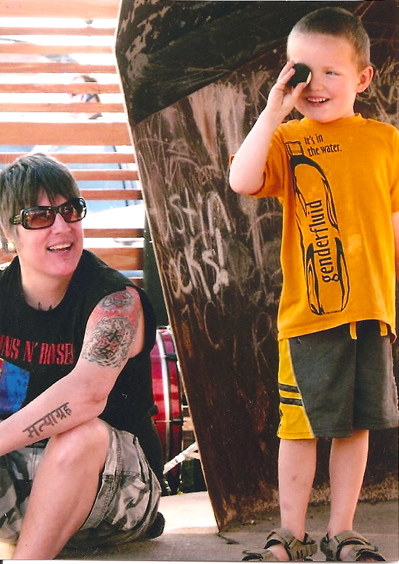
My wife, Katy, was not helping. Early that morning, she’d loaded up our vacation baggage. Then she’d navigated the car through hectic holiday traffic. Now she slouched in the chair beside me, tattooed arms folded across her pecs, head tilted back in a caricature of repose. Mirrored sunglasses shielded her eyes. She was ready for a nap.

I gamely answered the check-in questions, keeping one eye on Waylon, who was maneuvering across the floor on his belly. Like his parents, he was clad in black. His t-shirt was emblazoned with an electric guitar and the words “Toxic Waste.” I wondered how the clerk was perceiving our tousled entourage. Perhaps he thought that only the truly rich and famous would be bold enough to despoil the Sand Pearl Resort with such dishevelment. Did he think we might be rock stars?

Apparently, he sized us up and designated us “Mr. and Mrs. Schilt.”

As in, “well, Mr. and Mrs. Schilt, we hope you enjoy your stay.”

“The bellman will get those bags, Mr. Schilt.”

“Can I get you some ice, Mrs. Schilt?”

Thus registered in the hotel’s central database, we seemed doomed to pass the remainder of our holiday as hapless characters in a comedy of errors.

***
When Waylon was three years old, we started trying to include him in the ritual of holiday gift giving. “Waylon,” I began, “what do you think Mommy would like for Christmas?”

“Trains,” he said, without missing a beat.

What do you think Grandma would like?” I persisted.

“Trains.”

“What do you think we should get for Auntie?” By this time I was just fishing.

“Trains.”

Waylon is a boy with a single-minded passion for wheeled vehicles. When he got his first train set, he didn’t sleep for three nights. Eventually, in the kind of problem solving that emerges from intense sleep deprivation, I found myself napping on the couch at 3 am while Waylon navigated Thomas the Tank around the track.

By the next Christmas, Waylon’s allegiance had switched to cars, but gift-giving was still largely an exercise. With lots of not-so-subtle encouragement from his parents, Waylon strung some necklaces for friends and family, but he hadn’t really developed the capacity to imagine another person’s needs and desires. Most of his handiwork looked like a random aggregation of begrudgingly selected shapes and colors.

Ironically, the one bright glimmer of hope was the necklace Waylon made for my sister, an old-school goth with a penchant for black tights, ripped crinolines, and creepy Victorian bonnets. When he sat down to make Auntie’s necklace, Waylon carefully selected the darkest and most macabre beads in his little craft kit. Heartened, I consulted my child rearing bible, a tattered copy of Touchpoints, which reassured me that empathy–the capacity to imagine another person’s needs and feelings–develops along a slow and uneven trajectory.

***
One day, not long after Waylon made his Aunt a gothic necklace, Katy and I were stretched out on the couch of our couples therapist’s beigely appointed office. (We jokingly refer to our therapist as Guru–partly because of her preference for New Age shawls and partly because we truly believe that she is brilliant, compassionate, and wise.) On this particular day, we were talking about parenting (our favorite easy topic), and I happened to mention some of Waylon’s ideas about gender.

Guru’s normally unflappable exterior betrayed a hint of concern. As her eyebrow arched upward, I moved defensively to the edge of the couch. Guru asked a follow-up question. And then another.

“We’ve always talked about my surgery,” Katy explained. “He knows that I never felt completely like a girl and that I changed my chest to be more comfortable in my body.”

“He has his own vocabulary,” I added. “He calls Katy a ‘boy-girl.'”

Our therapist seemed most concerned about whether Waylon believed that his own gender and sex might be malleable. According to psychoanalytic timetables, core gender identity is supposed to be consolidated by two or three years of age. Were Guru’s pursed lips suggesting that we were in danger of derailing our child’s development?

Part of me felt defiant, wanting to challenge the whole notion of static gender identity. Another (irrational) part of me was sure she was going to call Child Protective Services the moment we left her office.

Queer people have been told for so long that we are not fit to be parents. It is impossible not to internalize some of the shame that is projected onto us, especially when it comes to our culture’s most hallowed idol, the family. So I felt the sting of my therapist’s troubled look. But I also understood that her reaction was rooted in the assumption that what’s normal is natural and good.

As queer parents, our blessing is to remember all the coaxing, coercion, and even outright violence it takes to make normal gender development seem inevitable and desirable. By the logic of that trajectory, we did not turn out okay–yet we know that we turned out okay. If we can hold onto this contradiction, if we can resist the shame, we can forge new family values that affirm gender diversity as a precious gift to the world.

***
On one of our first dates, my future wife brought a tape of her family’s home movies from the mid-60s and a joint. I think Katy guessed that my feminist consciousness was going to need expanding if we were to swap childhood stories in the way that new lovers do. She’d dated enough Women’s Studies majors to guess that “the cultural construction of gender” would be my mantra, the magic words that were supposed to save me from the depressing determinism of biology as destiny and the one-size-fits-all essentialism of universal sisterhood.

Savvy as Katy was, she could hardly have anticipated the intensity of my views. I leaned fervently, incontrovertibly toward the nurture side of the nature vs. nurture debate. If anyone spoke to me of gender as something innate or remotely natural, I did the intellectual equivalent of covering my ears and shouting “la,la, la, I can’t hear you!”

Now, in reel after reel, I discovered Katy at 2, 3, and 4–already miraculously masculine, already chaffing like a football player in frilly dresses, already looking dejected when she unwrapped yet another doll from underneath the Christmas tree.

Suddenly, the whole notion of nature vs. nurture ceased to make sense. Her pintsize Texan masculinity was culturally pitch-perfect–and a total violation of the prevailing gender system. It was incongruent with biology–and undeniably physical, emanating from every muscle and gesture.

The highlight of the home movie festival was the year when she appeared next to the Christmas tree in full Davy Crockett regalia. A second later, the wrapping paper was off, and she was jumping up and down, triumphantly brandishing a new BB gun.

“Dude,” I said, “this is blowing my mind.”

***
Last December, we made a family trip to Target to find a gift for Waylon’s friend Layla, whom he’s known from infancy. As I was hefting Waylon into the cart, I asked him what he thought Layla would like, fully expecting him to list his latest vehicular obsessions.

“Umm, I think…Barbie.”

Has ever a parenting moment been more bittersweet? I hugged him and showered him with praise for thinking about someone else’s feelings.

Privately, I was imagining my white, blonde, blue-eyed son delivering a Barbie to his brown-skinned, black-haired girl friend. It looked like a tableau with the caption “Gender and Imperialism.”

Luckily, at that moment, Katy arrived from parking the car and settled the matter with a phone call to Layla’s aunt. It turned out that Waylon was right; Layla was expecting a Barbie Dream House from Santa. And she needed furniture. Relieved that we would not be solely responsible for introducing Layla to Barbie, I followed my family to the toy aisle, where we proceeded to ponder tiny pink bedroom sets.

***
A few days later, we were installed at the fancy beach resort. It was beginning to dawn on me that $200 a night buys an alarmingly frequent level of personal contact. The entire staff seemed to be connected by walkie-talkie; as we passed from reception to the lobby to our room, we were repeatedly greeted as “Mr. and Mrs. Schilt.”

Although her identity is somewhere between genders, Katy is quite content to pass in such situations. It’s her voice that usually gives her away. That evening, in the time it took to for the waiter to unpack our room service order, she had gone from “Mr. Schilt” to “ma’am.” We joked about it on the way to the airport, imagining a one-woman show called “From Mister to Ma’am.”

No to be left out of the joke, Waylon said, “Yeah, he didn’t realize that you were a girl-boy,” in a tone of five-year-old comic exasperation.

“Wait, I thought you called Mommy a ‘boy-girl,'” I said, confused.

“No, that was back when I was only thinking of myself, so I always put ‘boy’ first. But now I’m thinking of other people,” he explained.

My parenting manuals say that five years old is when kids begin to develop the capacity to empathize with other people’s emotions and experiences. According to that developmental timetable, Waylon was right on schedule.

Lazy Lesbian’s Guide to Sex-Ed for Kids

One night in the bath, my five-year-old son poked at his testicles. “What are these things called again?”

“They’re called testicles, but sometimes people call them balls,” I said.

He seemed momentarily satisfied, but the next night, on the toilet, he returned to the subject.

“These tentacles…” he started.

“Testicles.”

“Testicles,” he repeated. “What are they for?”

We’ve always talked about bodies and used correct language for anatomy. But this conversation felt different. Waylon’s questions were self-initiated and specific. After offering a hastily constructed answer, I consulted my parenting books. They counseled me to offer my child correct, technical, and honest information and to avoid overwhelming him with any information that wasn’t age-appropriate and that he didn’t need to know yet.

Sure, that sounds easy. Just like walking a tightrope. My son has the disposition of an attorney. His favorite questions are “Why?” and “What about…?”

I thought it would make things easier to keep the conversation factual and age-appropriate if I had some nice, feminist, LGBT-affirming book for talking to kids about their bodies. So I did the laziest thing in the world. I went to Amazon.com and searched for children’s books about sexuality.

My first search turned up several books from Concordia’s Learning About Sex for the Christian Family series and books from Navpress’s God’s Design for Sex series. These books featured dialogue like this line from Where Do Babies Come From?:

“It was God who thought of putting us into families,” Daddy said. “Wasn’t it a good idea?”

Christians, I realized, have been busy imagining the needs of parents and families and thinking about ways to meet those needs while simultaneously operationalizing their values about gender, sexuality, and the family.

But gender, sexuality, and the family are equally important and contested terrain for feminists. Critiques of patriarchal families and reproductive sexuality have been a feminist staple since the 19th century. Surely, I thought, some feminist authors have penned children’s books about bodies and sexuality that operationalize feminist values for parents and kids.

Scrolling through the secular offerings on Amazon, I found my way to, What’s the Big Secret? by Laurie Krasny Brown and Marc Brown. School Library Journal calls this book “the gold standard for sex ed for young children.” I ordered a copy and read the first sentence with high hopes.

“From the moment your life begins, you are either a boy or a girl.”

Hmm. My partner, Katy–Waylon’s other Mommy–identifies as somewhere in the middle of gender. Waylon has grown up in a feminist, genderqueer community. He has aunties and uncles and auntie-uncles with multiple gender identities. The kid is a bigger critic of binary gender paradigms than most adults. (I’ve been trying to teach him old protest songs like “If I Had a Hammer,” but he won’t let me sing the line about “love between the brothers and the sisters” without throwing in a couple of other identities to make it more inclusive.)

To be fair, What’s the Big Secret? does spend several pages deconstructing gendered ideas about children’s play, clothing, and emotions. Ultimately, however, the book locates differences between boys and girls firmly in biology:

“Actually, the only sure way to tell boys and girls apart is by their bodies.”

And, like a lot of the secular children’s books I looked at, What’s the Big Secret? explains binary gender as natural and necessary to reproduction. In fact, the section called “Why Boys and Girls Differ” is subtitled “A Little Lesson in Reproduction.”

I knew this book was not going to work for my queer family (we made Waylon with a friend, a plastic syringe, and a Mason jar). And it probably wouldn’t work for other LGBTQ families either. Moreover, as a queer feminist dedicated to questioning biological narratives about the naturalness of gender and reproduction, I was hoping for something more.

At the very least, I was hoping for a children’s book about bodies that didn’t assume heterosexual reproduction as the alpha and omega. Was that too much to ask?

The time had come to do something slightly less lazy. I visited my local feminist bookstore, Bookwoman.

At Bookwoman, I found several copies of A Very Touching Book by Jan Hindman. Written from the perspective of preventing sexual abuse, this book has several things to recommend it. It’s body and sex positive. Using touch as the central concept, the book leads children through decision-making processes about good and bad touching. In the process, it discusses physical attributes without resorting to reproduction as the ultimate explanation.

In fact, A Very Touching Book does not reference reproductive sex at all. Rather than explaining adult sexuality as a function of reproduction, Hindman (who passed away in 2007) defines adult sexuality in terms of safety, pleasure, and informed decision-making:

“The second reason that the sharing of those parts is such a big deal is that grown-ups need to spend a lot of time thinking about who the special person will be that they decide to share their bodies with.”

Throughout the book’s discussion of adult sexuality, Hindman uses gender-neutral language. In the text and the pictures, heterosexuality is not assumed. With a few slight adaptations, this book could work for my family.

There are, however, a few things I don’t love about A Very Touching Book. The illustrations are distractingly busy. The jokes are cheesey. And Hindman sometimes illustrates her points with longish analogies (like the one comparing private parts to Christmas) that detract from the main point.

Although I don’t expect to find the perfect book, I was curious whether other feminist writers had addressed the need for children’s books about bodies and sexuality. In keeping with my lazy mode of inquiry, I decided to have lunch with a feminist librarian. So I made a date with Dr. Kristen Hogan, an expert on women’s bookstores and feminist publishing.

The woman brought a bibliography to our lunch date. I really, really love that.

Kris’s book list, which I will reproduce below, helped me see that feminist authors and presses are producing books about bodies and sexuality for young people. However, the majority of these books were for children approaching puberty. In the category of books for young children, Kris suggested the book I’d found at Bookwoman, A Very Touching Book, and a book about sexual abuse, Not in Room 204.

Kris’s List

Sweet Secrets: Stories of Menstruation
Kathleen O’Grady and Paula Wansbrough
Second Story Press, 1997

Growing Up: It’s a Girl Thing: Straight Talk about First Bras, First Periods, and Your Changing Body
Mavis Jukes and Debbie Tilley
Knopf Books for Young Readers, 1998

On Your Mark, Get Set, Grow!: A ‘What’s Happening to My Body?’ Book for Younger Boys
Lynda Madaras
Newmarket Press, 2008

My Body, My Self for Boys
Lynda Madaras
Newmarket Press, 2007

Not In Room 204
Shannon Riggs and Jaime Zollars
Albert Whitman & Co., 2007

Your Body Belongs to You
Cornelia Maude Spelman and Teri Weidner
Albert Whitman & Co., 2003

Changing Bodies, Changing Lives
Ruth Bell
Three Rivers Press, 1998

I’m still thinking about why children’s books about bodies and sexuality have been such productive terrain for religious conservatives and (seemingly) neglected terrain for feminists. I suspect it comes back to what’s viable in the publishing industry. In the introduction to Harmful to Minors: the Perils of Protecting Children from Sex, Judith Levine talks about her struggles to publish an adult book about cultural anxieties surrounding children’s sexuality. In the arena of children’s publishing, narratives about reproductive families and child protection function to contain discomfort about children’s sexuality.

Although we never found the perfect book, I think my partner and I are managing to answer my son’s questions about his body through improvisation, recurring dialogue, and a mish-mash of the available resources. But the lazy part of me still hopes that feminist, queer-affirming, sex-positive children’s writers will add more and more options to the available resources.

The Chaos, Hubbub and Order Scale

6:30 comes early when you go to bed at 2. Last night, my wife’s heavy metal band played to a packed house of head-banging lezzies. Of course we had to go out for triumphant post-show pancakes. Now it’s my turn to take our son to school, and I’m feeling decidedly less celebratory.

On the clock radio, an NPR announcer is explaining, for the umpteen billionth time, about credit default swaps. I think I understand: as a mother, I’m always struggling to balance love, work, creativity, and the mundane obligations of domestic life. I know the temptation of a little creative accounting. Right now, I’m trying to leverage the possibility that I might know the location of my son’s shoes for ten more minutes of sleep.

I roll out of bed, start the coffee, and search the living room for my hat. Blue hair seemed like a great idea when I was plotting to be the belle of the freak fest, but this morning I have to walk the gauntlet of parents between the car and the door of my son’s kindergarten class. Four hours of sleep have not prepared me to make small talk about my hairdo with friendly straight people.

After the drop off, I call the dentist’s office and reschedule my son’s appointment. I tell them Waylon has the flu, which is a lie; I don’t want to pay the $25 cancellation fee. I feel a tiny tickle of remorse for not prioritizing dental hygiene, but I have to get some writing done today. If I don’t, maternal martyrdom will inevitably lead to greater crimes and grander regrets.

Earnest Hemingway wrote 500 words a day. Once Papa reached the magic number, he was free to drink, fuck, visit Gertrude Stein, whatever. I was immediately drawn to this measure of creative productivity. It’s a humane yardstick for when to say “enough” and move on. Once Mama hits 500 words, I’m free to do all the other shit I have to do.

At 468 words, I stop to put the dishes in the dishwasher. As I’m bending down to pour detergent in the little trough, my gaze hovers for a moment at the baseboard, where layers of congealed dust are threatening to become fur. I don’t allow myself to intervene, even though I recently read a study that found a positive correlation between an orderly home and childhood literacy. The authors asked mothers to rank their homes on the “Chaos, Hubbub, and Order Scale”–an instrument that I had previously imagined to exist only in the sadistic arsenal of my superego.

Intellectually, I consider this study ludicrous, its biases completely transparent. However, now that the “Chaos, Hubbub, and Order Scale” has been confirmed to exist outside my mind, its Victorian standard keeps coming back to haunt me. “What about the child?” it whispers as I walk past the mountain of unfolded laundry. Waylon’s blue eyes seem to plead from every dust bunny.

I don’t want to succumb to a full-blown domestic project, so I escape upstairs to check on my wife, Katy. She’s still in bed, totally spent from last night’s show. The blinds are drawn, and the floor is littered with cough drop wrappers. I sit on the side of the bed and try to stroke her brow, but she recoils. It’s as if rock-n-roll has flayed her skin and exposed raw nerves. Attempts at conversation elicit pained grimaces and a few faint moans. Then she pulls the covers over her head and goes back to sleep.

I’m frustrated and self-conscious. When Waylon was born, Katy’s hometown paper ran a front-page story titled “SHOULD WAYLON HAVE TWO MOMMIES?” Although I am generally not in favor of public referendums on my family, on a day like today, when I’m cancelling pediatric dental appointments and Katy is in a musically-induced coma, my mind tends to compose its own headline: “SHOULD SLOVENLY ARTISTIC TYPES HAVE BABIES?”

I have to remind myself that performance consumes energy in violent, catastrophic bursts rather than moderate daily units. Around here, the impact is brief, albeit extreme. In a couple of days, Katy will be taking Waylon to school and loading the dishes while I’m holed up in my room, trying to churn out 500 words.

Since grocery shopping is usually Katy’s chore, tonight’s dinner will be take-out. I grab some tacos on the way home from work. As we unpack the food from greasy paper bags, we discuss the big news from kindergarten: Waylon got his conduct card changed from green to yellow for kissing Tina in the reading loft. In Waylon’s recounting of the story, it’s Joseph who was really at fault, for “telling everybody.”

“Who else have you kissed?” Katy asks.

“Oh…just Joe, and Charlie…and Frank.” A few minutes later, I get a text from Frank’s mom: “Rumor has it that Waylon got in trouble for kissing Tina. LOL.” I contemplate telling her that Tina’s not the only one, but decide to wait until after she babysits for me next weekend.

We eat dessert in the back yard; Waylon takes a bite of ice cream, swallows, runs to the playscape, climbs the latter, jumps to the trapeze, swings around 180°, and then comes back to the picnic table for another bite. His path is cluttered with plastic toys and garden tools. All the junk Katy shoveled out of the car in order to transport equipment to the rock show last night is jumbled in a trash bag on the doorstep. The bag might sit there a week or even a month before its contents are missed and sorted.

Surveying our disorderly domain, I force myself to focus on the bright side of that study about childhood reading and household order: at least one of the questions on the Chaos, Hubbub, and Order Scale asked about a regular bedtime routine. In my optimistic moments, I choose to interpret routine as ritual. I can’t promise Waylon cleanliness, but I can promise him ritual.

7:30 is story time. Waylon snuggles against me in the bed, and we take turns reading to each other. After that, Katy leads the bedtime song, a customized version of “The Farmer in the Dell.” In this version, the wife takes a wife and all kinds of strange pairings ensue: a block with a Lego, a horse with a worm, and (in a nod to E.B. White) a pig with a spider.

The song has to end the same way every night, or else Waylon won’t go to sleep. The spider takes the cheese. And then there’s a Freddie Merucury-style chant:

“Hi-ho the derry-o, the spider takes the cheese and makes a holey-wolly, holey-wolly, hole, hole, hole.”

Holey-wolly, holey-wolly, hole, hole, whole.

Passing (Or Not) at the Pool

It feels like 95 degrees in the shade. We’re standing in line at the municipal pool. The mom in front of us has three kids and a tattoo on her cleavage that says “Ivan” or “Juan,” I can’t tell which. My hand moves reflexively toward the “Katy” on my own arm. Before I can solve the mystery of Ivan/Juan, the woman moves on. Now it’s our turn to pay the pasty teen behind the concrete counter.

Once inside, we walk past dilapidated metal bleachers and spread our towels under a giant oak tree. By this time in the summer, we know where to sit to avoid fire ants. This is our Sunday afternoon family ritual: I swim laps while Katy takes our six-year-old son, Waylon, to the recreational side of the pool to play with his neon orange Nerf football.

I always feel like I’m getting away with something.

Why should I get to exercise in peace while my spouse does solo parenting duty? But, despite my qualms, I’m mostly superfluous to their fun. Childhood nearsightedness has left me with a permanent fear of flying objects. Katy, on the other hand, is the child of a football coach. She’s serious about passing on her athletic heritage. Waylon can already send the football soaring in a slow, perfect spiral. Each week she expands his vocabulary to include moves like “stiff arm” and “stripping the ball.”

I try to keep an eye on them from the lap lane. They’re usually easy to spot, because Katy makes dramatic, splashy dives for the ball and then stages elaborate fumbles so that Waylon, his head bobbing a few inches above the water line, can intercept. Before each pass, she feints in seven different directions, her face a cartoon of shifting intentions.

Lots of parents use the pool as cheap day care. A fun, involved parent in the water is like an underwater kid magnet. It’s not unusual to look up and see Katy running for the ball with two or three random kids clinging to her broad back, trying in vain to tackle her.

On this particular Sunday, I was just getting used to the rhythm of my breath in the water when a flash in the shallow end caught my eye. I had to stop, mid-lap, and remove my goggles for a better look.

All her life, before and after chest surgery, Katy has worn a t-shirt in the pool. In the water, the shirt gets loose and heavy, which makes it difficult to swim. Out of the water, the shirt gets cold and clingy, which makes it difficult to relax.

Now, some four years after her surgery, Katy had decided to take off her shirt. The flash was the blinding whiteness of her heretofore unexposed skin. It created a high-contrast canvas for the tattoo across her chest, an image of Siva Shakti, the father-mother deity who represents the transcendence of dualities.

When I saw her bare chest from across the pool, I felt a surge of happiness. I hoped she was feeling comfortable, physically and emotionally.

But, of course, taking off her shirt created a whole new set of conundrums. Once she had revealed her man-chest, she was de facto male at the pool. As a genderqueer dyke, she’s used to funny looks and even belligerent bathroom confrontations, but now the women’s changing room felt completely off-limits. And this isn’t some swanky pool with a gender-neutral “family” restroom. She started changing in the car, even on days when she still wore her shirt in the water.

Last Sunday, the t-shirt was on. A sociable four-year-old named Dylan was watching Katy and Waylon play. Katy was throwing Waylon really high in the air. He shrieked with joy on the ascent and cried “again, Mommy, again,” each time he came up for air.

Before long, Dylan sidled over and asked Katy to throw her up in the air too. Katy sent her to ask her mother, who was reading in the shade. Mom gave the thumbs up, doubtless relieved that someone else was entertaining her child.

Once Dylan had been tossed in the air a few times, Waylon got jealous and wanted to play catch instead. Dylan was too tiny to handle the football, so she turned her attention to the puzzle of Katy’s gender.

“You look like a boy,” she said, smiling.

“Yep,” Katy said, smiling back at her.

“You look like a boy because of your hair…and because you have so many tattoos.”

“Yeah, I do,” Katy answered, still smiling.

“Mommy, Mommy, throw it to me,” Waylon shouted. Katy threw it to him.

When I swam up and Waylon started calling me “Mom” too, Dylan looked like her head was going to explode. Still, she couldn’t tear herself away. She kept swimming to the side and then swimming back and asking to be tossed in the air again. I checked to see if her mother was alarmed that she had attached herself like a barnacle to a tattooed and gender ambiguous personage, but mom appeared to be completely absorbed in her book.

Finally, after several rounds of “just one more time” in the air, it was time for us to leave. We said goodbye to Dylan and told her maybe we’d see her next weekend. Katy and Waylon headed to the car to change. I went to the women’s changing room to rinse my hair in the shower.

Dylan followed me in, her mother close on her heels.

“I just want to see if she’s a boy or a girl!” she shouted.

My immediate thought was thank god Katy’s in the car. This is the kind of scene she dreads. My next thought was what’s going to happen now? I was fascinated that Katy’s illegibility had rendered me illegible as well.

Dylan’s mother, looking mortified, scooped her up just as she reached the showers.

“Oh, she has nail polish, she’s a girl,” Dylan concluded.

I had to smile that my 34A bust is apparently not the most salient aspect of my gender presentation.

Later, I would realize the extent to which privilege was shielding me from fear and shame. I sometimes feel a bit queer in the changing room, but, as a gender-conforming cis woman, I still feel a sense of unconscious entitlement.

Perhaps because I felt safe, and because the whole interaction seemed curious rather than hostile, I wasn’t quite ready to be read. As Dylan’s mother dragged her reluctantly away, I couldn’t help troubling the waters one more time.

“Boys can wear nail polish too!” I said, in my friendliest singsong voice.

Genderqueer Mommy

Lately, when I’ve been blogging about my wife, Katy Koonce, it’s been about her role as dynamic front man for the “silicone cock rock” band Butch County. In honor of Mother’s Day, I asked her to talk with me about mothering from beyond the gender binary. In the course of our conversation, we touched on t-ball, chest surgery, field trips, and bathrooms.

Paige: Although people on the street tend to call you “sir,” around our house, you’re known as “mommy.” Can you talk about your identity and how motherhood figures in?

Koonce: My identity is trans-genderqueer-butch-dyke-mommy. “Mommy” is the word I used as a kid to describe the person who could take all the pain away or support me when I needed it. To say “I want my mommy” meant “I want a kind of omnipotent force to swoop down and take care of this problem.” So, when our son Waylon was born, I chose “Mommy” as a name because I loved the idea of being that force for someone in this crazy world of ours. When I found myself really attached to the idea of being someone’s mom, I realized that my gender identity was–at least for this time–landing squarely in the middle and I really love it that way. I love to hear the word “mommy” and to be called “mom” sometimes. But that has no real bearing as to how I feel in my body. For I am often not at home there.

Paige: You had top surgery when our son was 18 months old. It strikes me that there are still so few resources for transgender parents, and especially few stories about parents who transform their bodies without the goal of full transition. Can you talk about what it was like to get chest surgery as a mom?

Koonce: Well, getting chest surgery was way more anti-climactic than I anticipated. Waylon did not look up and say, “Are you my mommy?” There were no marked changes in the amount of “sirs” I receive. My psychotherapy clients did not decompensate without the breasts; they seem to have stayed latched on to the metaphorical breast. The biggest change has been the absence of my private bathroom struggle with the mirror. Tight t-shirts are now my friends and my happiness with my physical presentation has by far made me a happier mommy.

Paige: What is it like being genderqueer in places like elementary school hallways or the t-ball field?

Koonce: Now we are getting into space that feels challenging. My extroverted, jovial personality, which earned me the title of Class Clown in high school, has served me well in uncomfortable situations. Before I was ever conscious of being an outsider, I was defending with humor. So, the elementary school and t-ball field are challenges that I meet in a counter-phobic way, by diving in to what seems least comfortable. I am the field trip chaperone for Waylon’s class. I help coach his t-ball team. Waylon loves this. He seems to actually (so far anyway) love how I stand out from the crowd. Lately, he relishes in literally trying to expose my “soft under-belly,” by pulling up my t-shirt in public, to see if I feel shame. He wants to know I stand strong in who I am even though I have shortcomings like everyone else. He needs reassurance that I/he can tolerate our self-perceived flaws and celebrate our differences. This is why, in a queer, gender diverse family, a trip to the ball park is really always a social experiment. My usual defense is to act like I belong and laugh a lot. The song in my head is from Dreamgirls, “You’re gonna love me!” All in all I suppose it is challenging but pretty awesome.

Paige: But I think you’re doing more than seeking acceptance. By being present and involved, you’re actually transforming people’s assumptions and expanding their gender vocabulary. Just to cite one funny example, I know Waylon’s friends like to create genderqueer characters when they play video games now.

We’ve done a fair amount of LG family events and activism. What is it like to participate in those events where the paradigm is “same gender” parents?

Koonce: I really think I am blessed to feel comfortable as someone who transgresses or transcends gender. Other people might be freaking on me but they can’t sway my feeling of belonging in these spaces.

Paige: Since Mother’s Day was originally an activist holiday, will you say a little bit about your recent activism?

Koonce:
Lately I am have been working with staff at local Austin inpatient mental health facilities to improve access and quality of care for trans people. And I just testified to the Texas legislature about adding gender identity and expression to the hate crimes act. Last but not least, I still use the women’s restroom. Word!

Paige: Thanks for sharing from your personal experience. Happy Mother’s Day, baby!

Keep Parenting Queer

A while back, I attended a workshop for LGBT families. At lunch, the organizers asked parents to break into small groups and talk about “things that sustain us.” My group was chewing its sandwiches in awkward silence, so I decided to plunge in: for me, one of the most sanity-preserving practices has been staying connected to my queer communities.

“You do that?” asked a gay dad in his late thirties. “How do you do that?”

His incredulity got me thinking. Chosen family and subcultural networks are two of the great blessings of being queer. For many LGBT folk, our queer communities have sustained us through better and worse, richer and poorer, sickness and health. So why is it that, after they have kids, so many people end up missing from the potluck and the film festival, the protest and the dance floor?

Is it exhaustion? Fear? Finances? Some kind of internalized oppression that says queer spaces are not kid spaces?

I have to admit, when Katy and I decided to have a baby, some of our friends were less than excited. They thought they weren’t going to see us anymore. It felt like they were mourning just when we were celebrating, which was hard to take.

In spite of my friends’ skepticism, I was determined not to disappear from their lives. It took me a long time to come out, and there was no way that I was going to trade my hard-won multi-generational queer subculture for a re-run of the nuclear family with two moms at the helm. It sounded boring, and it went against everything that I wanted to teach my son about community, engagement, and survival.

We’ve been parenting for six years now, and even our most dubious, anti-breeder friend has had to admit that things are turning out really different than she expected. These days, I feel closer and more connected to the people who really matter to me, but it’s taken intention and effort to maintain those connections. With that in mind, I offer the following tips about what has worked for us:

  1. Include your queer friends in your parenting. Dykes and fags love a good softball game, right? Well, recently we’ve found that they love a good t-ball game too. Our son, Waylon, has chosen “aunties” and “uncles” of various genders and orientations. They show up for his games, take him on adventures, and even babysit on occasion.
  2. Include your kids in queer community events. Waylon is an old hand at rallies, vigils, and protests. (As long as he gets to make and hold his own sign, he’s pretty happy.) He’s been to conferences like Gender Odyssey (hooray for Gender Spectrum Kids Camp). He has attended innumerable concerts, festivals, and parades. Last year, at Houston Pride, people were so excited to see a gayby that they were just handing over their beads, glow sticks, and other swag. By the end of the parade, Waylon looked like 80’s-era Madonna, completely weighted down with necklaces and bracelets. (Now, I know that some of you are worrying that parts of the parade might not be appropriate for young children. It’s true: one year a bunch of purple-robed gay evangelicals who were marching in the Houston parade tossed Waylon a coozie with a picture of the crucifixion and the words “He Died For You.” I thought that was a bit graphic.)
  3. Have your friends over after the kids are in bed. Sometimes you need grown-up time with your friends. For the past five years, an evolving group of friends has come over on Sunday nights to watch L Word. It’s not because we love the show (love to hate it, maybe), but because it gives us a chance to hang out and catch up with our friends without having to pay for a babysitter. Now that L Word is finally over, we’re transitioning to a Sunday night salon/potluck with a different theme every week.
  4. Get a sitter. This one takes a little planning and prioritizing, but it doesn’t have to cost loads of money. We regularly trade with the parents of Waylon’s friends for free babysitting. Waylon likes this system, because it means that he gets to have extra play dates and even the occasional sleepover. We like it because we get to know Waylon’s friends and we get to go out without draining our bank account. We also factor babysitting costs into our budget. Paying a good babysitter is expensive, but I think of it like one of those cheesy Visa ads; Babysitter: $13/hour. Staying in touch with your queer community: priceless.

To be perfectly clear, my queer communities include people who are gay, bi, and straight, people who are gender non-conforming and people who are (mostly) gender conforming. What’s queer about these networks of friends and chosen family is not necessarily the identities of the individuals. It’s the commitment to forging new ways of being together. It’s the creativity to look beyond the nuclear family and to find new ways of caring for each other. My friends have helped helped me survive illness, career change, political depression, bio-family drama, and the ups and downs of being a parent. Nurturing those networks is a skill I hope to pass on to my son.

The tips above have been helpful for me. I hope other parents will pass on what works for them.

Thomas Beatie Bedtime Story

The other night, my 5-year-old son, Waylon, was sitting on the toilet and reading Us Weekly. (Normally I would not confess that our home harbors such toxic tabloid sludge–much less that we expose our child to it–but since it is pivotal to my tale, I will just clarify that it is all my spouse’s fault.)

“Mom!” Waylon shouted from the bathroom. “Come here! You gotta see this cute baby.”

I marched into the bathroom, prepared to deliver my “stop stalling and get in bed” speech. Then my gaze met the baby in question. It was Thomas Beatie’s daughter, Susan. She really is a cute baby.

Amazed that Waylon, a child with a trans parent, had somehow managed to pick out the only trans family in the whole magazine, I sat down on the side of the tub. “Look at her cheeks,” Waylon cooed.

“Waylon,” I said, “did you know that the daddy in that family was born with a woman’s body and he had to change his body to match how he felt inside?”* My son studied the picture, raising the page to within a centimeter from his nose. I assured him that Thomas Beattie looks just like any other man, but Waylon persisted in his examination.

“Hmmm. Let me see….I think he looks–I think he looks French,” pronounced Waylon, who is also the child of Francophile parents.

To say that transgender families are underrepresented in children’s literature would be the understatement of the century. At our house, we create lots of stories with characters that mirror the diversity of the people whom Waylon knows and loves. But sometimes he still complains that the families in books are so different than ours. So I have to admit that–for one brief, bedtime moment–I was actually grateful for Us Weekly and the unexpected opportunity to show Waylon a family with a story like his own.

*(This is the five-year-old version, not necessarily the language I’d use with an adult.)

Boys and Buddy Time

Yesterday I spent the morning perched on a tiny plastic chair, observing my son Waylon’s yoga class. Although I have studied yoga for years, kindergarten yoga was most enlightening. For instance, I learned that the lotus position can also be called “criss-cross applesauce.” And kindergarten apparently presents an exception to the ancient injunction that yoga must be performed barefoot. (I suspect that convincing a group of five-year-olds to put their shoes back on would challenge the inner calm of even the most accomplished yogi.)

But the most fascinating lesson occurred when the class paired up for “buddy time.”

The girls ran to their girlfriends with wide eyes and huge smiles. They hugged and swayed and held hands while they waited for the teacher to call out the next pose.

And the boys?

Same exact story. From the looks of joy on their faces, buddy time might have been Christmas morning. I watched as Waylon and his friend Charlie wrapped their arms around each other’s waists. Between poses, Charlie rested his head on Waylon’s shoulder.

I checked the other pairs of boys and found that they, too, were beaming and clinging to one another. Their happiness was infectious, but it also made my heart hurt. I took a deep breath and tried to stay in the moment, but I found myself already anticipating a future when this easy intimacy between boys would disappear.

Waylon is my first child, so I can’t say exactly when it might happen–second grade? fourth? middle school?–but I fear that, far too soon, the majority of these boys will have internalized the implicit and explicit rules of our culture’s version of masculinity. No more lounging with their head on their buddy’s shoulder, no more looking deeply and directly into his eyes.

Watching their little bodies lean against each other in supported bridge pose, I grieved for all that they might lose: the sense of trust and openness, the comfort of a friend’s touch. Girls have their own real and harrowing challenges in our culture, but I don’t think they are expected to eschew intimacy with same-sex friends as a rite of passage.

As adults, we sometimes defend against the awfulness of this loss by telling ourselves that these gender differences are inevitable, natural, even biological. But I defy any observer of kindergarten yoga to tell me that boys do not have the capacity to develop close, nurturing friendships with other boys. If we are honest with ourselves, we have to acknowledge that it is cultural forces–namely sexism and heterosexism–that threaten to impoverish the emotional lives of our sons.

At the end of class, the instructor asked the kids if they remembered the intention that they had set at the beginning. “To be happy!” they called in chaotic harmony.

As I walked out the door, I wanted to collar every parent in that class and plead with them:

Don’t teach your sons that boys can only touch when they are fighting or playing sports.

Don’t teach them to hold themselves stiffly and keep their eyes to themselves.

Don’t teach them by teasing and example.

Don’t do it for their future friends and lovers.

Don’t do it because you want them to be happy and because it diminishes the sources of comfort and support that are available to them in this hard and crazy world.

Blog at WordPress.com.

Up ↑