Search

Queer Rock Love

A Family Memoir

Category

Uncategorized

The Incident

A few months back, I wrote that my son had never been bullied at his Texas public school. Perhaps it was inevitable, given that Waylon is in third grade now, but a week or two later there was an incident.

The story unfolded over dinner at our favorite neighborhood Texmex restaurant. Waylon was well into his second bean and cheese taco when he broached the subject. “Mom, B– said that being gay is bad.”

B– is a familiar character in our dinner table conversations. He’s an older kid who attends Waylon’s after-school program. He has a prime position in the elementary school social hierarchy because his parents allow him to play Call of Duty: Modern Warfare. Every day after school, B– captivates the children of our hippy dippy neighborhood with his encyclopedic knowledge of military weaponry.

“What did you do when he said that?” I was trying to keep my voice calm. I was thinking do not freak out, do not freak out, do not let him see that you are kind of freaking out.

“I said, ‘My parents are gay.'”

Oh my god, he’s like a LAMB to the SLAUGHTER!! What CALLOUS IDIOTS taught our son to be so trusting and forthright?

“What did he say?” my wife, Katy, asked. She was using her professional therapist voice.

“He said that must be why I look like his dog when I smile.”

I’m not going to lie; I wanted to track B– down and shake him ’til his eyes rattled. Then I wanted to drag Katy in the next room and chew her out for convincing me to have a kid in the first place.

Instead, I said, “How did that make you feel?”

Which sounds like a stupid thing to say. But somewhere, in the little part of my mind that wasn’t indulging in violent retributive fantasies or wallowing in guilt, I felt a tiny glimmer of hope that Waylon was willing to confide in his parents. I knew this wouldn’t be the last incident, and I needed to convince him that I could handle the truth.

“I don’t know,” Waylon said, looking kind of vague. “Bad, I guess…”

“Well, I feel really mad,” I said. My voice was calibrated to convey approximately 10% of my actual rage. “It’s not okay for him to say that.” I felt I was walking a tightrope, trying to help him identify his feelings without turning the whole conversation into the Seething Mom Show.

“Do I need to kick his ass?” Katy asked.

Waylon looked shocked. “I’m just kidding,” she said. “Sort of.” He smiled. I could tell he was glad that his mom had his back against a bully, even though he knew it was a fantasy.

Katy is a former bully herself, a gender nonconforming kid who kept people from messing with her by being the meanest, toughest kid on the playground. I emerged from a momentary reverie to hear her explaining about bullies, how they lash out because they’re scared, how B– was probably parroting his parents, repeating some version of the messages he’d received about himself.

Waylon was absolutely clear that he did not want us to intervene directly with B–. He wanted to see if he could handle the situation on his own before he risked antagonizing a powerful older kid.

The next morning, I was on the phone with the director of the after-school program. I didn’t violate Waylon’s trust; I didn’t tell her the name of the kid or any identifying characteristics, but I did let her know what had been said.

The director promised to respond with a generic lesson about name-calling and respect. I suggested that a unit on family diversity might be more effective, and she made some vague placating noises. I sent her a link to a research-tested curriculum about different kinds of families. I’m sure she and her colleagues had a good laugh about that one.

This is, after all, Texas public school. No one, not even the most progressive teacher, seems quite sure what they are allowed to say to public school children about the gays. Last year, I asked if our school could print the district’s nondiscrimination clause – which includes sexual orientation – in the school handbook. The principal deftly suggested that the school might run a statement in support of the nondiscrimination policy without actually printing the inflammatory words.

The next evening, when I picked Waylon up from aftercare, the head teacher approached me. He’d heard the details of the incident from his supervisor, and he wanted to assure me that they had a plan to respond.

“Yeah, we’ve got a whole bunch of worksheets for them. You’re probably going to hear Waylon complain about how boring it is for the next couple of days.”

Apparently, that’s our response to bias in Texas – bore the victim.

I was angry all over again. I coldly suggested that there might be a problem if he could predict in advance that his lesson would be mind-numbingly dull. It’s not, I explained, inherently boring material. Difference is actually pretty juicy.

But I knew I was barking up the wrong tree. The aftercare program is staffed by college students, and it takes training to facilitate the kind of conversation that these kids needed to have. It requires the freedom to acknowledge and describe all kinds of differences and the intense feelings they engender. I didn’t have much hope that kind of freedom was going to blossom from a worksheet.

As we walked to the car, I was feeling pretty low. I was ashamed of myself for snapping at the teacher. I felt guilty for being a self-employed writer who sends her son to low-cost after-school care. I felt like a self-indulgent jerk who had saddled her child with the burden of a weird family.

There’s nothing like parenthood for bringing out internalized homophobia.

Luckily, Waylon was in a talkative mood. “Did you see B–?” he asked. “I can’t believe he said I look like his dog!”

“I know,” I said. I stopped and looked him right in the eye. “I’m so sorry that that happened to you. I feel terrible.”

“Wait,” Waylon asked. “Why do you feel terrible?”

“I just think you’re so great, and I feel awful that someone would say something that made you feel bad about yourself.”

“Oh I don’t feel bad about myself,” Waylon said in a Mom-you-are-weird kind of voice. He opened the car door and tossed his backpack inside.

I’ve reviewed this moment many times. Was he feeling pressure to reassure me? Was he repeating something we’d said? Or could he really separate the slur from his own self-image?

When I was a kid, if people picked on me or called me names, I felt shame. I was afraid to tell my parents, because I didn’t want them to know that something was wrong with me. I thought it was my job to keep everyone happy with me at all times, which is probably why I didn’t come out until I was almost 30.

I’d like to believe that Waylon’s experience has been completely different. I hope he knows that the problem isn’t him – or even B–. It’s about whole systems of power and inequality, privilege and oppression, which we try to discuss in everyday words on everyday occasions.

In any case, we’ve lived through the incident, and I’m sure we’ll weather many more.

Mostly, I just hope Waylon keeps talking.
Donor Duet, II

Before Waylon was born, I believed that my future child would not watch much television. On the rare occasions when he did watch television, I imagined, he would choose something that I liked – something witty and subversive like PeeWee’s Playhouse.

Apparently there’s a karmic debt to be paid for such hubris, because my son did turn out to like television, quite a bit. At age four, his favorite show was Thomas and Friends, a neo-Victorian boy’s tale about anthropomorphic steam engines who compete to be “a really useful engine” in the eyes of a pig-eyed industrialist called Sir Topham Hatt.

“Mom, can I watch just one more Thomas?” Waylon asked, his face a caricature of exaggerated yearning. We had spent the morning jumping waves and building sand castles and flying kites on the beach. We were exhausted and a little bit sunburned. We’d had a late lunch and a shower, I’d removed most of the sand from Waylon’s hair, and now we were lounging on the worn couch of our rented beach house, waiting for Katy and Brian to return from band practice.

“OK,” I said, cuddling him closer. “You can watch one more episode. But you have to turn it off when Uncle Brian gets back.”

Two days earlier, when Brian and his wife Kathy arrived at our house in Austin, Waylon had dutifully dispensed hugs and kisses before retreating to the safety of his toys. Today was our first full day at the beach, and Waylon was still a little shy around the newcomers.

I remembered what it was like to meet some relative whom your parents always talked about. You felt pressure to produce fond feelings, to fall in love with this new person. But it was awkward, even stifling, because the relationship was pre-defined. I was thinking about how to help Waylon feel comfortable (and succumbing to a familiar Thomas and Friends stupor) when I heard the sound of boots on the outside stairs. Katy came in first, walked over, kissed us both, and sat on the couch. Brian entered next, nodded in our general direction, and headed to the fridge for a beer.

Over the past 24 hours, Brian had become increasingly edgy and withdrawn. Today’s practice was the first of only three full rehearsals for the show. Some of the band members hadn’t touched their instruments for almost 20 years. From the look on Brian’s face, I guessed things hadn’t gone so well.

He brought his beer into the living room and sat across from us, looking pale beneath his five o’ clock shadow. He looked like a different man from the rocker in Katy’s old photos. His long, bleached hair was now short and dark. He wore cargo shorts and a baggy T-shirt. It was hard to believe that he’d once pranced around the stage in eyeliner and a jockstrap. Right now he looked like he’d prefer to crawl under a blanket and never come out.

“Waylon,” I said, “it’s time to turn off Thomas.” I was afraid that the minor dramas of the station house would push Brian over the edge.

For once, Waylon turned off the TV without complaining. While Katy and I chatted about band practice, he dragged Master the robot from behind the couch and began to play in Brian’s vicinity. I could see Waylon looking at this new grown-up from the corner of his eye. I guessed that he wanted to engage, but he wasn’t quite sure how to begin. He flipped Master’s switch on and off, over and over again.

“I-am-Master. I-sense-your-fear.”

“I-am-Master. I-sense-your-fear.”

“I-am…”

“Wait,” Brian said, coming out of his reverie, “What is he saying?”

Waylon repeated it for him slowly, “He says ‘I sense your fear.'”

“No,” Brian said, deadpan. “No.” Waylon looked confused, almost heartbroken.

“No,” Brian explained, “He says, ‘I-am-Master. I’ll-buy-you-a-beer.'”

Waylon cracked up. Apparently this was one of the funniest things he’d ever heard. He couldn’t stop repeating it, talking over Master’s mechanical voice, forcing the robot to buy endless rounds of cheer for everyone in the living room.

Read Part III here.

Donor Duet, III

Surfside Beach is connected to the mainland by a string of chemical plants. Vast plantations of pipes and cooling towers squat over the shallow waters of the bay. At night, illuminated by security lights, the plants were strangely beautiful. In the daytime, they made me think of cancer and three-headed fish.

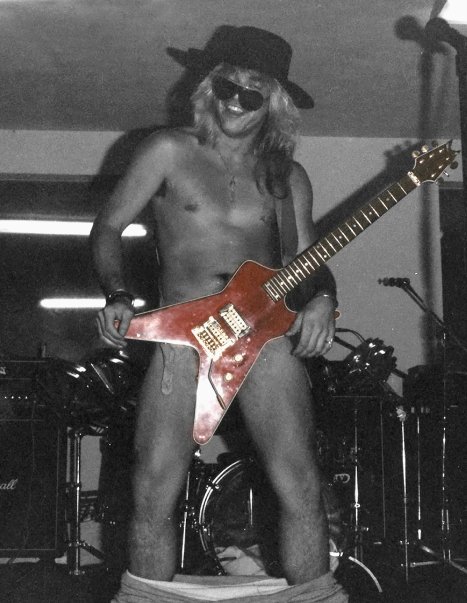
We were traversing this no-man’s-land because Katy had a mission. She had found an old picture of Brian onstage, naked except for a cigarette, a fedora, and a strategically placed guitar. We were driving to the Brazosport Mall to get it transferred onto t-shirts for the show.

“I want a shirt too,” Waylon said from the back. “I want a shirt with Uncle Brian on it.”

“Hmm,” I said. “I’m not sure that would be appropriate.”

“Oh, what the hell,” Katy protested. “He wants a t-shirt of his donor.”

“Well, you can’t wear it to school,” I said, weakly. What the hell. It was a hilarious picture.

We were just coming over the bridge to the mainland, and Katy pulled over at a store called Buc-cee’s, which was a combination convenience store, surf shop, and t-shirt emporium. They sold diesel fuel, bikinis, flip flops, and blow-up rafts, along with hamburgers, chicken wings, chewing tobacco, beer, and homemade fig preserves.

Waylon was immediately drawn to a large display of sand pails and shovels. Katy headed for the children’s clothes and started flipping through the racks for a size 4 black t-shirt. I decided to try on floppy sun hats. If you can’t beat the consumers, I figured, you might as well get something good.

“Mommy, Mommy, can I have this?”

Waylon was dragging an enormous plastic ship through the racks of bathing suits and trunks. When it was clear that he was addressing Katy as “Mommy,” everyone in the store, from the teenage girl in the bikini aisle to the trucker waiting for his food order, did a double take. I couldn’t tell if Katy noticed.

“Sure,” she said automatically. “Check out this t-shirt.” She held up a black t-shirt with an anchor on the sleeve that said “Surfside Beach.” It matched the tattoos on her arms.

“Yes!” Waylon exclaimed. They high-fived.

The line at the cash register was long. One vacationing family was buying snacks for a day on Surfside. But mostly it was chemical plant workers, grabbing coffee and donuts before reporting to shifts at Dow and Shintech. Katy scooped up Waylon and held him while we waited. “My boy,” she said, kissing his head. “My boy is going to get a shirt just like Mommy’s.” Waylon nodded enthusiastically.

“If anybody asks you who’s on the back, what do you say?”

Waylon shrugged.

“You say, ‘that’s my Donor!'”

***

That night, after practice, Brian was even more nervous. He sat silently through dinner, answering his wife’s cheerful queries about band practice with terse, one-word answers. Kathy’s daughter, Jessica, was visiting from college, and I felt bad, because Brian’s nerves were casting a pall over their mother-daughter time.

“We could build a bonfire on the beach tonight?” Kathy asked, hopefully. Brian shrugged and stared at his food. The silence was awkward, unbearable. All of the women, myself included, immediately began to fill it with airy small talk. But when Brian left the room, Kathy scraped his plate with barely contained fury, her lips pressed together in a thin line. After the dishes were done, she wiped the formica table in sharp, precise circles.

I hovered between helping and not helping. The whole scene was like a rerun of the family gatherings of my early adolescence. I knew the script by heart: men set the mood, women set the table…and cook, and clean up. As a teenager, I’d vowed to resist my assigned role in this drama. Now, stuck in the beach house, I felt angsty and oddly irritated with Katy. I didn’t sign on for this much heterosexuality! Why are you making me sit through this? I wanted to hold my hands over Waylon’s eyes. Don’t watch!

My angst was tempered by a guilty sense of sympathy. I guessed Kathy wasn’t used to seeing her husband this nervous. They had met long after he retired from Rokitt. In her world, Brian was a caseworker for people with developmental disabilities. I had seen him with some of his clients when we visited Michigan. He was relaxed, patient, sweet.

After dinner, Brian retired to the back porch to smoke. Everyone else gathered in the living room. It was clear that no bonfire was going to materialize.

“Mom, can I watch one more Thomas?” Waylon asked.

I felt ambivalent. I knew he was bored, but I didn’t want to be rude, hogging the TV with kiddie shows.

“Ask Uncle Brian if he wants to use the TV,” I answered. Just then, Brian walked in the door and started to cross the room. Waylon followed him across the linoleum floor.

“Can I watch TV?” he asked, tugging on Brian’s shorts.

“I don’t know,” Brian said, sullenly. His whole body recoiled from the responsibility that the question implied. “Ask your mom.”

***

The next day, Waylon and I escaped to the beach to jump waves. Every few minutes he yelled, “This is so fun!” as if he couldn’t quite believe his luck. I felt the same way. As a child, I would stay in the surf for so long that my body could feel the rise and fall of the waves in my bed at night. Now Waylon’s excitement was making me feel like we shared a special bond.

When he got winded, I held him on my hip and jumped for him. Waylon told me stories about preschool. I told him stories about childhood vacations. We talked until I ran out of stories, but he still wasn’t ready to go ashore.

“Are you excited for the big rock show tonight?” I asked.

“Uh-huh.” He shook his head. We’d been taking him to shows since he was a month old.

“Are you going to dance for Uncle Brian?” I asked.

“Yes, and I’m going to sing with the band. On the stage.” he informed me.

“Oh.” This was the first time I’d heard of this plan. I didn’t want to smash his dreams, but I also didn’t want him to be disappointed if it didn’t work out.

“Um, Sweetie, Mommy is singing with the band. Did anyone tell you that you were going to sing with the band?”

“No,” he said serenely. “I just am.”

Read Part IV here.

Donor Duet, IV

The sun is setting on the beach as we make our way down Surfside’s narrow, two-lane highway. When we pull into the sandy parking lot of Stahlman Park Recreation center, I’m relieved to see that the parking lot is fairly crowded. It helps that every third vehicle is a puffed-up Ford F150, which takes up one and a half regular parking spaces.

I release Waylon from the back of our Volkswagen. He looks adorable in his black t-shirt with Brian’s picture on the back.

“Are you ready to rock?” I ask.

“Yeah!” he yells.

“We’re going to dance and clap really loud, right?”

“Yeah, and I’m going to sing with Uncle Brian,” he assures me as we walk across the sandy parking lot.

“That’s a sweet idea,” I tell him, taking his hand. “But it’s not very likely, at least not tonight.” I know that I sound like a wet blanket. I just don’t want my baby to get hurt. Waylon breaks away and charges up the wooden ramp to the rec center. Outdoor floodlights illuminate the picture of Brian on his back. “Slow down!” I yell as he disappears through the swinging doors.

The danger of any kind of reunion is finding out that you’re just not that relevant to people’s lives. I have only heard about Rokitt from Katy, and she is Brian’s best friend. I don’t have a good sense of what Rokitt meant to other folks – until I walk into the bright, air-conditioned space of the rec center. The folding chairs are filled with old rockers and their teenage kids, chatting and eating in tidy rows of 10-foot banquet tables. I spot Waylon near the kitchen, where a team of women is setting out cookies. The buffet table is decorated like a high school prom, with plastic picture cubes that displayed Rokitt photos on all six sides.

By the time I cross the room, Waylon has a cookie in hand and is making his escape. He runs straight into his Tía Sandra, Katy’s other best friend, who catches him in a bear hug. As I make my way to where they’re standing, Sandra pretends to devour the “sugars” from Waylon’s neck, which make him laugh and squeal. When she finally hands him back to me, he is content to rest on my hip and eat his cookie.

“Sandra,” I ask, “did you know Brian when he was in Rokitt?” Sandra and I are the same age – nearly a decade younger than most of the people in the rec hall – and I’m curious to hear her perspective on the whole scene.

“I went to see them when I was in high school. Some of my rocker friends took me to their show at the KC Hall. The next day, everyone was wearing Rokitt t-shirts to class. You would have thought fuckin’ Motley Crue had come to town.”

I’ve seen pictures of Sandra from the eighties, when her black, curly hair was styled in a glorious Mexican mullet. Back then, she and Katy were both identified as “butches with hair.” Now she wears it close to her head in a crew cut. She has recently been hired as an operator at one of the plants that line the beach road. One of those big, puffy trucks in the parking lot belongs to her.

A white man with hands and neck like sunburned hams is approaching. Redneck alert! Redneck alert! I pull Waylon closer to me. As the ham man walks past, on his way to the cookie tray, he gives Sandra a subtle nod. “How you doin?” Sandra says, nodding back. I marvel at how my friend has taken her place in a world of men who work in the volatile chemical plants.

Suddenly, the band members take their places. There’s no stage, so they just walk, unceremoniously, to their instruments. A skinny guy with hair like Kenny G is speaking into the microphone. I think he’s the emcee, but the people in the audience don’t seem to notice. Brian is pacing in front of the drum kit, his movements cramped by nervousness. He’s wearing Katy’s tight black jeans and a t-shirt that says “I rock,” with a picture of an antique rocking chair. His face is deathly pale. I’m afraid he might puke before the end of the introduction. Finally, the emcee hands over the mic. The band starts to play. Brian lets out a feeble whoop. The audience stops talking.

From the back of the room, I realize that I’m holding my breath, and I force myself to breathe naturally. They sound okay. Brian’s voice is clear and tuneful. He’s still stiff, but he manages a jaunty kick at the end of the first song. I find an empty folding chair near Kathy. Waylon scoots onto my lap as the band dives into their second number, a Judas Priest cover. I sneak a peek at Kathy’s face. She looks happy and relieved and a little teary. Rokitt is loosening up now, and the crowd gives them hearty applause. In the next row, an elderly lady with white hair turns to her daughter. “Breakin’ the law, breakin’ the law,” she quotes.

Brian is looking less frightened. “I just took some Geritol, and I’m waiting for it to kick in,” he jokes between songs. I wonder if anyone under 35 has ever heard of Geritol. “Feel free to dance, if you can find some room,” he adds. “Any time.”

I’m from Austin, where there’s an unspoken thirteenth commandment: thou shalt dance when thy friend’s band plays. At the Stahlman Park Recreational Center, the folding chairs dominate all but a tiny space in the very front. People are behaving like they’re at a church social – grabbing plates of potato salad and catching up with their neighbors while the band plays. Between the chatter and the bright lights and the absence of an actual stage, the whole thing is lacking a certain intensity. I’m worried about the energy of Brian and the other guys. I just want people in this room to bear proper witness to the miracle of middle aged men making music together.

Katy’s up at the front, bouncing and head-banging, but she’s interrupted every few minutes by someone who wants to catch up on old times. Katy was elected “Howdy Queen” at her high school, an honor bestowed on the friendliest freshman girl. However, even as Howdy Queen, Katy didn’t look like a girl. I’ve seen the coronation photos, and she looks like a football player in half-hearted drag. Throughout high school, Katy’s mom outfitted her daughter with Jane Mansfield-style bras that made Katy’s boobs loom in front of her like alien orbs. Twenty-five years later, she has a surgically flattened chest and can wear her clothing of choice: jeans and a muscle shirt. Her body is still ambiguous. And her warmth and enthusiasm still have the power to charm people who would otherwise be frightened by the mystery.

It doesn’t hurt that she’s the daughter of a football coach. When Katy comes up to sing with Brian, the little old lady in the front whispers something to her daughter. I imagine it’s along the lines of “Who’s that tattooed dyke?” Her daughter answers and the lady shakes her head excitedly. “Oh, that’s Katy Koonce.” She taps her husband on the shoulder. “That’s Katy Koonce!” she yells in his ear. He shakes his head too. People here remember the days when Brazoswood High went to the state championship. Katy ran onto the field with her dad after every game.

I figure the people must have some kind of fond memories of Katy, because the crowd is cheering as Katy humps Brian’s leg through the chorus of “Talk Dirty to Me.” It’s hard to believe that the Stahlman Park Recreation Center is bearing witness to such a queer spectacle. These two old friends feed each other’s energy, and their duet shifts the mood in the room. Waylon, for one, is out of his seat and dancing. As the band makes its way through original numbers like “Sweet Sixteen” and “You Make Love Too Tough,” he bounces and bangs his head. Occasionally he throws in some Kung Fu moves and King Tut poses. Every time he gets too close to the band, I have to run up in front of the folding chairs and drag him out of the spotlight. “That’s Katy Koonce’s lesbian lover,” I imagine the old woman saying to her husband. “And their gay love child!”

After the tenth time that Waylon rushes the band, I pull him aside for a little talk.

“Mommy was singing with the band because they invited her,” I explain. “You can’t keep going up there and getting in their way. It’s Uncle Brian’s big night.”

Waylon nods obediently, and then runs away. An old friend of Katy’s stops to talk to me, but I’m distracted, trying to spot Waylon in the crowd. By the time my eyes find him, he’s already back at the front. He’s somehow managed to take apart one of the plastic picture cubes, and he’s holding a handful of old photos. As the band launches into the final song, Waylon crawls up to the microphone and carefully lays the pictures at Brian’s feet.

“You show us everything you’ve got,” Brian growls into the mic. “And baby, baby that’s quite a lot.”

Waylon is jumping up an down, elated. He knows this song! Brian leans down toward him for the chorus.

“I wanna rock and roll all night,” he growls.

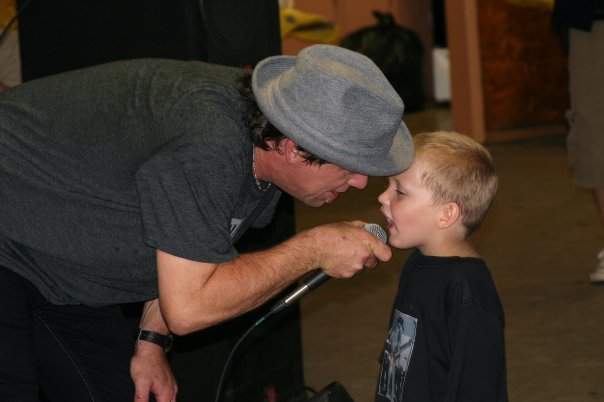
He extends the microphone to Waylon. Waylon contemplates it for a beat.

“And party ev-er-y day!” he squeals in his high, four-year-old voice.

Brian leads into the chorus again, and Waylon sings his part. He’s on the beat now, and people in the room are beginning to laugh and look at one another like, “Who is that kid?” By the time the second chorus comes around, the two have fallen into an easy call and response: first phrase low and gravelly, second phrase high and squeaky.

“I wanna rock and roll all night,” Brian calls.

“And party ev-e-ry day!” Waylon answers, looking proud. Every time he hits his line, people in the crowd hoot and clap. It’s a magical moment, the kind that you wish would never end because you can’t quite believe it’s real.

Katy comes up and puts her arms around me. I can feel her tears sliding down my neck. I look around the room and see Sandra against the back wall. She’s smiling and crying big butch tears too. Sandra helped raise two nieces in this community. Now she and her girlfriend are thinking about having a baby of their own.

Brian nods to the band to play the chorus one more time. “I wanna rock and roll all night.”

“And party every day!” They sing the last line together. Then Brian hangs up his microphone and sweeps Waylon into his arms. Waylon throws his arms around Brian’s neck, and they hug for a long time. Brian turns to the audience and makes the devil horns. Waylon painstakingly folds his middle fingers down to imitate Brian’s heavy metal salute.

The crowd is shouting and clapping and calling for an encore. They’re honoring Rokitt and honoring their youth. It feels like they’re honoring our queer family, with all of its twists and unexpected turns. For the moment, I’m so glad that we decided to step into this particular unknown.

Donor Duet

Originally published on The Bilerico Project in May 2011.

Two days before our sperm donor was due to arrive in Texas, my wife walked in the door with a bulging sack of secondhand toys.

“Waylon already has too many toys,” I said, shaking my head. “His birthday was a month ago! He’s barely four and he has enough stuff to fill two closets.”

“I know, I know,” she replied, looking sheepish. “But he’s going to be the only kid at the beach this weekend.”

This is one of our most familiar family dynamics: Katy indulges, Paige worries, Waylon gets the loot. But for once I wasn’t worried about my son’s consumer character. I was more concerned about my wife’s impulse to play Santa in July.

On the surface, her justification for the new toys was entirely plausible. We were about to embark on the kind of trip down memory lane that only the middle-aged can appreciate. Katy’s best friend Brian, Waylon’s sperm donor, was coming to Texas to play a reunion show with Rokitt, his hair metal band from the ’80s. But rather than the gritty Texas blues clubs that they played in their prime, this time Rokitt was planning to electrify their die-hard fans from the fluorescently-lit comfort of the Stahlman Park Recreation Center on Surfside, a tiny island south of Galveston.

Surfside Beach is not exactly the Riviera of the Texas coast. But Waylon wasn’t exactly a beach snob. He played in the sand all day long at his preschool, digging holes and tunnels and rivers. Every night at bath time, he reluctantly parted from a personal reserve of sand. Despite Katy’s worries, there could be no doubt that he was looking forward to a vacation that involved beaches full of unlimited sand.

When it came to the ocean, however, Waylon’s expectations were as murky as the waters off the Texas coast. We had taken him to the Gulf of Mexico a few times before, but it wasn’t clear that he remembered. When I asked if he was looking forward to playing in the waves at Surfside, Waylon remained vague. “Uh huuuuuh,” he murmured, looking off into the middle distance.

It was pretty much the same situation when I asked if Waylon was looking forward to seeing “Uncle” Brian. They had only met once, when Waylon was about 18 months old, and I knew Waylon didn’t remember. Brian called him at Christmas and birthday time, and Waylon communicated with the harassed politeness that children everywhere extend to long-distance relatives.

With the Rokitt reunion on the horizon, Katy had been pulling out old pictures and trying to enlist Waylon’s enthusiasm for the band and its sperm donor front man.

“Waylon,” she said, holding out a picture from an amateur photo shoot circa 1987, “Do you know who this is?”

Waylon looked up from his blocks, scanned the picture of a man in a ripped tank top and lace tights, and shook his head.

“That’s Uncle Brian!” Katy explained, in a sing-song Barney voice. “Remember, he gave us the seed that we needed to make you?”

This line about the seed was what we’d been telling Waylon ever since he was old enough for us to tell him something about the way we made him. I worried at times that it was too euphemistic, but it was technically accurate. Thus far, although Waylon loved to hear stories about how his parents met and decided to have a baby, he hadn’t expressed interest in the mechanics of conception. From what I could tell, it hadn’t yet crossed his radar that his moms couldn’t make a baby on their own. Whatever we were saying about seeds just seemed extraneous.

Regardless of what Waylon understood, Katy’s enthusiasm for her best friend and his erstwhile band was hard to resist. Over the last few days, Waylon had begun to recognize the guy in the pictures and to look forward to seeing Rokitt play. I was getting excited, too. But I was also scared.

Brian wasn’t part of our queer milieu of chosen family. He had a wife, an ex-wife, and a son in high school. The few times that we’d met, I hadn’t been able to decipher his dudely, understated manners. From my vantage point, it wasn’t clear if Brian was really down for new and complicated family ties. I worried that this vacation would prepare Waylon to expect a relationship that would never materialize.

When I wasn’t fretting about too little connection, I worried about too much connection. I imagined Waylon, fifteen and leather-jacketed, leaving home in a storm of adolescent angst. “You just don’t understand me,” he yelled as the backdoor slammed shut. “I’m going to live with my Dad.” Dad. Dad. Dad. In fantasy, the forbidden D-word lingered in the air as Katy and I huddled in the kitchen, broken apron strings dangling limply at our sides. What if Waylon and Brian had some kind of mystical masculine bond? What if Waylon decided to abandon his moms? Could Brian love and support our son without trying to supplant us? Was Katy secretly worried about this, too? Was that the real explanation for her toy store shopping spree?

All of these questions were swirling in my mind when Waylon came home from preschool and gravitated to the big bag of toys. Katy told him he could pick one now and save the rest for the beach, so he closed his eyes and plunged his hand into the bag, feeling around until he located the largest toy: a three-foot plastic robot with a helmet and a ray gun. (Apparently, my feminist, nonviolent shopping criteria were the first casualty of Brian’s visit.) Waylon was in heaven. Grinning, he searched for the “on” switch. And then there was sound:

“I-am-Master,” the robot announced. “I-sense-your-fear.”

Read Part II here.

Photo by Steve Keys is covered by a Creative Commons licence. Some rights reserved.

My Mother-in-Law

When Donna Koonce went into the hospital, I kept telling everyone that “Katy’s mom” was having bypass surgery. I didn’t want to give the state of Texas too much credit for recognizing my relationship to this extraordinary woman.

By the time Donna was moved to the ICU, I needed the shorthand of “mother-in-law.” I spoke the words into the intercom, and the nurses buzzed me into the locked ward. (Every time I said, “I’m here to see my mother-in-law,” I had to remind myself that I wasn’t fudging: Katy and I are legally married–in California and the eight other states that recognize our marriage. But that legal status is pretty theoretical when you’re stuck in a small southern town.)

Donna Schley Koonce.jpg

Now that Donna is dead, it feels strange to use a stuffy matrimonial label to describe her. For one thing, she was terribly vain and would not abide any appellation that made her sound old. (Her own grandchildren were forbidden from using the dreaded G word.) For another thing, saying “mother-in-law” inevitably reminds me of our first wedding and how Donna Koonce, grand southern diva that she was, nearly derailed it.

Donna’s presence, and her disapproval, could be formidable. In 1981, when Katy came home for Christmas with a “friend,” her mother “accidentally” discovered their love letters in Katy’s bag. Donna called the girls to the living room, where she presided over the house from a throne-like velour recliner. Trembling, Katy and her girlfriend awaited judgment on the couch. Mom stared the girlfriend down.

“Do you love her?” she asked, finally.

“Yes,” said the young woman, sneaking a glance at Katy, “I do.”

“Well, good,” Donna answered, taking a drag on her cigarette. “You better.”

This was the era of panic over the new “gay cancer.” Only three years earlier, Anita Bryant and her minions had campaigned to remove anyone who supported gay rights from positions in California public schools. Donna’s husband was a high school football coach–a position of considerable visibility and social standing in small Texas communities. The Koonce family lived on the Gulf Coast, in Lake Jackson, a historically segregated community for white employees of Dow Chemical. But even a “chemical corridor” town like Lake Jackson was cosmopolitan compared to the place where Donna was raised: Carthage, Texas, near the notorious Piney Woods of East Texas.

As its ancient namesake might suggest, Carthage is located in one of the more violent parts of the Deep South. The names of other East Texas cities resonate with histories of racial discrimination and terror: Paris, Tulia, Jasper. So how did a privileged white woman from Ku Klux Klan territory come to unquestioning acceptance and support for her butch lesbian daughter? I’ve thought about this question a lot, and I have a few answers: she was extraordinary, she was full of love, and she didn’t give a fig for what other people thought.

“Extraordinary” is shorthand in our family for Donna’s tendency to behave like minor royalty. When Donna went to the bank to make a deposit, she refused to deal with anyone below a Senior Vice President. If she made reservations for a restaurant, she asked to speak with the manager before dropping her own name: “Dhis is Donna Koonce, do you have a good table for me tonight?” If Donna sent you to the Kroger for a cut of meat, she’d remind you to “tell ’em you’re a Koonce.”

If a Koonce was gay, then, by Donna’s logic, gay was good.

She didn’t really care what other people thought, just as long as they were paying attention. As a forty-something mother of three, she wore mini-skirts and go-go boots and Angie Dickinson wiglets. At the Junior Civic League variety show, she played Mae West, but threw in some Sophie Tucker jokes for maximum shock value. On the golf course, she was known as “Dirty Donna” for her foul mouth. “Goddamnit, Donna,” her introverted husband would say at the end of a party, “it’s time to go home.” “Oh shit, Phil,” she’d habitually reply. “You go on home.”

She loved a lengthy public prayer. Before any family meal, she’d gather kids, grandkids, friends, and spouses into a circle. When everyone had joined hands, she’d begin, “Lord, thank you for allowing us to be together once more.” And then, depending on her mood, she would go on, mentioning those who were absent, those who had come before, those whose financial foresight to invest in natural gas had paid for this meal we were about to consume. The length and superciliousness of the average Donna Koonce prayer could cause respectable grown-ups to be seized with fits of giggles. If anyone dared to make eye contact across the prayer circle, it was all over.

For private prayers, Donna preferred moonlight. When the moon was full, she’d slide on her house shoes and shuffle out to the moist swath of grass behind the house. There, with a Carlton 120 in one hand, she’d unload her troubles to a personal god–a confection of Father, Son, and pagan moon goddess. She prayed for all her many grandchildren (including the ones conceived outside of marriage, who occupied a special place in her heart). She prayed for patience with her husband. She prayed for the social life of her cross-dressing neighbor. For the success of her housekeeper’s daughter’s quinceañera. Most of all, she prayed for her adult children, that they would find peace and stability before she had to leave them.

Saying your prayers to the moon is pretty risqué stuff in a town where the Baptists still believe that Methodists go to hell. But Donna wasn’t shy about it. If the moon was particularly big and beautiful, she’d come inside, pour another drink, and then call friends and family. It wasn’t unusual to hear the phone ring at 11 pm. “I want you to go outside and look at that moon,” she’d evangelize. Then she’d fill your ear with everything she’d been praying about–especially if it had to do with you. Just in case her intercession with the moon didn’t work, she was going to take the earthly opportunity to let you know exactly what she thought you should do with your life.

As you might imagine, I was full of trepidation the first time I met Donna. I’d heard stories of previous girlfriends who’d suffered Donna’s frank appraisal–which grew more frank throughout the evening as Donna consumed her customary cocktail–scotch and water in a 24 oz styrofoam cup. At the time, I had 3/4″ hair that was dyed old-lady silver. I wore round black glasses that made me look like a raccoon. I was nerdly. I could not pull off a convincing “y’all.” I had never tasted gumbo with oysters. I was a Yankee.

I could tell you that we bonded over the crossword puzzles that she completed every day. I could say it was Donna’s gumbo or her cornbread dressing, which I ate with relish and appreciation. Or our shared love of vintage fashions from the 1950s and 60s. But the truth is, it felt like she loved me before any of these things.

It’s a cliché to say that your in-laws make you feel like one of the family–and yet, that’s exactly what Donna did by being herself. I still remember the first time I saw her get into an argument with Katy. It all happened so quickly; one minute they were talking about taxes and the next minute they were digging into buried reserves of anger and reproach. I wanted to melt into the couch. “That’s it,” I thought, “the visit’s ruined. We’ll have to go home.” But while I was mentally packing the suitcases, mother and daughter had moved on to some lighter topic and were once again enjoying each other’s company. I couldn’t believe it. Watching them taught me about myself, how unrooted I was, how every little storm could make me feel like I’d been felled.

Although I found Donna’s emotional volatility a bit scary, I learned that I could trust the authenticity of her emotions. When she hugged me goodbye at the end of a visit, I could honestly feel the love flowing towards me. It wasn’t unusual for her to cry a little and to tell me how very, very grateful she was that Katy had found me. “Thank you, Darlin,” she’d whisper in my ear. “Thank you.”

In spite of her love for me, Donna Koonce disrupted my wedding.

PaigeandDonna.jpgIt was a balmy July evening in Austin, Texas. The elegant oak trees and simple pine plank fences were strewn with tiny white lights. More than 150 people had gathered for a backyard ritual designed to acknowledge our friends and family, our queer village and social support network. Twenty of our most special people were seated on the patio behind us, with Donna on the front row.

Our celebrant was Gretchen Phillips, singer, songwriter, and inveterate marriage skeptic. Katy and I had needed to break through a lot of resistance to convince her to unite us in unholy matrimony. Now, just as Gretchen was about to deliver the words she’d crafted for the occasion, Donna stood up and grabbed the mic. There was a gasp from the audience. “Your turn is coming,” Gretchen admonished. Donna, undeterred, pointed to the sky. Then she spoke, slowly and Southernly, into the microphone.

“I. Want. You…to look at that Moon!” Thus instructed, the entire audience gazed skyward and gasped again. A giant silver orb, a spectacular full moon, was shining its blessing on our nuptials.

Eight years later, I was hurrying back to the hospital in Lake Jackson. It was day six of Donna’s hospital stay. Her blood pressure had never returned to normal after the bypass and her vital organs were failing. The surgeon had offered the possibility of exploratory surgery, but cautioned that Donna was unlikely to survive another procedure. The family thoughtfully declined. Now the nurses said she wouldn’t last another night.

I had taken our son, Waylon, to stay with friends and was anxious to rejoin the rest of the family. Stuck at a stoplight, I felt something looming in my peripheral vision. The moon. It was a spectacular golden dinner plate pasted on the sky. I texted Katy: “look at that moon.”

Back at the ICU, Katy held Donna’s hand and told her about the beautiful spring moon. Then she spoke with the nurse. The doctor had given permission to stop the blood pressure medicine that was Donna’s last artificial tie to life.

When I arrived, Katy stepped out of the room to call her brothers. It was the first time in six days that I’d been alone with Donna. With everyone else gone, I didn’t feel self-conscious about taking her hand and putting my face next to her ear.

“Donna,” I said, “it’s Paige.” I had to try to project over the sound of the respirator. “Thank you for always being so sweet to me,” I said. “Thank you for always loving Waylon like he was any other grandchild,” I sobbed. And then, just as a wave of emotion was swelling inside me, I felt something equally strong and real emanating from Donna. Her emotional response hit me like a tidal wave. Her presence was so strong, I was almost reeling, but I stood my ground and stayed in close.

“I learned so much from you,” I said. My throat was tight with emotion. “It’s Paige,” I added. “I know you might not recognize my squeaky voice.” But, even as I said it, I knew she knew me. “I love you and I’ll miss you.”

Still touching her arm, I sat back down on the stool by the bed. The fullness of her presence had subsided now, but I could feel it resonating inside me.

Katy came back from calling her brothers. She took her mother’s hand. “I just called Phil and Blaine, Mommy. It’s okay, you can let go if you need to.” She kissed her mother and settled in to wait.

It was hard to look at Donna’s beautiful face disfigured by swelling and tubes. We stared at the blood pressure monitor, which produced a new reading every 15 minutes. Katy busied herself by making sure her mom still had the crumpled tissue that she habitually clutched for comfort.

There was little sign of change until the heart monitor began to beep. We watched the lines on the screen grow slower and farther apart. Donna did not labor or rasp. Because she had a DNR order, the nurses walked calmly into the room. One put a stethoscope to Donna’s chest. Then she handed it to the other. They agreed that the last heartbeat had happened at 12:13 am.

Except for the screaming of the heart monitor, the difference between life and death was barely evident. Then the nurses turned off the respirator and she was still. The respiratory therapist came and rolled the machine away.

I waited with Katy until her brother Phil arrived. Then I stepped outside to give them some time alone with their mama. Phil’s wife was in the hallway and we made small talk. Donna was gone, but the intensity of our moment together was so great that she didn’t feel all the way gone to me. The body in the room seemed insignificant now, because a small part of her spirit had migrated to my heart. I can still feel it right now, as I’m writing these words. It fills my chest and buoys me up.

A Road Trip, Told as a Series of Pit Stops

It’s the kind of truck stop where a voice on the loudspeaker calls out “Customer 47, your shower is ready.”  In the back, plywood covers a large hole in the wall, a monument to some past collision. In the front, porcelain bald eagles are arrayed next to bright yellow boxes of energy “vitamins.”

When I was a straight, white college student, I used to appreciate places like this as kitsch. That was before I traveled the U.S. with my ex–a gender non-conforming man of color, a non-citizen. Now I sense the undercurrent of violence. I can taste the ambient terror.

My six-year-old son, Waylon, has to pee. I take him with me to the women’s bathroom, then begrudgingly allow him to choose a candy treat. “Those are two for one,” drawls the white woman behind the counter. I just want to get out of this place, but Waylon’s already made a beeline back to the candy aisle.

Just then, Katy walks up. “Do you have your phone on you?”

“You want to make a phone call right now?” I ask, incredulously. I have cash in hand. My eyes are fixed to the spot where I’m waiting for Waylon to reappear with a second pack of Skittles.

“No,” she says, sounding only slightly exasperated. “I need to do the phone trick.”

Duh. I’ve been focused on my own freaked out feelings and shepherding Waylon out of this place. I’ve forgotten to think about how Katy is going to pee.

“The phone trick” is something Katy came up with over our last summer road trip. It’s a survival strategy for places where an ambiguously gendered body is likely to run into trouble in public restrooms.

It’s simple. She holds the phone to her ear as she enters, pretending to be engrossed in conversation. She speaks in a high voice, so that people who might be confused by her appearance can assign a gender category that allows her to use the women’s restroom. She never puts the phone down or stops talking, leaving no opening for strangers to engage her.

A few minutes later, I’m sitting in the front seat with my eyes on the door of the truck stop. When Katy finally emerges, she slides into the driver’s seat and hands me back my phone. “How did it work?” I ask, relieved that we’re all safely in the car.

“I needed it,” she says. “It worked.”

We’re not the most vulnerable to violence in a truck stop in a place like Van Horn, Texas. I’m well aware that our travels are protected by the buffer of our race and class and citizenship privilege. No economic dislocation launched this voyage. We’re on vacation. We chose to come to West Texas. We’re driving a Prius with a Would Jesus Discriminate? bumper sticker. From far away, all people can read is “Jesus.”

Katy slows down when she sees a white car in the distance, but speeds up again when she sees the green stripe that signifies border patrol, not state trooper.

I’m remembering what it was like to go through checkpoints with my ex, how he tensed up miles ahead of time. The agent leaned into the window and said “U.S. citizens?” out of the corner of his mouth. My ex showed his driver’s license and maybe his permanent resident card. He used his deepest, dudeliest voice while the agent surveyed our belongings in the back of the truck.

Fort Davis, Texas
Katy gets pulled over for speeding. The officer makes her get out of the car before he’ll approach. I watch in the mirror. Even though she’s got driver’s license and insurance papers ready, I’m afraid. We’re in the middle of the nowhere. What if the trooper doesn’t take kindly to someone whose presentation doesn’t match her gender marker? What will he think of the two of us traveling with a child?

Waylon is watching cartoons on the iPod, oblivious to all around him. Later, when we’re safely on the road again, Katy teases him: “You didn’t even bat an eye when Mommy got pulled over by that cop!”

“You mean when you were talking to that cowboy?” he says, completely unalarmed.

He’s too complacent about cowboys, I decide. I’ve just been re-reading Borderlands/La Frontera, and I try to tell a six-year-old version of Anzaldua’s history: how the Cochise people moved southward, how the Aztecs dominated other tribes and the Spanish exploited those divisions, how the Treaty of Guadalupe Hidalgo robbed people of their property. We end up in a conversation about different ways of understanding humans’ relationship to land.

“I don’t think anyone can own the earth!” Waylon says, outraged. I have to smile, because–as an only child in an owning-class family, he can’t even share toys very well. Still, I’m glad that borders don’t seem natural or inevitable to him.

After all this talk about how the west was stolen, Waylon has another question: “But how do we tell them that we’re not the bad kind of white people?”

I pause. I’m trying to parse the “them” and to imagine what kind of encounter he’s imagining. We talk about the people we know who variously identify as Native American, Hispanic, Chicano/a, or Mexican. I’m trying to think of how to teach him to be just without being self-righteous. How do you inculcate reflexivity? Six-year-olds have a fairly dualistic worldview. Either you’re good or you’re bad, just like the cartoon characters he watches on the iPod.

“Maybe the answer is just not to act like a know-it-all,” I say. Waylon shakes his head eagerly. He hates know-it-alls. They are the bane of his kindergarten social landscape.

Marfa, Texas
We’re staying for the night in Marfa, the hipster capitol of west Texas. With its big sky and classic county courthouse, Marfa looks like a movie set of a western railroad town. Some of the scenes from Giant were shot in our hotel. Now the 1920s storefronts are homes for galleries and trendy restaurants, thanks to the magnetism of the nearby Chinati Foundation.

They’re used to weird white people here. bathroomguy.jpgWe don’t even stand out next to the noisy German art collectors and East Coast ArtForum types. At breakfast, we become enamored of a seventy-something woman with round, black-rimmed glasses and a helmet of silver hair. She’s a dead ringer for Edith Head. Katy waits in the vestibule outside the bathroom, hoping to capture a surreptitious iPhone picture of our crush, but ends up accidentally snapping some random dude exiting the restrooms.

Balmorhea, Texas
We make a day trip to San Solomon Springs, a natural spring-fed pool in the middle of the desert. It’s Saturday, and the place is full of middle and working class families, brown and white. There are thickets of picnic tables, and people are barbecuing, hanging out, horsing around. Everyone from middle-aged bikers to tiny kids line up to jump off the high dive, which was constructed–like the rest of the pool–in the 1930s. There are no lifeguards.

While I’m swimming with the fishes in the deep end, Waylon has to pee again. Katy escorts him to the entrance of the men’s restroom. Using the men’s room on his own is relatively new, so she attempts to give him a refresher about what to do if anyone approaches him. “I’ll just kick ’em in the balls,” he says, slipping out of her grasp and lighting out for the urinals.

After our swim, we stop at a roadside general store to stock up on chips, soda, and ice cream bars for the drive back to Marfa. As I slide into the car, I tell Katy that there are two single-stall bathrooms at the back of the store, with a gender-neutral common area for washing up. “It’s probably your best bet for miles around for a trouble-free pee,” I say. She jumps back out of the car. It’s been hours since we left our hotel this morning, and I wonder how long she’s had to go.

Las Cruces, New Mexico
We decide to spend an afternoon at the movies. Halfway through the film, I have to pee. I emerge from the dark theater, still in a cinematic dream state, and suddenly I’m confronted by a sign that says, “Restrooms for Humans Only.” Perhaps because I’ve been studying too much Traditional Values Coalition propaganda, it takes me some time to figure out that this isn’t intended as anti-trans intimidation. Because we’re in the southwest, it takes me even longer to ascertain that the cartoon alien on the sign isn’t part of some kind of anti-immigrant campaign.

I stand in front of the sign for a long minute. I realize it’s an ad for a sci-fi movie. I proceed to the bathroom, feeling oddly suspect.

Carlsbad Caverns, New Mexico
At Carlsbad Caverns National Park, we find the only gender-neutral “family” restroom on our 1000-mile road trip. That, and the spectacular caverns, make it well worth the drive.

Boygirls, Pillbugs, and Cool Dudes

Last week was spring break, so I got to spend a lot of time gardening with my four-year-old son, Waylon. He was really excited to capture his first roly poly bug of the season. The poor creature had curled up into a little protective ball, and Waylon was about to shove it in his pocket, but then thought better of it (ahem) with a little parental prodding. He decided instead to free it in a pot where we had just planted a little green succulent called “Mother of Millions.”

“Mom, I put that roly poly in the plant, and he or she—or if it’s a girlboy or a boygirl—is going to dig in the dirt and make it soft.”

Waylon, you had me at “he or she.”

As a feminist parent, I have experienced few greater joys than hearing non-sexist language carefully applied to a pill bug. But although I would love to take credit for Waylon’s refusal to assume the gender of the pill bug, it’s really his own creative adaptation to his context, just as “girlboy” and “boygirl” are categories he created to describe the people around him.

Now, when I was in college, my Child Development professor taught that children begin to consolidate their concepts of gender identity around three years of age, and that the process is often marked by heightened rigidity about gender norms. So I thoroughly expected Waylon to become a little gender cop when he hit three. He did go through a phase when he wanted to categorize everyone. One of his favorite games was a toddler form of people watching, where he would look at people in the park or in the grocery store and yell out “boy!” or “girl!” And while I wanted to support Waylon in whatever developmental thing he was working through, this game could be extremely socially mortifying. I would estimate that he was “right” (in that his attributions matched the gender identities of passersby) about 75% of the time.

Luckily it didn’t take Waylon too long to come up against the inadequacy of his binary categories. Another of his favorite games around this time was to ask, over and over, “Mama, are you a girl?” For me it was easy to answer with a straightforward “yes,” but for Katy things were not so simple. Since he asked this question about ten times a day for at least a month, she had plenty of time to formulate a good answer. “I’m kind of a mix of girl and boy,” she’d say. “I’m a mommy, but I look more like a boy than Mama does.”

Contrary to what child development specialists might predict, Waylon did not skip a beat. Before long, he was asking “Mommy, are you a boygirl?” ten times a day, and Waylon’s four-coordinate gender axis (girl, boy, boygirl, girlboy) was born. It may not be exhaustive (what gender system could be), but it has more descriptive depth than a binary. The first time we really saw this system in action was when our friend Kelly came to visit from San Francisco when Waylon was three. Kelly is a trans-identified butchy queer with blonde, boyish looks. She has tattoos of ships on her arms and endless patience for playing Thomas the Train, so Waylon adores her. One morning Kelly and Katy were taking Waylon and his best friend, Flynn, to the playground. Katy was driving, Kelly was riding shotgun, and Waylon and Flynn were strapped in their car seats in the back. Flynn leaned over to his buddy and said, in an astonished three-year-old stage whisper, “Waylon, is that a boy or a girl?”

“Silly, that’s Kelly,” said Waylon. “She’s a boygirl.”

Around that same time, Time published an editorial in which James Dobson condemned Mary Cheney’s decision to have a baby with her partner. “Love alone is not enough to guarantee healthy growth and development,” Dobson opined. “The two most loving women in the world cannot provide a daddy for a little boy–any more than the two most loving men can be complete role models for a little girl.” This week, as I’ve been pondering Waylon and his pill bug, I’ve been also been contemplating what the four coordinate gender axis does to Dobson’s notion of a “complete” gender role model.

When I was growing up, I had a family, and a father, that at least resembled Dobson’s prescription, but I still grew up only knowing one version of masculinity—my dad’s verbally-fluent, academic, leg-crossing, middle class version of masculinity. I rarely saw my friends’ dads (the 1970s in suburban America were not that different from the 1950s in terms of paternal involvement, as far as I can tell), but when I did, I always thought they must be mad about something, because I was so unaccustomed to their predominantly silent, aggrieved, inexpressive ways. (I distinctly remember seeing my friend Amy’s dad, who had just come back from Vietnam, open the fridge and drink milk from the carton, and it was such a disturbing breach of known fatherly protocol that I almost had to run home.)

The fact is that there have always been multiple masculinities, multiple genders, and queer families probably have even better resources in terms of introducing their children to a range of genders and gender expressions. And, although Dobson might like people to believe it, we’re not raising our kids in a test tube—we have families and communities. For masculine role models, Waylon has his (now openly gay) grandpa, who takes him for rides in his Corvette and lets Waylon throw an endless supply of pebbles in his pool. He has “Uncle Brian,” his donor, an old working class rocker who found his calling as a social worker with mentally retarded people. Most importantly, he has Mommy, who created her own uniquely Texan brand of female masculinity from her cowboy big brothers and her football coach dad.

Our extended family “village” also includes the teachers at Waylon’s school, Habibi’s Hutch. I don’t know if it’s because childcare is so undervalued (and under-compensated) in our society, or if it’s the remnants of the 1980s daycare sexual abuse hysteria, but daycares with male directors and male teachers seem relatively rare. Habibis’ has both a male director and a gender balanced staff of committed teachers, many of whom have been teaching there for more than a decade. Waylon has loved all of his teachers, but the dudes have played a special role in his life.

When Waylon was first potty-trained, his lesbian mothers thought it would be great if he kept sitting down to pee for a long as possible, thus saving our bathroom floors from his errant stream for as long as possible. I’m pretty sure it was the male teachers at Habibis who intervened to save him from parentally-programmed dorkiness, and before long he could hit the bowl like a pro. Several months later, Waylon was peeing at home and I was sitting on the edge of the tub, talking to him. He stopped mid-stream, adjusted his pants a little further down, and resumed his pee. Then he turned to me and said, with casual confidence, “It’s called choking your balls.”

“What?!?”

“When your underwear goes up too high while you’re peeing. It’s called ‘choking your balls.’”

I would never have known.

As I write this post, I’m mourning the fact that this will be Waylon’s last spring at Habibi’s. He’ll start kindergarten in the fall, and then his preschool teacher, Mike Esparza, won’t be as much a part of our daily lives. Mike has taught at Habibi’s for fifteen years. He usually sports long hair, a moustache and goatee, tube socks, and black plastic glasses. He looks a bit like a Mexican Jad Fair, but more handsome and coordinated. He rides a BMX bike to work, and he regales the kids with tales of death-defying bike adventures, as well as yarns from his childhood with a rotating cast of characters like his friend “Fat Jason” and his “dumb uncle.” Mike tends to speak in aphorisms that get repeated like the sacred word around our house. I can always tell when I am about to get a dose of Mike wisdom, because of the reverential tones in Waylon’s voice before he enlightens me.

“Mom, if you’re looking for something, and you stop looking for it, then you’ll probably find it.”

“Mom, people who say ‘stupid’ a lot probably are stupid.”

“Mom, the headliner is usually the best one.”

Some of the male teachers at Habibi’s are really warm, fuzzy, nurturing guys. If Waylon is having trouble with the morning transition, then hands-down it is Andrew he wants to go to. Andrew hugs him and tells him, “I’m so glad you’re here,” in the sweetest, most sincere voice imaginable. Mike’s style of nurturing is different, but not indifferent. There’s a little more distance there, but it’s an interested distance, one that lets the kids have their own process and make their own discoveries. I appreciate it, because I want Waylon to grow up comfortable with lots of different styles of masculinity and lots of different versions of “role model.” I know Waylon appreciates it too. When I asked him to describe Mike, the usually loquacious Waylon would only say, “he’s cool.”

Prologue: Think Pink

Katy’s mother, Donna Koonce, wanted a baby girl.

The year was 1962. Donna and her husband, a small-town Texas football coach called Big Phil, already had two strapping young sons. But Donna yearned for a soul mate, a confidante, a fashion plate. In a word, she wanted a daughter.

This was before the advent of routine prenatal ultrasounds, but Donna was undaunted by the lack of reliable information about the secondary sex characteristics of her fetus. A hardy optimist with a penchant for bullet bras and blond wiglets, Donna put her faith in the science of positive thinking. She taped a picture of a baby girl to the Frigidaire. She tied pink ribbons to lampshades and chairs, so she could see them as she dusted the end tables and vacuumed the dining room.

In order to enlist the help of the community, Donna threw a “Think Pink” shower. Her friends served pink cake and adorned Donna with a pink corsage. They brought pink presents. Hand-smocked dresses with tiny petticoats were laid in the dresser in the nursery, which was (of course) pink.

When the due date finally arrived, Donna had a bad case of pneumonia. She arrived in the delivery room heavily drugged. The family doctor, an unassuming sadist named Grundy Cooper, knew how badly Donna wanted a girl. “Oh, he looks real good, Donna,” Grundy teased from behind the modesty curtain that bisected her upper and lower halves.

“Shut up, Grundy, she is not a boy,” Donna growled.

After the final push, Donna shouted “Let me see her genitals! Let me see her genitals!” Grundy took his sweet time, holding the baby upside down, delivering the breath-inducing spank, and finally placing the tiny body on the scale where Donna could see. When the fluorescent lights reflected off the shiny steel cradle of the scale, Donna’s drug and hormone-addled eyes noted two things: a vagina and a hazy white halo.

“She’s an angel, Phillip,” she said to her husband, who had been hastily summoned from the waiting room. “She’s an angel.”

***

Nine years later, my own parents were speeding toward the hospital in their purple Volkswagen beetle. Mom was breathing “hee, hee, hoo” as the contractions came closer together. She’d planned a natural birth, without drugs or modesty curtains; she very nearly had a natural birth without a hospital. By the time the car pulled up at the hospital, she was too far along to sit in a wheelchair. She had to waddle into the delivery room on her own. Nurses rushed my father into a gown so that he could fulfill his duties as labor coach.

Although my parents’ milieu of Lamaze exercises and German cars may seem worlds away from Donna Koonce’s East Texas, my mom and dad had at least one thing in common with Donna: a determination to shape their child’s gender identity and expression. But while Katy’s mother dreamed of birthing a tiny beauty queen, my parents aspired to raise the next Bella Abzug.

Instead of frilly dresses, my parents gave me a pink plaster plaque that said “Girls Can Do Anything!” They bade me goodnight with the affirmation, “You can grow up to be the First Woman President.” And they bought me the Sunshine Family dolls as antidote to the bimboesque influence of Barbie.

Sunshine Family lived in a cardboard craft store, complete with spinning wheel and pottery kiln. Sunshine Mama (whose name was “Steffie”) wore her baby in a pack on her back. She had a calico maxi-dress, and her barefoot feet were realistically flat. But Steffie’s half-inch waist and candy floss hair were pure Mattel fantasy. In my imaginative play, her husband, Steve, worked the cash register, while she pricked her finger on the spinning wheel. Despite Steffie’s hippie accessories, the horizon of her liberation was circumscribed by marriage and motherhood. My parents’ good intentions were no match for the contradictions of pop culture.

Thus, although Free to Be You and Me was in heavy rotation on my plastic ladybug record player, I grew up convinced that marriage or the convent were my only possible destinies. By the time I was eight, I had already concluded that I was too brunette and substantial to inspire romance. I regret to say that I did not indulge in proto-lesbian fantasies about convent life, but rather viewed the nun’s habit as a badge of failure, a kind of scarlet V for unwanted virginity. Laura Ingalls Wilder’s Little House on the Prairie series consoled me with the thought that a strong work ethic might make me worthy to be some man’s wife. My solitary twin bed was the site of vivid fantasies about scrubbing his shirts on a tin washboard.

***

On one of our first dates, my future wife brought a tape of her family’s home movies from the 60s and a joint. I think Katy guessed that my feminist consciousness was going to need expanding if we were to swap childhood stories in the way that new lovers do. She’d dated enough Women’s Studies majors to guess that “the cultural construction of gender” would be my mantra, the magic words that were supposed to save me from the depressing determinism of biology as destiny and the one-size-fits-all essentialism of universal sisterhood.

Savvy as she was, she could hardly have anticipated the intensity of my views. I leaned fervently, incontrovertibly toward the nurture side of the nature vs. nurture debate. If anyone spoke to me of gender as something innate or remotely natural, I did the intellectual equivalent of covering my ears and shouting “La,la, la, I can’t hear you!”

In my heart, I believed that acknowledging a biological component to gender was a slippery slope that would land me right back in front of that washboard, scrubbing collars.

Now, in reel after reel, I discovered Katy at 2, 3, and 4–already miraculously masculine, already chaffing like a football player in frilly dresses, already looking dejected when she unwrapped yet another doll from underneath the Christmas tree.

Suddenly, the whole notion of nature vs. nurture ceased to make sense. Her pintsize Texan masculinity was culturally pitch-perfect–and a total violation of the prevailing gender system. It was incongruent with anatomy–and undeniably physical, emanating from every muscle and gesture.

The highlight of the home movie footage was the year when Katy appeared next to the Christmas tree in full Davy Crockett costume. Freed from the confines of fussy dresses, she sprawled on the floor next to a large, oblong package. A second later, the wrapping paper was off, and she was jumping up and down, triumphantly brandishing a new BB gun.

Having grown up with the peaceful Sunshine Family, I was hardly used to celebrating childhood gun ownership…and yet, I found myself strangely un-horrified. There was something undeniably liberating in her joy, something that forced me to reach beyond my usual knee-jerk reactions. Maybe it was the pot. Or maybe I was falling in love.

“Dude,” I said, “this is blowing my mind.”

Blog at WordPress.com.

Up ↑