Yesterday morning, I was tooling around on Oprah’s web site, trying to figure out how to submit a personal essay for O Magazine. Unfortunately, according to the terms of use, anything you submit online automatically becomes property of Harpo Industries, to be developed as they choose in any medium they see fit. (As much as I’d like to see a reality series based on a gay, trans, rock-n-roll family raising a son in the South, I wouldn’t trust anyone else to develop it, because I wouldn’t trust a casting agent to recognize low-femme nerd realness.)
Since I can’t come to O Magazine, I decided to bring a little bit of Oprah to the blog. Here are some of my favorite things. Picture me lavishing them upon you like an Oprah-style giveaway, because they are all cheap or free.
1) Tango, My Childhood Backward and in High Heels by Justin Vivian Bond
Justin Vivian Bond performed in Austin a few weeks ago, and I had the pleasure of reading this memoir while I could still hear the cadence of v’s voice, the way every sentence pulls up short, leaving half the meaning in the space between.
Here’s one of my favorite lines:
“But looking back, I think that a frosted pink is a perfect color for a little trans child in first grade.”
This book has (deservedly) great blurbs, including one from Michael Warner, who says that Tango “should be in the hands of every child who can read.” (For those of us with a queer theory background, it’s kind of delicious to speculate what else might be on MW’s recommended reading list for children.)
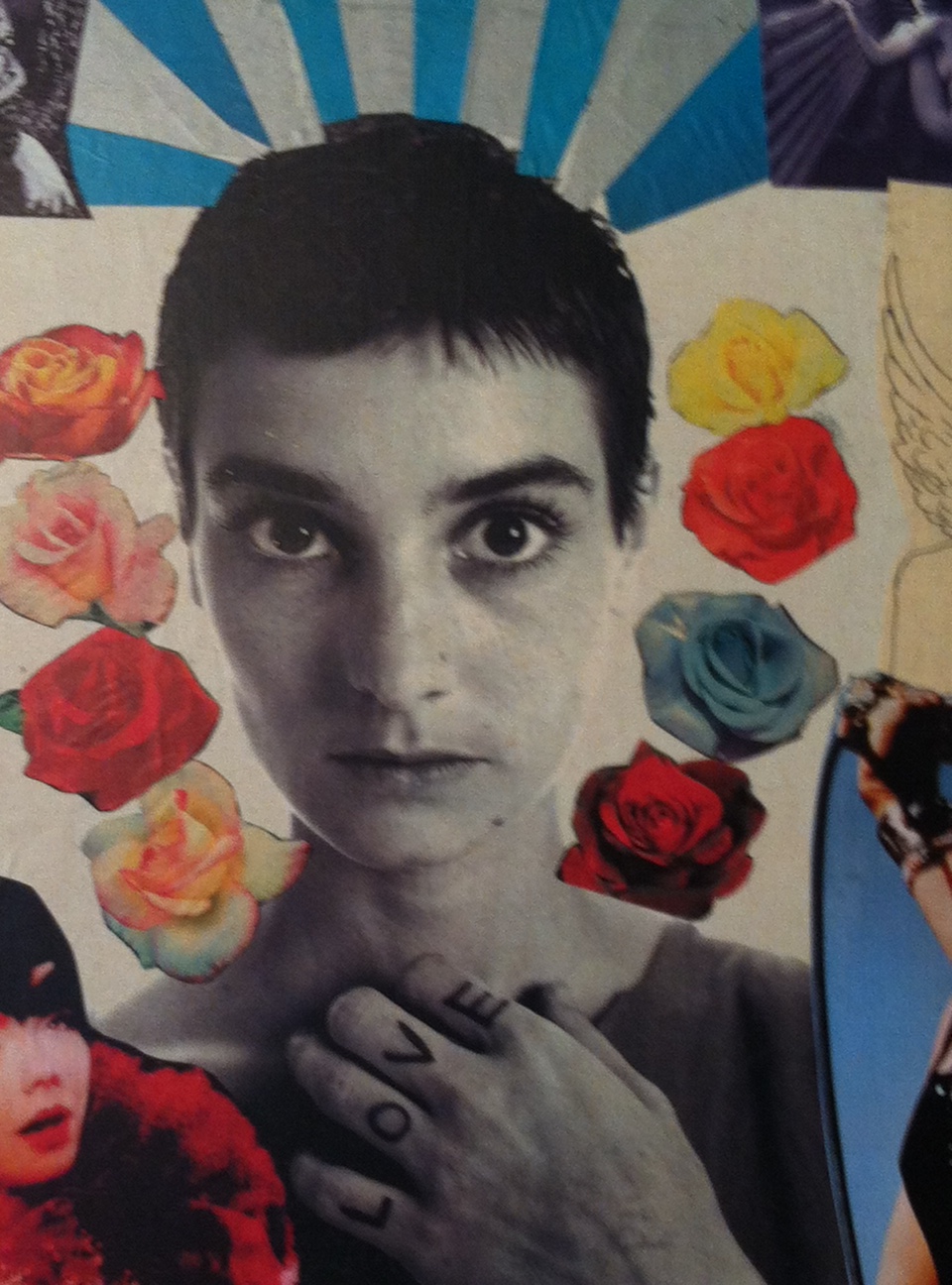
2) Sinead O’Connor Bathroom Shrine
I was having kind of a rocky time a few weeks ago, and the universe sent two signs from my personal savior, Sinead O’Connor. First, The Atlanticpublished a long biographical article titled “The Redemption of Sinead O’ Connor,” and then Justin Vivian Bond, Christeene Vale and Silas Howard played “Black Boys on Mopeds” at the aforementioned show. It reminded me to ask for solace and guidance at the Sinead shrine in my bathroom (and to listen to Faith and Courage, one of my favorite albums of all time).
I made the shrine with magazine clippings and mod podge.
3) Succulent Garden
My most recent fortune cookie said “time and nature heal all wounds.” Now that temperatures have finally dropped into the double digits, I’ve been healing myself in the beautiful golden light of Texas in October. My favorite puttering project is a succulent garden on our front porch. Most of the plants were originally gifts from friends, and others were pocketed from public places. (The great thing about succulents is that a single leaf can grow into a whole new plant. They just need “a touch of earth” as my friend Gretchen likes to say.)
4) Used Record Player
I have to admit that I rolled my eyes when Katy pulled this portable turntable out of her mom’s best friend’s garage. Apparently I was underestimating the quality of a mid-1970s portable Sanyo, because this baby sounds amazing.
So much about this school year has been stressful—finding academic support for our dyslexic child—or boring—helping him plow through mountains of worksheets. It seems like there’s always something to do: eat vegetables, practice handwriting, brush your teeth, put your napkin in your lap, practice multiplication tables. Last night, I was cooking dinner and (between rounds of homework) I put B-52s on our new turntable. As cries of “hot lava” filled the kitchen, Waylon broke into spontaneous dance. He did the mashed potato and the twist and a funny little Mick Jagger dance with mincing feet and chicken wings. He grabbed a spatula and a serving spoon and danced until he cracked himself up, and I thought “when I think of this year I will remember this moment.”
5) Dear Colleague Letter from the Department of Education
If you would like to feel enthused about the Obama administration, I suggest that you re-read this 2010 letter from the Department of Education, which explains how federal civil rights law pertains to bullying based on race, color, national origin, sex or disability.
Here’s one of my favorite parts:
Title IX prohibits harassment of both male and female students regardless of the sex of the harasser—i.e., even if the harasser and target are members of the same sex. It also prohibits gender-based harassment, which may include acts of verbal, nonverbal, or physical aggression, intimidation, or hostility based on sex or sex-stereotyping. Thus, it can be sex discrimination if students are harassed either for exhibiting what is perceived as a stereotypical characteristic for their sex, or for failing to conform to stereotypical notions of masculinity and femininity. Title IX also prohibits sexual harassment and gender-based harassment of all students, regardless of the actual or perceived sexual orientation or gender identity of the harasser or target.
6) The Gang
Waylon and I have been creating stuffed homemade stuffed animals from a pile of fleece blankets that our neighbor gave us. Originally we got the pattern from Sewing School: 21 Sewing Projects Kids Will Love to Make, which was a gift from Uncle Rachael. Then we decided that we wanted to create on a slightly smaller scale, so I free-handed a pattern with a sharpie and a piece of copy paper.
Their names are Jean Pierre (he’s the one made out of a sock, which is way too difficult), Stripes and Jessie (inspired by the femme stylings of Jessie Dress.) There was another guy, with a jaunty bandanna, but we gave him away and now we’re sad.
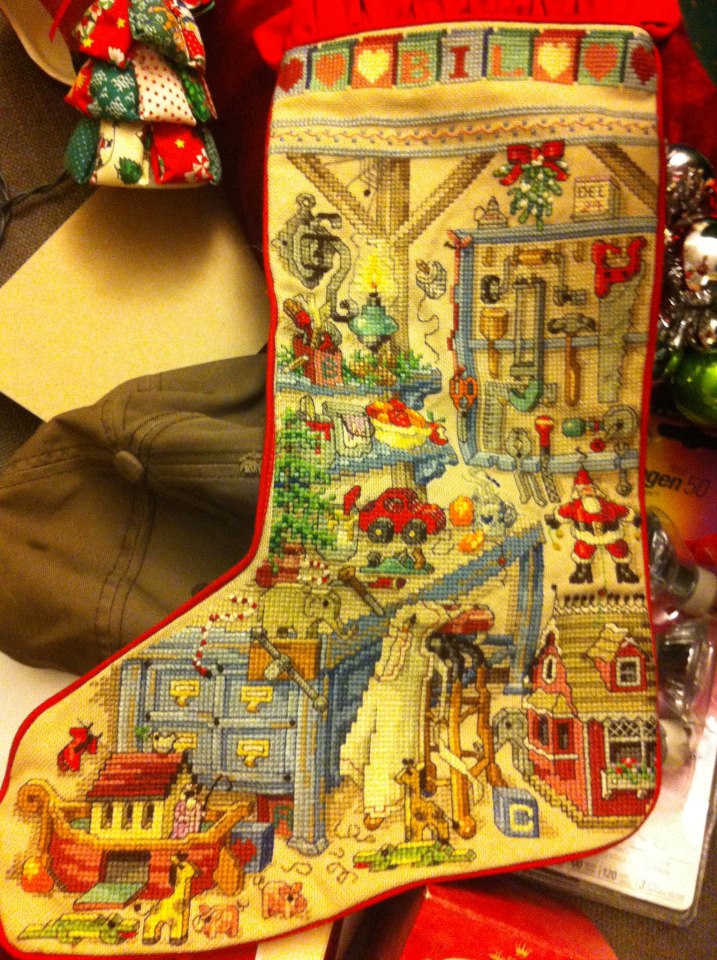
7) Men Who Sew
I had a sweet sewing date with Waylon and his friend a few weeks ago. There’s something about a man who sews really captures my heart. Speaking of which, check out this needlepoint stocking created by Bil Browning, beloved editor of The Bilerico Project.
8) Indian-Inspired Pantry Dinner
I’ve been on a quest to use up odds and ends in my pantry and refrigerator. Here’s a recipe that can accommodate almost any combination of veggies and canned beans. The only mandatory ingredient is fresh ginger.
Step 1
Put some brown rice on to boil. Dice some fresh ginger, as much as you like. Dice onions and celery or whatever aromatics you have on hand. Sauté in olive oil until nicely browned. Add 1 tsp curry powder, 1 tsp cumin and ½ tsp crushed cumin seeds.
Remember to turn the rice down to a simmer.
Step 2
Add some more veggies. I used leftover chard, and I let it cook down a bit. Then I added a can of diced tomatoes with green chilies and a can of garbanzos. I had a little bit of tomato paste in the freezer, so I threw that in too. I let it cook until all the flavors got gay married and the rice was ready to eat.
Step 3
If you like it spicy, you could add some cayenne or crushed red pepper. Serve over the rice. Enjoy!
This fall, as elementary-age kids head back to the classroom, some transgender students are returning with more than just new school supplies. For these children, the beginning of the academic year is an opportunity to introduce a new name, new pronouns, and a new social identity.
Over the past several years, resources for transgender elementary students and their families have grown rapidly. They now include multiple mainstream media reports (with varying levels of accuracy and sensationalism), new organizations such as TYFA and Gender Spectrum, and innovative medical protocols to delay the onset of puberty. While access to these resources is by no means universal, it is becoming increasingly possible for elementary-age children to begin their transition before the maelstrom of middle school.
However, as Elizabethe Payne and Melissa Smith suggest in their recent Huffington Post article, most elementary school teachers and administrators have not been trained in strategies for create an inclusive learning environment for gender nonconforming and transgender students.
As an elementary parent and an educator, I am passionate about welcoming schools. Katy Koonce and I recently had the privilege of creating a training for teachers and staff at a local elementary school. There are stellar materials available, and I wanted to share our outline and some of the things that we found most helpful.
Establishing a developmental timeline
As Payne and Smith point out, “Americans think of young children as ‘innocent’ and ‘asexual,’ so sexuality is considered unmentionable in elementary classrooms.”
Children are perceived as ‘too young’ for such conversations. Because of the ways gender and sexuality are connected in our culture and thinking, addressing non-normative gender brings the ideas of ‘sex’ and ‘sexuality’ into the ‘innocent’ elementary school space and is thus dangerous.
The first task of our training was to reorient teachers and administrators with accurate information about gender and child development. We used Stephanie Brill and Rachel Pepper’s The Transgender Child, specifically chapter three, “Developmental Stages and the Transgender Child,” which contains a detailed breakdown of gender identity at different ages. (If you don’t have access to the book, there is a version of this timeline available on the Gender Spectrum website.)
Information about developmental stages (hopefully) speaks to elementary educators in the language of their professional education. Our next step was to introduce them to the words and experiences of transgender and gender nonconforming elementary students. (Again, our overarching concern at the outset of our presentation was to convince listeners that “this really happens at the elementary level.”)
To this end, our training included excerpts from Queer Youth Advice for Educators, which is based on interviews with LGBT youth from across the nation and includes several personal stories about elementary school experiences. This book is available as a PDF download from What Kids Can Do, and hard copies are available for $9.95. I give copies to school counselors and administrators whenever I can.
Establishing the costs of inaction
Once we had established that gender identity is within the purview of elementary education, we wanted to briefly highlight the social and emotional costs of unprepared schools. The personal narratives from Queer Youth Advice for Educators continued to be helpful on this point, especially when paired with GLSEN’s Harsh Realities: The Experiences of Transgender Youth in Our Nation’s Schools. Based on the 2007 National School Climate survey, this report speaks to educators in their language, linking harassment and lack of safety to poor educational outcomes.
In our case, we felt it prudent to follow the carrot of educational outcomes with the big stick of federal antidiscrimination law. Presumably most educators are already familiar with Title IX, the section of the Education Code that prohibits gender discrimination. We were excited to learn about a 2010 letter from the Department of Education that interprets Title IX as applying to gender-based discrimination that targets transgender students.
Title IX prohibits harassment of both male and female students regardless of the sex of the harasser—i.e., even if the harasser and target are members of the same sex. It also prohibits gender-based harassment, which may include acts of verbal, nonverbal, or physical aggression, intimidation, or hostility based on sex or sex-stereotyping. Thus, it can be sex discrimination if students are harassed either for exhibiting what is perceived as a stereotypical characteristic for their sex, or for failing to conform to stereotypical notions of masculinity and femininity. Title IX also prohibits sexual harassment and gender-based harassment of all students, regardless of the actual or perceived sexual orientation or gender identity of the harasser or target.
Special thanks to the National Center for Transgender Equality for making this letter available as a PDF on their blog.
Outlining best practices
At this point, we felt it was important to move into practical, proactive policy recommendations. For this particular educational context, our recommendations included the following:
Honoring preferred name and pronouns
Maintaining confidentiality
Restroom accessibility
Staff and faculty training
Addressing gender inclusion in the curriculum
Our recommendations were based on personal experience as well as three excellent resources:
Initially, making suggestions for gender-inclusive curriculum seemed like the tallest order. After all, we live in Texas, a state that’s not exactly known for its progressive curriculum. Luckily, my friend Abe Louise Young alerted me to Gender Doesn’t Limit You: A Research-Based Anti-Bullying Program for the Early Grades, which was developed by the Gender and Racial Attitudes Lab at the University of Texas and distributed through the Southern Poverty Law Center’s Teaching Tolerance program. While not explicitly designed to speak to transgender issues, these detailed lesson plans include case studies and rhyming scripts to help young children learn to analyze and respond to gender-based bullying, and many of the examples involve behaviors that don’t conform to rigid gender norms. As an added bonus, the rhyming scripts can be useful for teachers who need words to respond to gender bias and bullying on the spot in everyday classroom contexts.
Future presentations
We learned a great deal from our first training with elementary educators, and we hope to continue to work with more schools and to share resources with other people engaged in similar projects. Personally, I’d like to write some case studies based on experiences of elementary students who have transitioned at school. Do you have other suggestions for other resources or ideas to help us improve?
Paige Schilt has taught college students for 18 years and served as Interim Assistant Dean of Student Multicultural Affairs at Southwestern University in 2011-2012. Katy Koonce is a former school social worker and a psychotherapist in private practice.
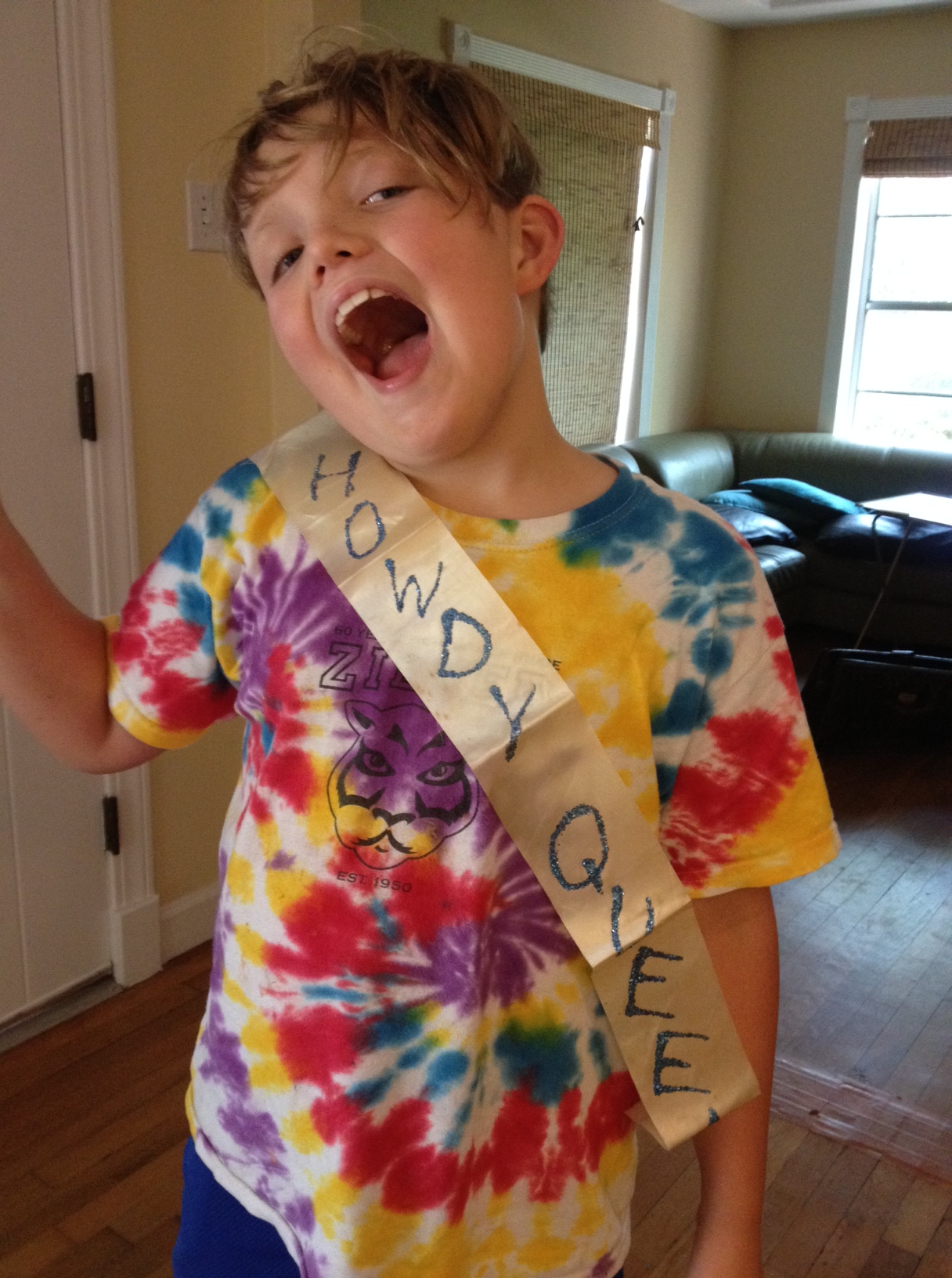
In my story Donor Duet, I mention that Katy was Brazosport High School’s 1976 Howdy Queen (an honor bestowed on the friendliest freshman girl) despite the fact that she was already kinda howdy kingly. The other day, Katy found her Howdy Queen sash (I didn’t even know such a thing existed), and Waylon proudly tried it on.
This interview caused me to vacillate wildly. The premise was marriage equality, and it was easy to answer the reporter’s questions about how long Katy and I have been together, when we got married, and when we had Waylon. After I hung up the phone, I realized that I had inadvertently left out a huge swath our lives together, so I called the reporter back.
Do you have a minute? I forgot to say that my wife identifies as transgender–actually genderqueer, which is somewhere on a spectrum of masculine and feminine–and it’s important to mention that Trinity is also a trans-affirming church.
“Wait…but…are you guys gay?”
Poor man, I could tell he was worried that he’d wasted 20 minutes of his life. I felt bashful about leading him down the mazelike path of multiple identifications, but he did ask…sort of.
The interview wasn’t the end of my dithering. The worst part was my hair–my lovely lavender hair! For some reason, I decided to dye it dark brown for the photograph, and then regretted it immediately. It’s taking forever to grow out, and I consider my many bad hair days as a lengthy object lesson. Next time I’m interviewed, I’ll remember to resist the magnet-pull of fake representativeness and respectability.
My lovely lavender hair is gone, and it’s all my own fault!
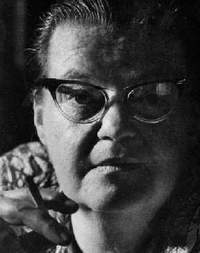
I remember the day I became obsessed with Shirley Jackson.
Photo credit: Laurence Jackson, Shirley’s son
It was summer, I had a deadline, and I was supposed to be watching my six-year-old son and his friend. In an act of desperation, I googled “wifi” and “bounce house” and we embarked for Let’s Go Bananas!—a dark and dusty warehouse filled with listing inflatable landscapes. I propped my laptop on a picnic table that was usually reserved for birthday parties. Every five minutes or so, I unfolded my legs from a pint-size plastic chair and checked to see if the ambient screams were emanating from one of my charges. In this manner, I managed to produce perhaps 200 words (half a page) in two hours.
Around this time, a friend loaned me two collections of Jackson’s domestic memoirs: Life Among the Savages and Raising Demons.* In these tales, which first appeared in magazines like Good Housekeeping and Women’s Day, Jackson creates a glib and distant fantasy of family life. She always seems to be stirring a pudding, sewing costumes for the school play, beating dust from the curtains, and attending little league games—all while observing her four children with a wry yet loving eye.
A casual reader of Life Among the Savages might assume that Jackson’s husband, literary critic Stanley Edgar Hyman, was the sole writer in the family’s book-lined study. The word “typewriter” appears only once, and it is identified as “father’s typewriter.” Jackson’s stories might as well have appeared on the doorstep like milk bottles, for she certainly never discusses her work habits. You would never guess that she published six novels, two memoirs, a play, and scads of critically acclaimed short stories in the years while her children were still very young.
Because Miss Jackson wrote so frequently about ghosts and witches and magic, it was said that she used a broomstick for a pen. But the fact was that she used a typewriter–and then only after she had completed her household chores.
—New York Times, 1965 (obituary)
Jackson has been on my mind again lately. It’s summer, I’m freelancing, my now nine-year-old son is skulking around the house, and I haven’t worked on my personal writing in more than a month. My wife, the therapist, gets to leave the house every day and no one can call her in the middle of a session to complain that they’ve lost the batteries for the wii remote.** I’m here with the kid and the dogs and the dirty dishes, and I have the sensation of needing to do ten things at once and doing a little bit of everything a little bit badly.
To top it all off, we’re really broke right now. We’ve been amassing the paperwork to apply for a home equity loan, and I had to explain my work history to a 25-year-old loan officer in matching Banana Republic career separates.
“I was working part-time because I was, uh…” Oh for heaven’s sake, just say it. “I-was-trying-to-write-a-book.” The loan officer regards me impassively. Her baby doe eyes can neither confirm nor deny the validity of my literary ambitions.
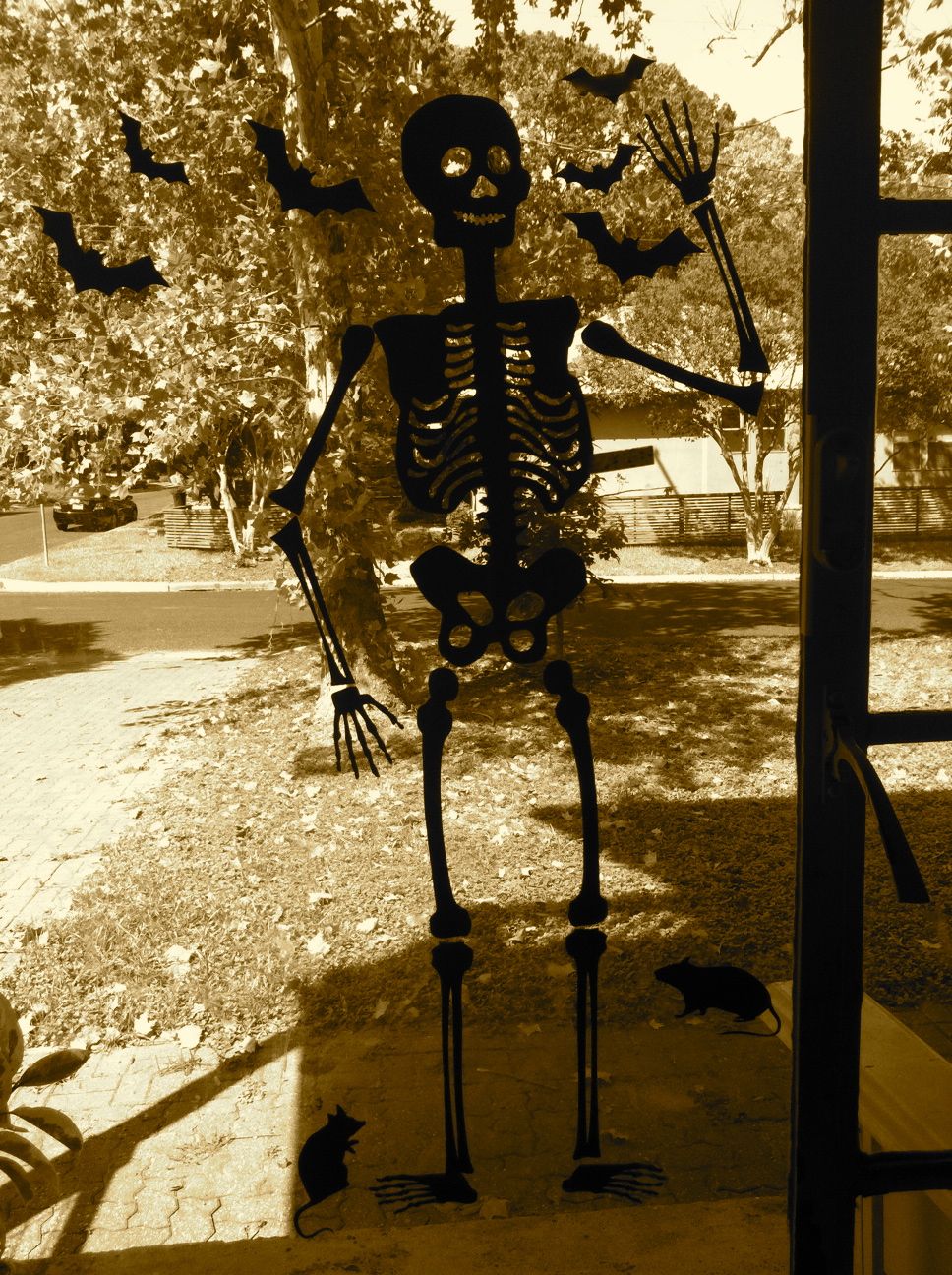
The view from our dirty windows. Yes, that’s a Halloween decoration from last fall.
Later, I notice that she has simply entered “homemaker” as my profession.
This tickles me to no end. I wish that she could see my home—the piles of unfolded laundry, the tumbleweeds of dust and dog hair, the brown sludge at the bottom of the refrigerator drawers. If anything, I’ve become more resistant to household chores since I’ve started working from home. And the irony is even sweeter because I have been supporting myself by writing chatty copy about seasonal veggies, home-canning and other domestic pursuits (this despite the fact that my son only eats toaster waffles, dino-nuggets, Granny Smith apples (regardless of season), pizza, bean tacos, and California rolls.)
“She learned early that the special breed known as the housewife-mother-writer must make important choices and firm decisions. If she looked up from her typewriter and noticed that the windows were dirty, she did not get up and wash them.”
–Lenemaja Friedman, Shirley Jackson (1975)
There isn’t a really great biography of Jackson, but there is a compulsively readable one: Judy Oppenheimer’s Private Demons: The Life of Shirley Jackson. Oppenheimer is overly given to psychologizing—except in the moments when one might crave it the most. (For instance, when Jackson develops a debilitating writer’s block after a critic suggests that her novels feature lesbian themes…)
There’s a particular moment in Private Demons that I cherish: Jackson is invited to speak at a writer’s conference, and her daughters have been farmed out to neighbor women for the weekend. “Without premeditation,” Oppenheimer recounts, “each woman, in response to an irrepressible urge, immediately grabbed the little girl left to her, and dumped her into the bathtub to wash her hair.” It’s almost as if their hair has never been combed before, one of the neighbors recalls. The matted snarls are so intractable that the girls end up with haircuts. Then Shirley comes home, and she’s pissed, because she thinks the other moms are trying to show her up by cleaning her kids.
In citing this story, I’m not indulging in schadenfreude; I’m in awe of Jackson as a writer and as the “housewife-writer-mother” who managed to look away from dirty hair and dirty windows. I am continually reproached by dirt and disorder. I can’t help it; I come from a lineage of repressed artists and impeccable housekeepers. At my grandmother’s memorial, every single testimonial included a reference to her legendary cleanliness. My mother likened her mom’s spotless refrigerator to a still life.
Oppenheimer describes Jackson’s frequent letters to her parents, in which she depicts herself as a “mature, well-organized, serene housewife and mother.” I imagine the letters as rough drafts for the domestic memoirs—fictional feats in which feminine expectations are deftly transformed into a commodity to support her unorthodox life and writing.
“Her letters were her revenge,” says her son, and I’m struck by the warmth and empathy that the Jackson children seem to harbor towards their mom—despite the snarled and dirty hair. It’s a sharp contrast to my paranoid fantasies of my son’s future. I tend to imagine him on a therapist’s couch. “She was always tyyyyping,” he complains. “She made me toast my own Eggo.”
***
Earlier this summer, The Atlantic published a much-discussed article by Anne-Marie Slaughter titled “Why Women Still Can’t Have It All.” (Nothing sells magazines like a disillusioned feminist.) Personally, I can’t remember the last time I worried about having it all. I am usually too focused on staying sane for the next fifteen minutes.
My recipe for sanity has many ingredients: writing, exercise, activism, sex, family, friends, dresses. I need to make money and care for my loved ones and keep my personal space clean enough that it doesn’t interfere with any of the aforementioned items. On a given day, I’m lucky if I manage to juggle three of these priorities. Usually it’s writing that falls to the very bottom of the list, until I begin to feel pent up and frustrated and then it pushes back to the top.
In the summertime, it’s even harder to keep all the balls in the air. I’ve been lucky to have lots of paying jobs, but they’ve come right at the moment when I had hoped to spend more quality time with Waylon. We’ve had several visits from family, and I always seem to watch them approach through dirty windows.
Can’t wait for fall.
=====================================
*I suppose that the title “Life Among the Savages” is partly a Romantic reference to childhood and partly an ironic reference to Jackson’s white, Christian neighbors. I imagine that the publishers were eager to capitalize on the fame of “The Lottery” and Jackson’s reputation as an observer of small-town New England mores. My paperback copy of Life has a picture of a white woman posed between a white child in an African mask and a white child in a Native American headdress, which may also be a reference to husband Stanley’s writing about African folk traditions and African American literature. I can’t help wondering what Shirley’s friend Ralph Ellison had to say about the title and the cover (see Ellison’s “Slip the Yolk, Change the Joke,” which is a response to Hyman and a meditation on masks and archetypes.)
**In all fairness, Katy tried to talk me out of working from home with Waylon. I believe her professional prediction was something like “it will drive you crazy.”
A couple of years ago, I interviewed my wife, Katy Koonce, about life as a genderqueer mommy. Many things have changed since that initial interview: our son is in third grade, and Katy’s gender presentation is ever-evolving. In honor of Mother’s Day, I decided to post an updated conversation about mothering in the middle.
Barton Springs, April 2012
Paige: These days, it seems like half the strangers you encounter read you as a man and the other half read you as a woman. That’s a pretty good match for your identity, but it’s awfully unpredictable. What is it like to live with that uncertainty?
Katy: You know, it’s mixed. It feels exciting and right, but it can also be really hard. The other day, I was in GNC shopping for vitamins, and the sales guy started calling me “sir.” Then, about half way through our interaction, he seemed to change his mind. Before I left, he actually asked whether the masculine terminology was correct. I loved that! I told him I was very comfortable with both and that he “couldn’t get it wrong.” Poor guy. I think it was like a “Pat” moment and he was left more confused than before. I kinda want to go back and interview him about what made him question his assumption and where he got the nerve to ask. Part of me feels responsible, like I should try to ease his discomfort. But I also want to reinforce that it’s okay to ask. Cuz that’s how I roll.
Paige: Our son is in third grade, which has been the threshold of greater self-consciousness about his family. You volunteer in his classroom every week. What’s it like being the indeterminately gendered parent in that setting? How do you navigate that?
Glam Mommy
Katy: Several weeks ago, one of Waylon’s classmates, whom I have known for a couple of years, yelled “Waylon, your dad is here!” It surprised me so much. “Dad” does not resonate with me. I am Mommy! Luckily, about half the class responded “that’s Waylon’s mom” in unison.
My approach to the elementary school setting is very specific to my personality. I am just plain old counter-phobic. I used to be afraid of heights, so I bungee jumped and skydived. At Waylon’s school, I often find myself being extra charming and behaving as if no one should be shocked when I casually mention that I am identified as transgender and then ask them if I can pick their kid up next week for a play date at our house.
Paige: Sometimes you say you feel tempted to transition simply because the pressure of staying in the middle is too much. When do you feel that most?
Katy: BATHROOMS! Also at the mall when they “sir” me the whole time and then, when I am giving them my money, they ask for my name and address so they can send me spam.
Paige: How has being a parent affected the way you inhabit your body?
Katy: In every way possible. Waylon likes to be on me. It appears I am very comfortable to “lay” on. (In Texas, we say “lay down.”) He likes to grab my belly and knead it. It can be a challenge, because I come from a fat phobic family and my belly has typically been a source of shame and discomfort. But I really feel that he loves every inch of my menopausal body, wrinkles and all. In response to this, I have felt shame just completely transform. I can’t say it’s completely gone, but it is different, no doubt about that.
Paige: What’s your favorite thing about being mommy?
Katy: Even in a room full of people who think I am a dude, it still makes me so happy to hear “mommy, mommy look!” I love the way he loves me. I love that he knows I am the mama bear that will protect him at all cost.
Paige: Hey, I’m the mama bear! You are the mommy bear. Step off my nomenclature!
Anything else you’d like to add?
Katy: Yes. Happy Mother’s Day to the best co-parent a girl/boy could ever ask for. You really are the best!
I wish I was a newsy blogger. I know my editor at Bilerico, Bil Browning, wishes I would pump out a topical post now and again. But lately I’ve been forced to squander all my snappy, punctual prose on writing gigs that pay the bills. I saved up my Queer Rock Love news for this convenient digest.
In this issue:
Bitch Interview on Genderful Parenting
Credit in the Straight World
I Have a Reading in Chicago
My Favorite Reader Comments
John Cameron Mitchell Humped My Wife
Subscribe to Queer Rock Love via email
Interview at Bitch Media
Malic White interviewed me for a series about “the end of gender” at Bitch Magazine online. He was interested in my philosophy of genderful (as opposed to gender neutral) child-rearing. You can read more about those ideas here.
Credit in the Straight World
A few stories about our family have been reprinted in venues that aren’t specifically queer! I was especially happy with the lively response to “The Incident,” at offbeatmama.com. And a new site called Role/Reboot: Make Sense of Men and Women ran “Think Pink” and “That Damn Family Unit.” (I don’t think my pieces have been such a hit there, perhaps because making sense of binary roles ain’t really my project. But I’m still super grateful for the chance to reach new readers.)
My Favorite Reader Comments
I wanted to call out a few stellar points from the comments section.
maybe a new leaf wrote:
Found you recently and love your writing…
I’m also glad to find someone writing about queer parenting who has an older kid (as in older than a toddler). Ours are 5 & 2, and the older the get, the less online company we feel like we have.
This is so true! Even though I’m working through a series about breastfeeding and chest surgery right now, I know a lot of readers (myself included) hunger for queer family stories that aren’t just about pregnancy, birth, adoption, and new parenthood. I’ve got some good stuff about third grade and chosen/extended family in the hopper, I swear.
I don’t know how it treats gender, but I know it’s goal is to explain reproduction in a way that doesn’t assume a particular heterosexual two-parent family model.
Yes! I donated to this guy’s kickstarter campaign! I am really looking forward to this book. I’m hopeful that it will be a great gender-inclusive, sex-positive, nonheteronormative resource for early sex ed.
I Have a Reading Coming Up in Chicago
I’m doing a lunch-time reading and Q&A for the Center for the Study of Gender and Sexuality at the University of Chicago on May 17. It’s free and open to the public. I don’t know the exact time and location yet, but I’ll post more soon.
Finally, the biggest news of the season: Katy got to sing with John Cameron Mitchell at gaybigaygay!
You might think that I’m just name-dropping, but you have to understand: Katy and I had a Hedwig and the Angry Inch theme wedding. Our friends put together a band and played “Origin of Love” as we walked down the aisle. I’ve taught the film in my classes for years. I wore out my CD of the movie soundtrack and my copy of the compilation tribute album. An entire section of our bathroom is collaged with pictures of Hedwig. We have a 4′ x 6′ oil painting of Hedwig in our living room.
We’re really big fans.
And we knew for a while that Hedwig’s creator, John Cameron Mitchell, was going to play at gaybigaygay, because our friends Deb and Keri and Kaia were asked to be his band for the gig.
I was super excited, but I somehow imagined that JCM was going to show up in a limo, play his two songs, and then disappear like a diva with his entourage. I NEVER, in my wildest dreams thought that he would be walking around our dirty queer fest, listening to bands, smiling, hugging, and generally acting beatific.
In fact, JCM showed up in time to hear the end of Katy’s new side project, Metal Fist. Then he invited Katy to come up on stage and sing back-up during Midnight Radio. During his set, he delivered a righteous punk rock oration about not experiencing life through the lens of your cell phone camera. And he was so right, because no recording can capture the epic power of his voice or the magic intimacy of that moment. By the time he jumped into the crowd and started body surfing, I was screaming uncontrollably, like a frenzied teenager in old footage of The Beatles.
Just when I thought it couldn’t get any better, he jumped back on stage, pogoed over toward Katy, fell onto the ground, then jumped into her arms and wrapped his legs around her “like a fork shoved on a spoon.”
There’s video here, but it doesn’t really do it justice.
Subscribe
Hey, did you know you can be notified via email every time there’s something new on Queer Rock Love? Just scroll down to the very bottom of this page and click “follow blog via email.” I just got twitter too, @queerrocklove.
The beginning of this post bears a superficial resemblance to the previous post, but fear not. This is a much-expanded version that delivers sex, drugs, rock-n-roll, trans history, romance, surgery, Donna Koonce, go-go girls and havin babies.Thanks to everyone who wrote asking for more!xoxox
As a chronicler of queer family life, there are two topics I have studiously avoided: breastfeeding and my wife’s chest surgery.
It has not escaped my notice that both of these topics have to do with boobs.
All my life, breasts have been vexed. As a fourth grader under the influence of Judy Bloom, I waited vigilantly for signs of “development.” In the absence of any mammarian swellings, I was too embarrassed to ask my mother for a bra. I was afraid she’d ask the obvious question: “what for?” My best friend, the frighteningly precocious Susie Patterson, smuggled 29AA hand-me-downs to school. She delivered the goods under the watchful eyes of the cafeteria ladies, and I hastily shoved the mass of straps and padding into my Muppet Movie lunchbox…and proceeded to forget about them, until later that night, when I heard my mother shrieking with laughter as she unpacked my lunch.
By the time I reached high school, I was furtively searching my health textbook for information about the outlying age range for breast development. Was it possible that I was just a late bloomer? Are you there God? It’s me, Paige. I’m not asking for a miracle. I’m just asking for a B cup.
Eventually I realized that a late-adolescent growth spurt was not going to materialize. I purchased a Maidenform padded push-up bra. In Speech class, I memorized a section from Nora Ephron’s classic essay, “A Few Words About Breasts.” I played my flat chest for laughs, but the words resonated more than I wanted to admit. Like Ephron’s narrator, I believed that breasts were the magical badge of femininity. My A-cup assets made me slightly uneasy – not just about my attractiveness – but about my identity.
My wife’s experience was quite entirely different. By age thirteen, it was clear that Katy had inherited her mother’s legendary rack. And since she refused to set foot in the lingerie department, Katy was at the mercy of her mother’s taste in bras. Thus, throughout the low-slung seventies, Katy sported Jayne Mansfield-style bras that launched her boobs up and out, like minor planets orbiting her chin.
It was not a style that complemented a softball uniform. Or a basketball uniform. Or any of the other sporty ensembles that might otherwise have offered androgynous refuge for a budding butch. In the context of Katy’s broad shoulders and chiseled jawline, the bullet bras made femininity seem like awkward and unfortunate drag.
Throughout her teen years, Katy’s parents enjoined her to “Lose some weight.” Have a stomach ache? “If you lose some weight, it would feel better.” Sprained your ankle? “You need to lose some weight.” A hangnail? “Lose some weight.” Looking back at old pictures, it’s clear that Katy didn’t really need to lose weight. She was a natural athlete who played multiple sports. “Lose some weight” was her family’s way of expressing discomfort with physical difference. They couldn’t very well tell her to stop moving and looking like a linebacker with boobs – they had no language for gender nonconformity. They might have known words like “butch” or “dyke,” but their implications would have been unspeakable. Weight became the focal point for the desire to fix a body that refused to be fully feminine.
Her parents, especially her mother, would live to regret it. When Katy was nineteen, she moved to Hollywood. She stopped wearing bullet bras and began wearing tight long-sleeved leotards under her clothes. At first she favored the leotards because they flattened her chest. Later she needed the leotards to cover her track marks.
When Katy came home to Texas for a visit, her parents were ecstatic. “Finally,” Donna wrote in the family photo album, “a size 6!!!” It’s easy to understand how she was beguiled. In photographs from that era, Katy looks skinny, even a bit gaunt. But she also looks comfortable in her body, more congruent, confident, and even sexy. Katy told her parents that she had discovered a remarkable new diet medicine. In fact, she had discovered a powerful means to androgynize her body: crystal meth.
The tale of Katy’s addiction is a long story in itself – one that I will delve into elsewhere. When she was homeless, hungry, living in her car and cheap motels, her mother came to fetch her from Hollywood. Even then, Katy wasn’t ready to give up on speed and the relief it afforded from dysphoria. She clung to it until she realized that the drugs had changed more than her body – she had become a person whom she did not like or respect – and then she quit.
By that time, Katy’s parents had changed too. Katy had come out as a lesbian when she moved to Hollywood, and her family had accepted the news with love and grace. “You know,” her dad said one day, in his deadpan East Texas drawl, “that k.d. lang is a lezben.” They were less attached to having a particular kind of daughter and were simply glad that she had survived. Thus, when Katy gained back weight and boobs, she was able to convince her parents to pay for a partial breast reduction.
* * * *
Katy’s mother, Donna, was a lovable narcissist. It grieved her that Katy didn’t treasure their shared hereditary abundance. Still, to her credit, Donna did accompany Katy to nearby Galveston to meet the plastic surgeon, Dr. Ted Huang.
“She’d just like a nice B cup,” Donna informed the doctor, making a suggestive cupping gesture with her hand.
“Mom! I want to be flat,” Katy corrected. “I want people to look at me and say ‘that girl is so flat!'”
Katy had no idea that Dr. Huang was affiliated with the Rosenberg Clinic, one of the oldest gender clinics in the South. She’d never heard of genderqueers or transmen or transgender community; she had no idea that there were other people who felt the way she did.
Apparently, Dr. Huang did not feel compelled to enlighten her on these points. But he did remove eight pounds of breast tissue from Katy’s chest. The breast reduction didn’t leave her totally flat, and it didn’t resolve her feelings of gender dysphoria, but it did make living in her body a lot more bearable.
* * * *
Katy performs with Raunchy Reckless.
The first time I saw Katy, she was wearing a prosthetic plastic man-chest with perfectly molded pecs and sculpted abs. It was 1999, and Katy was performing with Raunchy Reckless and the Amazons, a Xena tribute band/queer performance troupe whose motto, “keep the dream alive,” was literalized in outrageous mythological costumes that transformed private fantasies into fabulous public realities. Katy’s character was called “Koonce the Vulgar Viking,” and she sang a catchy song about her masculine physique:
All the girls love it,
While the scrawny boys want it.
Don’t you wanna touch it?
Don’t you wanna touch it?
Man-chest!
Despite its chirpy surf-rock style, “Manchest” never seemed like kitsch to me, and Katy’s costume never exactly read as drag. In contrast to the bullet bras of Katy’s youth, the man-chest looked comfortable, and it seemed clear that she would have worn it all the time if she could have gotten away with it.
We didn’t meet that night. I didn’t even know Koonce the Vulgar Viking’s real name. I was standing in the back of the darkened room, feebly trying to sell t-shirts to support the grassroots youth organization that I had created with my sister and a bunch of other riot grrl-inspired feminists. I hadn’t come out yet, and the crowded club – packed with sweaty, dancing, libidinous queers – filled me with longing and despair. I had no idea how to make this thing inside of me, my queerness, visible.
* * * *
A year later, I was on stage before a live audience of sweaty, dancing, libidinous queers. In my continuing quest to shed my straight-girl image, I had volunteered to go-go dance at a Valentine’s Day dance party at Gaby and Mo’s, a ramshackle coffeehouse with a tiny stage that served as Austin’s main lesbian art space.
With my silver hair and black tights, I was dressed like my small-breasted fashion idol, Edie Sedgwick. I felt that I didn’t have a good enough go-go dancer body, and, as I ascended the homemade plywood go-go box, I began to feel painfully self-conscious. I had thought that I wanted queer visibility, but now I wished I could just fade into the woodwork. The room became a blur of bright lights and loud bass beats.
Suddenly, someone was saying my name.
“Paige, do you want me to fix that spotlight? It’s shining right in your eyes.”
S/he wasn’t wearing a full beard or a plastic man-chest, but I knew immediately that it was the Viking from Raunchy Reckless. I also knew that this person, with his or her butch chivalry, was the sexiest thing I had ever seen. And s/he knew my name! I had a crush so brutal and instantaneous that my face blushed and I could barely speak.
“No,” I mumbled, turning my face away from the spotlight and the directness of Katy’s gaze. “It’s okay.”
Katy shrugged and walked back to her friends. My heart skipped a beat. I had blown my chance! And now I had to dance all night with that stupid light shining in my eyes.
* * * *
Later that week, on February 18, 2000, The Austin Chronicle ran one of its first major stories about trans issues. The previous year, on January 8, 1999, a young transwoman named Lauryn Paige Fuller had been brutally murdered. As the murderer’s trial approached, it was a watershed moment, a time when terrible violence forced the city to take a closer look at itself. The story quoted a local therapist named Katy Koonce, who spoke about the dire lack of services for transgender youth.
I felt a particular connection with Lauryn Paige because we shared a name. I scoured the news for details of her life. When I read The Chronicle story, I made a mental note to contact this Katy Koonce to see how my grassroots feminist organization might be able to connect with young transwomen.
What happened next strains the limits of plausibility. And yet, it’s true.
A few days after I danced at the Valentine’s party, I was due to begin group therapy. It was something I had been thinking about for a long time, and I’d met several times with the therapists who led the group, to make sure that the group was right for me and that I was right for the group.
When it was time for my first group session, I arrived early. Outside on the street, I smoked a cigarette and gave myself a pep talk. Being part of a group would be good. It would help me learn to deal more directly with my emotions. I would gain self knowledge. Hoo-fucking-ray.
I stubbed out my cigarette and gathered enough courage to go up the stairs and into the therapy office. The door was open. Some people were already sitting in couches and on chairs. I took a seat close to the door and glanced nervously around. No one spoke. In the unforgiving light of self-consciousness, my prospective peers looked like they’d been photographed by Diane Arbus. I began to have doubts. What was I doing with all these crazy people?
Suddenly, a majestic figure came barreling down the hall and through the office door. Head tilted, long hair falling forward like a shield – it was the Viking person. And s/he pointed straight at me.
“I know you,” Katy said, plopping into the chair next to mine.
* * * *
Group therapy is an odd place to meet your future partner. Long before we ever went on a date, Katy knew that I was a depression-prone approval-seeker with an addiction to vintage clothes. She knew that I was divorced, that I was ambivalent about my academic career, and that I tended to smile and joke when I was hurt or angry.
I knew that Katy was a former drug addict with hepatitis C. I knew that her anger could command a room, but her vulnerability could take my breath away.
We bonded over body issues. I had grown up in a family of unrelenting dieters. Katy’s mom had warned her never to wear white shirts or horizontal stripes. In response, Katy wore oversize men’s shirts with outlandish patterns. They were calculated to distract the eye and disguise her body. I longed to run my hands down her back, to explore whether she was wearing a binder or an undershirt or nothing at all, but group rules forbade physical contact.
In one of my earliest group sessions, Katy was agonizing because she had been misquoted in the Austin Chronicle story on Lauryn Paige. Suddenly, it dawned on me: Katy from group = Koonce the Vulgar Viking = that smart Dr. Koonce (that was how I thought of her) from the newspaper. But Katy was mortified, because the story had bungled the distinction between sex and gender and sexuality.
To be fair, it was an era with a pretty steep learning curve. New language and new identities were proliferating. Although she used a feminine name and feminine pronouns, Katy also ran a support group for transmen. I guessed that she was moving toward transition, but that her own identity hadn’t quite caught up to the available options.
We saw each other once a week for an hour and a half, in a room full of other people. At the end of six months, I took a teaching job in Pennsylvania. Despite the fact that I was moving across the country, despite the fact that we had never been alone together, never kissed, had never even hugged, I felt strangely confident that we would end up together.
I was almost equally sure that Katy would eventually transition. At the time, I didn’t realize that Katy’s baby clock was ticking faster than her gender clock.
As a chronicler of queer family life, there are two topics I have studiously avoided: breastfeeding and my wife’s chest surgery.
It has not escaped my notice that both of these topics have to do with boobs.
All my life, breasts have been vexed. As a fourth grader under the influence of Judy Bloom, I waited vigilantly for signs of swelling in my chest area. My best friend, the frighteningly precocious Susie Patterson, smuggled 24AA training bras to school for me in her lunch box. She could afford to be generous; as Susie never failed to remind me, she had moved on to bigger (and implicitly better) sizes.
By the time I reached high school, I was furtively searching my health textbook for information about the outlying age range for breast development. Was it possible that I was just a late bloomer? Are you there God? It’s me, Paige. I’m not asking for a miracle. I’m just asking for a B cup. As the years passed, I hitched my hopes to any old wagon, grasping at stories of short boys who grew an inch or more after age 18.
Eventually I realized that a late-adolescent growth spurt was not going to happen. I purchased a Maidenform padded push-up bra and learned to make light of my plight. I was a budding thespian, and my signature monologue was Nora Ephron’s “A Few Words About Breasts,” which begins like this:
I have to begin with a few words about androgyny. In grammar school, in the fifth and sixth grades, we were all tyrannized by a rigid set of rules that supposedly determined whether we were boys or girls. The episode in Huckleberry Finn where Huck is disguised as a girl and gives himself away by the way he threads a needle and catches a ball — that kind of thing. We learned that the way you sit, crossed your legs, held a cigarette and looked at your nails, your wristwatch, the way you did these things instinctively was absolute proof of your sex. Now obviously most children did not take this literally, but I did. I thought that just one slip, just one incorrect cross of my legs or flick of an imaginary, cigarette ash would turn me from whatever I was into the other thing; that would be all it took, really. Even though I was outwardly a girl and had many of the
trappings generally associated with the field of girldom — a girl’s name, for example, and dresses, my own telephone, an autograph book — I spent the years of my adolescence absolutely certain that I might at any point gum it up. I did not feel at all like a girl. I was boyish. I was athletic, ambitious, outspoken, competitive, noisy, rambunctious. I had scabs on my knees and my socks slid into my loafers and I could throw a football. I wanted desperately not to be that way, not to be a mixture of both things but instead just one, a girl, a definite indisputable girl. As soft and as pink as a nursery. And nothing would do that for me, I felt, but breasts.
While my adolescent self was not particularly athletic or rambunctious, Ephron’s essay resonated more than I let on. I believed that breasts were a magical badge of femininity. My A-cup assets made me slightly uneasy–not just about my attractiveness–but about my identity.
Katy as a teenager. No doubt this picture was posed by her mother, the inimitable Donna Koonce.
My wife’s experience was quite different. Katy inherited her mother’s legendary rack. And since she refused to set foot in the lingerie department, Katy was at the mercy of her mother’s taste in bras. Thus, throughout the low-slung seventies, Katy sported Jane Mansfieldian bras that launched her boobs up and out, like minor planets orbiting her chin.
It was not a style that complemented a softball uniform. Or a basketball uniform. Or any of the other sporty ensembles that might otherwise have offered androgynous refuge for a budding butch. In the context of Katy’s broad shoulders and chiseled jawline, the bullet bras highlighted femininity as awkward and unfortunate drag.
More later…
(Special thanks to Katy for digging up this picture and letting me post it. Despite the fact that she finds it slightly mortifying. I think the transgender butch shines through, don’t you?)
 1) Tango, My Childhood Backward and in High Heels by Justin Vivian Bond
 I was having kind of a rocky time a few weeks ago, and the universe sent two signs from my personal savior, Sinead O’Connor. First, The Atlantic published a long biographical article titled “The Redemption of Sinead O’ Connor,” and then Justin Vivian Bond, Christeene Vale and Silas Howard played “Black Boys on Mopeds” at the aforementioned show. It reminded me to ask for solace and guidance at the Sinead shrine in my bathroom (and to listen to Faith and Courage, one of my favorite albums of all time).
 My most recent fortune cookie said “time and nature heal all wounds.” Now that temperatures have finally dropped into the double digits, I’ve been healing myself in the beautiful golden light of Texas in October. My favorite puttering project is a succulent garden on our front porch. Most of the plants were originally gifts from friends, and others were pocketed from public places. (The great thing about succulents is that a single leaf can grow into a whole new plant. They just need “a touch of earth” as my friend Gretchen likes to say.)
 I have to admit that I rolled my eyes when Katy pulled this portable turntable out of her mom’s best friend’s garage. Apparently I was underestimating the quality of a mid-1970s portable Sanyo, because this baby sounds amazing.
 Waylon and I have been creating stuffed homemade stuffed animals from a pile of fleece blankets that our neighbor gave us. Originally we got the pattern from Sewing School: 21 Sewing Projects Kids Will Love to Make, which was a gift from Uncle Rachael. Then we decided that we wanted to create on a slightly smaller scale, so I free-handed a pattern with a sharpie and a piece of copy paper.
 7) Men Who Sew









 Queer Rock Love