A couple of years ago, I interviewed my wife, Katy Koonce, about life as a genderqueer mommy. Many things have changed since that initial interview: our son is in third grade, and Katy’s gender presentation is ever-evolving. In honor of Mother’s Day, I decided to post an updated conversation about mothering in the middle.
Barton Springs, April 2012
Paige: These days, it seems like half the strangers you encounter read you as a man and the other half read you as a woman. That’s a pretty good match for your identity, but it’s awfully unpredictable. What is it like to live with that uncertainty?
Katy: You know, it’s mixed. It feels exciting and right, but it can also be really hard. The other day, I was in GNC shopping for vitamins, and the sales guy started calling me “sir.” Then, about half way through our interaction, he seemed to change his mind. Before I left, he actually asked whether the masculine terminology was correct. I loved that! I told him I was very comfortable with both and that he “couldn’t get it wrong.” Poor guy. I think it was like a “Pat” moment and he was left more confused than before. I kinda want to go back and interview him about what made him question his assumption and where he got the nerve to ask. Part of me feels responsible, like I should try to ease his discomfort. But I also want to reinforce that it’s okay to ask. Cuz that’s how I roll.
Paige: Our son is in third grade, which has been the threshold of greater self-consciousness about his family. You volunteer in his classroom every week. What’s it like being the indeterminately gendered parent in that setting? How do you navigate that?
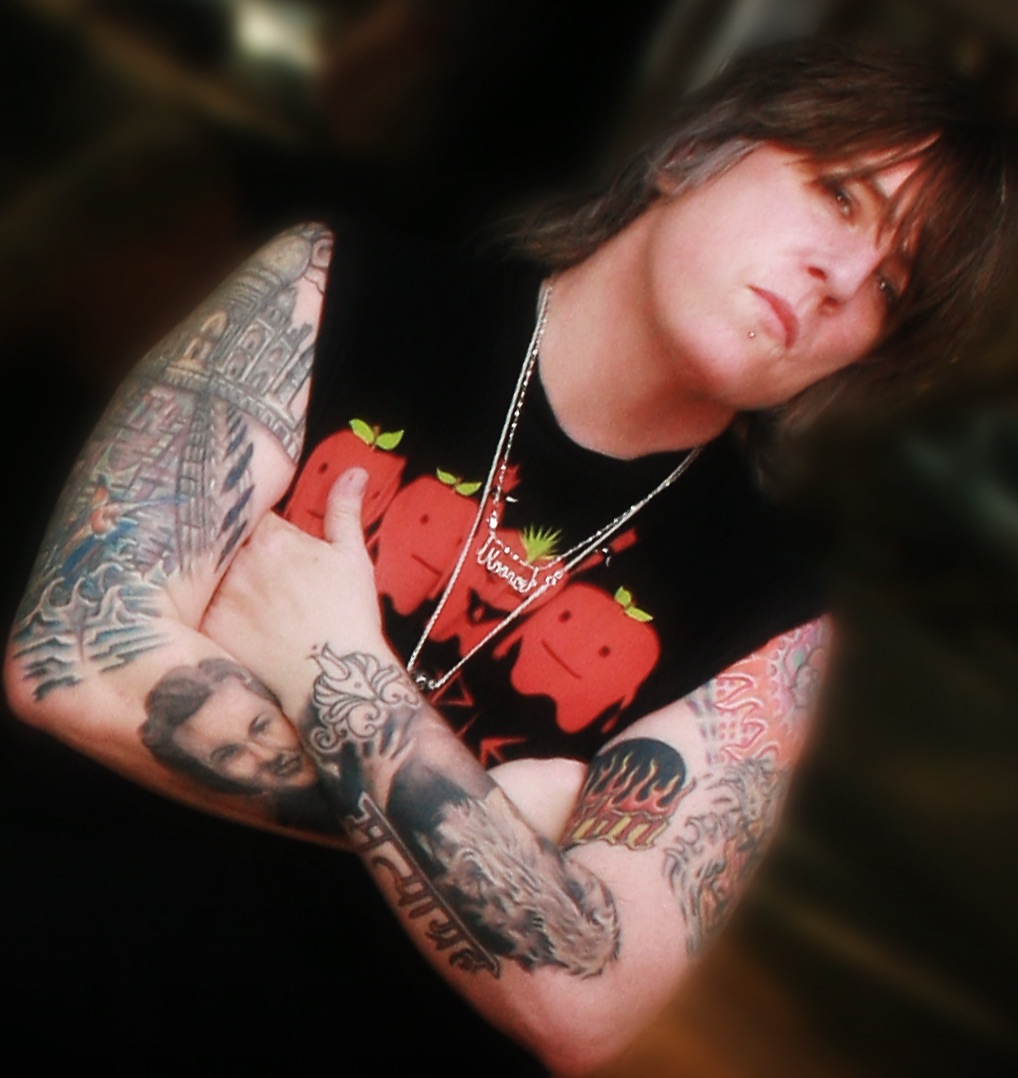
Glam Mommy
Katy: Several weeks ago, one of Waylon’s classmates, whom I have known for a couple of years, yelled “Waylon, your dad is here!” It surprised me so much. “Dad” does not resonate with me. I am Mommy! Luckily, about half the class responded “that’s Waylon’s mom” in unison.
My approach to the elementary school setting is very specific to my personality. I am just plain old counter-phobic. I used to be afraid of heights, so I bungee jumped and skydived. At Waylon’s school, I often find myself being extra charming and behaving as if no one should be shocked when I casually mention that I am identified as transgender and then ask them if I can pick their kid up next week for a play date at our house.
Paige: Sometimes you say you feel tempted to transition simply because the pressure of staying in the middle is too much. When do you feel that most?
Katy: BATHROOMS! Also at the mall when they “sir” me the whole time and then, when I am giving them my money, they ask for my name and address so they can send me spam.
Paige: How has being a parent affected the way you inhabit your body?
Katy: In every way possible. Waylon likes to be on me. It appears I am very comfortable to “lay” on. (In Texas, we say “lay down.”) He likes to grab my belly and knead it. It can be a challenge, because I come from a fat phobic family and my belly has typically been a source of shame and discomfort. But I really feel that he loves every inch of my menopausal body, wrinkles and all. In response to this, I have felt shame just completely transform. I can’t say it’s completely gone, but it is different, no doubt about that.
Paige: What’s your favorite thing about being mommy?
Katy: Even in a room full of people who think I am a dude, it still makes me so happy to hear “mommy, mommy look!” I love the way he loves me. I love that he knows I am the mama bear that will protect him at all cost.
Paige: Hey, I’m the mama bear! You are the mommy bear. Step off my nomenclature!
Anything else you’d like to add?
Katy: Yes. Happy Mother’s Day to the best co-parent a girl/boy could ever ask for. You really are the best!
I wish I was a newsy blogger. I know my editor at Bilerico, Bil Browning, wishes I would pump out a topical post now and again. But lately I’ve been forced to squander all my snappy, punctual prose on writing gigs that pay the bills. I saved up my Queer Rock Love news for this convenient digest.
In this issue:
Bitch Interview on Genderful Parenting
Credit in the Straight World
I Have a Reading in Chicago
My Favorite Reader Comments
John Cameron Mitchell Humped My Wife
Subscribe to Queer Rock Love via email
Interview at Bitch Media
Malic White interviewed me for a series about “the end of gender” at Bitch Magazine online. He was interested in my philosophy of genderful (as opposed to gender neutral) child-rearing. You can read more about those ideas here.
Credit in the Straight World
A few stories about our family have been reprinted in venues that aren’t specifically queer! I was especially happy with the lively response to “The Incident,” at offbeatmama.com. And a new site called Role/Reboot: Make Sense of Men and Women ran “Think Pink” and “That Damn Family Unit.” (I don’t think my pieces have been such a hit there, perhaps because making sense of binary roles ain’t really my project. But I’m still super grateful for the chance to reach new readers.)
My Favorite Reader Comments
I wanted to call out a few stellar points from the comments section.
maybe a new leaf wrote:
Found you recently and love your writing…
I’m also glad to find someone writing about queer parenting who has an older kid (as in older than a toddler). Ours are 5 & 2, and the older the get, the less online company we feel like we have.
This is so true! Even though I’m working through a series about breastfeeding and chest surgery right now, I know a lot of readers (myself included) hunger for queer family stories that aren’t just about pregnancy, birth, adoption, and new parenthood. I’ve got some good stuff about third grade and chosen/extended family in the hopper, I swear.
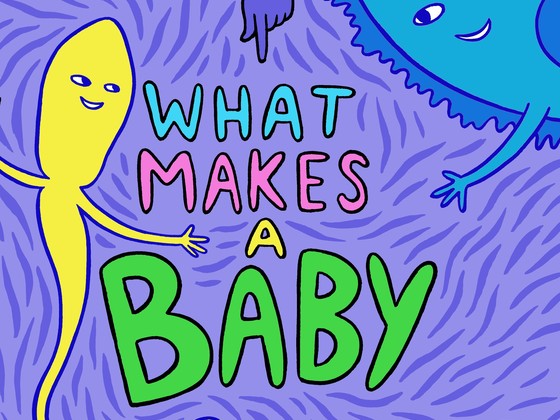
I don’t know how it treats gender, but I know it’s goal is to explain reproduction in a way that doesn’t assume a particular heterosexual two-parent family model.
Yes! I donated to this guy’s kickstarter campaign! I am really looking forward to this book. I’m hopeful that it will be a great gender-inclusive, sex-positive, nonheteronormative resource for early sex ed.
I Have a Reading Coming Up in Chicago
I’m doing a lunch-time reading and Q&A for the Center for the Study of Gender and Sexuality at the University of Chicago on May 17. It’s free and open to the public. I don’t know the exact time and location yet, but I’ll post more soon.
Finally, the biggest news of the season: Katy got to sing with John Cameron Mitchell at gaybigaygay!
You might think that I’m just name-dropping, but you have to understand: Katy and I had a Hedwig and the Angry Inch theme wedding. Our friends put together a band and played “Origin of Love” as we walked down the aisle. I’ve taught the film in my classes for years. I wore out my CD of the movie soundtrack and my copy of the compilation tribute album. An entire section of our bathroom is collaged with pictures of Hedwig. We have a 4′ x 6′ oil painting of Hedwig in our living room.
We’re really big fans.
And we knew for a while that Hedwig’s creator, John Cameron Mitchell, was going to play at gaybigaygay, because our friends Deb and Keri and Kaia were asked to be his band for the gig.
I was super excited, but I somehow imagined that JCM was going to show up in a limo, play his two songs, and then disappear like a diva with his entourage. I NEVER, in my wildest dreams thought that he would be walking around our dirty queer fest, listening to bands, smiling, hugging, and generally acting beatific.
In fact, JCM showed up in time to hear the end of Katy’s new side project, Metal Fist. Then he invited Katy to come up on stage and sing back-up during Midnight Radio. During his set, he delivered a righteous punk rock oration about not experiencing life through the lens of your cell phone camera. And he was so right, because no recording can capture the epic power of his voice or the magic intimacy of that moment. By the time he jumped into the crowd and started body surfing, I was screaming uncontrollably, like a frenzied teenager in old footage of The Beatles.
Just when I thought it couldn’t get any better, he jumped back on stage, pogoed over toward Katy, fell onto the ground, then jumped into her arms and wrapped his legs around her “like a fork shoved on a spoon.”
There’s video here, but it doesn’t really do it justice.
Subscribe
Hey, did you know you can be notified via email every time there’s something new on Queer Rock Love? Just scroll down to the very bottom of this page and click “follow blog via email.” I just got twitter too, @queerrocklove.
The beginning of this post bears a superficial resemblance to the previous post, but fear not. This is a much-expanded version that delivers sex, drugs, rock-n-roll, trans history, romance, surgery, Donna Koonce, go-go girls and havin babies.Thanks to everyone who wrote asking for more!xoxox
As a chronicler of queer family life, there are two topics I have studiously avoided: breastfeeding and my wife’s chest surgery.
It has not escaped my notice that both of these topics have to do with boobs.
All my life, breasts have been vexed. As a fourth grader under the influence of Judy Bloom, I waited vigilantly for signs of “development.” In the absence of any mammarian swellings, I was too embarrassed to ask my mother for a bra. I was afraid she’d ask the obvious question: “what for?” My best friend, the frighteningly precocious Susie Patterson, smuggled 29AA hand-me-downs to school. She delivered the goods under the watchful eyes of the cafeteria ladies, and I hastily shoved the mass of straps and padding into my Muppet Movie lunchbox…and proceeded to forget about them, until later that night, when I heard my mother shrieking with laughter as she unpacked my lunch.
By the time I reached high school, I was furtively searching my health textbook for information about the outlying age range for breast development. Was it possible that I was just a late bloomer? Are you there God? It’s me, Paige. I’m not asking for a miracle. I’m just asking for a B cup.
Eventually I realized that a late-adolescent growth spurt was not going to materialize. I purchased a Maidenform padded push-up bra. In Speech class, I memorized a section from Nora Ephron’s classic essay, “A Few Words About Breasts.” I played my flat chest for laughs, but the words resonated more than I wanted to admit. Like Ephron’s narrator, I believed that breasts were the magical badge of femininity. My A-cup assets made me slightly uneasy – not just about my attractiveness – but about my identity.
My wife’s experience was quite entirely different. By age thirteen, it was clear that Katy had inherited her mother’s legendary rack. And since she refused to set foot in the lingerie department, Katy was at the mercy of her mother’s taste in bras. Thus, throughout the low-slung seventies, Katy sported Jayne Mansfield-style bras that launched her boobs up and out, like minor planets orbiting her chin.
It was not a style that complemented a softball uniform. Or a basketball uniform. Or any of the other sporty ensembles that might otherwise have offered androgynous refuge for a budding butch. In the context of Katy’s broad shoulders and chiseled jawline, the bullet bras made femininity seem like awkward and unfortunate drag.
Throughout her teen years, Katy’s parents enjoined her to “Lose some weight.” Have a stomach ache? “If you lose some weight, it would feel better.” Sprained your ankle? “You need to lose some weight.” A hangnail? “Lose some weight.” Looking back at old pictures, it’s clear that Katy didn’t really need to lose weight. She was a natural athlete who played multiple sports. “Lose some weight” was her family’s way of expressing discomfort with physical difference. They couldn’t very well tell her to stop moving and looking like a linebacker with boobs – they had no language for gender nonconformity. They might have known words like “butch” or “dyke,” but their implications would have been unspeakable. Weight became the focal point for the desire to fix a body that refused to be fully feminine.
Her parents, especially her mother, would live to regret it. When Katy was nineteen, she moved to Hollywood. She stopped wearing bullet bras and began wearing tight long-sleeved leotards under her clothes. At first she favored the leotards because they flattened her chest. Later she needed the leotards to cover her track marks.
When Katy came home to Texas for a visit, her parents were ecstatic. “Finally,” Donna wrote in the family photo album, “a size 6!!!” It’s easy to understand how she was beguiled. In photographs from that era, Katy looks skinny, even a bit gaunt. But she also looks comfortable in her body, more congruent, confident, and even sexy. Katy told her parents that she had discovered a remarkable new diet medicine. In fact, she had discovered a powerful means to androgynize her body: crystal meth.
The tale of Katy’s addiction is a long story in itself – one that I will delve into elsewhere. When she was homeless, hungry, living in her car and cheap motels, her mother came to fetch her from Hollywood. Even then, Katy wasn’t ready to give up on speed and the relief it afforded from dysphoria. She clung to it until she realized that the drugs had changed more than her body – she had become a person whom she did not like or respect – and then she quit.
By that time, Katy’s parents had changed too. Katy had come out as a lesbian when she moved to Hollywood, and her family had accepted the news with love and grace. “You know,” her dad said one day, in his deadpan East Texas drawl, “that k.d. lang is a lezben.” They were less attached to having a particular kind of daughter and were simply glad that she had survived. Thus, when Katy gained back weight and boobs, she was able to convince her parents to pay for a partial breast reduction.
* * * *
Katy’s mother, Donna, was a lovable narcissist. It grieved her that Katy didn’t treasure their shared hereditary abundance. Still, to her credit, Donna did accompany Katy to nearby Galveston to meet the plastic surgeon, Dr. Ted Huang.
“She’d just like a nice B cup,” Donna informed the doctor, making a suggestive cupping gesture with her hand.
“Mom! I want to be flat,” Katy corrected. “I want people to look at me and say ‘that girl is so flat!'”
Katy had no idea that Dr. Huang was affiliated with the Rosenberg Clinic, one of the oldest gender clinics in the South. She’d never heard of genderqueers or transmen or transgender community; she had no idea that there were other people who felt the way she did.
Apparently, Dr. Huang did not feel compelled to enlighten her on these points. But he did remove eight pounds of breast tissue from Katy’s chest. The breast reduction didn’t leave her totally flat, and it didn’t resolve her feelings of gender dysphoria, but it did make living in her body a lot more bearable.
* * * *
Katy performs with Raunchy Reckless.
The first time I saw Katy, she was wearing a prosthetic plastic man-chest with perfectly molded pecs and sculpted abs. It was 1999, and Katy was performing with Raunchy Reckless and the Amazons, a Xena tribute band/queer performance troupe whose motto, “keep the dream alive,” was literalized in outrageous mythological costumes that transformed private fantasies into fabulous public realities. Katy’s character was called “Koonce the Vulgar Viking,” and she sang a catchy song about her masculine physique:
All the girls love it,
While the scrawny boys want it.
Don’t you wanna touch it?
Don’t you wanna touch it?
Man-chest!
Despite its chirpy surf-rock style, “Manchest” never seemed like kitsch to me, and Katy’s costume never exactly read as drag. In contrast to the bullet bras of Katy’s youth, the man-chest looked comfortable, and it seemed clear that she would have worn it all the time if she could have gotten away with it.
We didn’t meet that night. I didn’t even know Koonce the Vulgar Viking’s real name. I was standing in the back of the darkened room, feebly trying to sell t-shirts to support the grassroots youth organization that I had created with my sister and a bunch of other riot grrl-inspired feminists. I hadn’t come out yet, and the crowded club – packed with sweaty, dancing, libidinous queers – filled me with longing and despair. I had no idea how to make this thing inside of me, my queerness, visible.
* * * *
A year later, I was on stage before a live audience of sweaty, dancing, libidinous queers. In my continuing quest to shed my straight-girl image, I had volunteered to go-go dance at a Valentine’s Day dance party at Gaby and Mo’s, a ramshackle coffeehouse with a tiny stage that served as Austin’s main lesbian art space.
With my silver hair and black tights, I was dressed like my small-breasted fashion idol, Edie Sedgwick. I felt that I didn’t have a good enough go-go dancer body, and, as I ascended the homemade plywood go-go box, I began to feel painfully self-conscious. I had thought that I wanted queer visibility, but now I wished I could just fade into the woodwork. The room became a blur of bright lights and loud bass beats.
Suddenly, someone was saying my name.
“Paige, do you want me to fix that spotlight? It’s shining right in your eyes.”
S/he wasn’t wearing a full beard or a plastic man-chest, but I knew immediately that it was the Viking from Raunchy Reckless. I also knew that this person, with his or her butch chivalry, was the sexiest thing I had ever seen. And s/he knew my name! I had a crush so brutal and instantaneous that my face blushed and I could barely speak.
“No,” I mumbled, turning my face away from the spotlight and the directness of Katy’s gaze. “It’s okay.”
Katy shrugged and walked back to her friends. My heart skipped a beat. I had blown my chance! And now I had to dance all night with that stupid light shining in my eyes.
* * * *
Later that week, on February 18, 2000, The Austin Chronicle ran one of its first major stories about trans issues. The previous year, on January 8, 1999, a young transwoman named Lauryn Paige Fuller had been brutally murdered. As the murderer’s trial approached, it was a watershed moment, a time when terrible violence forced the city to take a closer look at itself. The story quoted a local therapist named Katy Koonce, who spoke about the dire lack of services for transgender youth.
I felt a particular connection with Lauryn Paige because we shared a name. I scoured the news for details of her life. When I read The Chronicle story, I made a mental note to contact this Katy Koonce to see how my grassroots feminist organization might be able to connect with young transwomen.
What happened next strains the limits of plausibility. And yet, it’s true.
A few days after I danced at the Valentine’s party, I was due to begin group therapy. It was something I had been thinking about for a long time, and I’d met several times with the therapists who led the group, to make sure that the group was right for me and that I was right for the group.
When it was time for my first group session, I arrived early. Outside on the street, I smoked a cigarette and gave myself a pep talk. Being part of a group would be good. It would help me learn to deal more directly with my emotions. I would gain self knowledge. Hoo-fucking-ray.
I stubbed out my cigarette and gathered enough courage to go up the stairs and into the therapy office. The door was open. Some people were already sitting in couches and on chairs. I took a seat close to the door and glanced nervously around. No one spoke. In the unforgiving light of self-consciousness, my prospective peers looked like they’d been photographed by Diane Arbus. I began to have doubts. What was I doing with all these crazy people?
Suddenly, a majestic figure came barreling down the hall and through the office door. Head tilted, long hair falling forward like a shield – it was the Viking person. And s/he pointed straight at me.
“I know you,” Katy said, plopping into the chair next to mine.
* * * *
Group therapy is an odd place to meet your future partner. Long before we ever went on a date, Katy knew that I was a depression-prone approval-seeker with an addiction to vintage clothes. She knew that I was divorced, that I was ambivalent about my academic career, and that I tended to smile and joke when I was hurt or angry.
I knew that Katy was a former drug addict with hepatitis C. I knew that her anger could command a room, but her vulnerability could take my breath away.
We bonded over body issues. I had grown up in a family of unrelenting dieters. Katy’s mom had warned her never to wear white shirts or horizontal stripes. In response, Katy wore oversize men’s shirts with outlandish patterns. They were calculated to distract the eye and disguise her body. I longed to run my hands down her back, to explore whether she was wearing a binder or an undershirt or nothing at all, but group rules forbade physical contact.
In one of my earliest group sessions, Katy was agonizing because she had been misquoted in the Austin Chronicle story on Lauryn Paige. Suddenly, it dawned on me: Katy from group = Koonce the Vulgar Viking = that smart Dr. Koonce (that was how I thought of her) from the newspaper. But Katy was mortified, because the story had bungled the distinction between sex and gender and sexuality.
To be fair, it was an era with a pretty steep learning curve. New language and new identities were proliferating. Although she used a feminine name and feminine pronouns, Katy also ran a support group for transmen. I guessed that she was moving toward transition, but that her own identity hadn’t quite caught up to the available options.
We saw each other once a week for an hour and a half, in a room full of other people. At the end of six months, I took a teaching job in Pennsylvania. Despite the fact that I was moving across the country, despite the fact that we had never been alone together, never kissed, had never even hugged, I felt strangely confident that we would end up together.
I was almost equally sure that Katy would eventually transition. At the time, I didn’t realize that Katy’s baby clock was ticking faster than her gender clock.
As a chronicler of queer family life, there are two topics I have studiously avoided: breastfeeding and my wife’s chest surgery.
It has not escaped my notice that both of these topics have to do with boobs.
All my life, breasts have been vexed. As a fourth grader under the influence of Judy Bloom, I waited vigilantly for signs of swelling in my chest area. My best friend, the frighteningly precocious Susie Patterson, smuggled 24AA training bras to school for me in her lunch box. She could afford to be generous; as Susie never failed to remind me, she had moved on to bigger (and implicitly better) sizes.
By the time I reached high school, I was furtively searching my health textbook for information about the outlying age range for breast development. Was it possible that I was just a late bloomer? Are you there God? It’s me, Paige. I’m not asking for a miracle. I’m just asking for a B cup. As the years passed, I hitched my hopes to any old wagon, grasping at stories of short boys who grew an inch or more after age 18.
Eventually I realized that a late-adolescent growth spurt was not going to happen. I purchased a Maidenform padded push-up bra and learned to make light of my plight. I was a budding thespian, and my signature monologue was Nora Ephron’s “A Few Words About Breasts,” which begins like this:
I have to begin with a few words about androgyny. In grammar school, in the fifth and sixth grades, we were all tyrannized by a rigid set of rules that supposedly determined whether we were boys or girls. The episode in Huckleberry Finn where Huck is disguised as a girl and gives himself away by the way he threads a needle and catches a ball — that kind of thing. We learned that the way you sit, crossed your legs, held a cigarette and looked at your nails, your wristwatch, the way you did these things instinctively was absolute proof of your sex. Now obviously most children did not take this literally, but I did. I thought that just one slip, just one incorrect cross of my legs or flick of an imaginary, cigarette ash would turn me from whatever I was into the other thing; that would be all it took, really. Even though I was outwardly a girl and had many of the
trappings generally associated with the field of girldom — a girl’s name, for example, and dresses, my own telephone, an autograph book — I spent the years of my adolescence absolutely certain that I might at any point gum it up. I did not feel at all like a girl. I was boyish. I was athletic, ambitious, outspoken, competitive, noisy, rambunctious. I had scabs on my knees and my socks slid into my loafers and I could throw a football. I wanted desperately not to be that way, not to be a mixture of both things but instead just one, a girl, a definite indisputable girl. As soft and as pink as a nursery. And nothing would do that for me, I felt, but breasts.
While my adolescent self was not particularly athletic or rambunctious, Ephron’s essay resonated more than I let on. I believed that breasts were a magical badge of femininity. My A-cup assets made me slightly uneasy–not just about my attractiveness–but about my identity.
Katy as a teenager. No doubt this picture was posed by her mother, the inimitable Donna Koonce.
My wife’s experience was quite different. Katy inherited her mother’s legendary rack. And since she refused to set foot in the lingerie department, Katy was at the mercy of her mother’s taste in bras. Thus, throughout the low-slung seventies, Katy sported Jane Mansfieldian bras that launched her boobs up and out, like minor planets orbiting her chin.
It was not a style that complemented a softball uniform. Or a basketball uniform. Or any of the other sporty ensembles that might otherwise have offered androgynous refuge for a budding butch. In the context of Katy’s broad shoulders and chiseled jawline, the bullet bras highlighted femininity as awkward and unfortunate drag.
More later…
(Special thanks to Katy for digging up this picture and letting me post it. Despite the fact that she finds it slightly mortifying. I think the transgender butch shines through, don’t you?)
A few months back, I wrote that my son had never been bullied at his Texas public school. Perhaps it was inevitable, given that Waylon is in third grade now, but a week or two later there was an incident.
The story unfolded over dinner at our favorite neighborhood Texmex restaurant. Waylon was well into his second bean and cheese taco when he broached the subject. “Mom, B– said that being gay is bad.”
B– is a familiar character in our dinner table conversations. He’s an older kid who attends Waylon’s after-school program. He has a prime position in the elementary school social hierarchy because his parents allow him to play Call of Duty: Modern Warfare. Every day after school, B– captivates the children of our hippy dippy neighborhood with his encyclopedic knowledge of military weaponry.
“What did you do when he said that?” I was trying to keep my voice calm. I was thinking do not freak out, do not freak out, do not let him see that you are kind of freaking out.
“I said, ‘My parents are gay.'”
Oh my god, he’s like a LAMB to the SLAUGHTER!! What CALLOUS IDIOTS taught our son to be so trusting and forthright?
“What did he say?” my wife, Katy, asked. She was using her professional therapist voice.
“He said that must be why I look like his dog when I smile.”
I’m not going to lie; I wanted to track B– down and shake him ’til his eyes rattled. Then I wanted to drag Katy in the next room and chew her out for convincing me to have a kid in the first place.
Instead, I said, “How did that make you feel?”
Which sounds like a stupid thing to say. But somewhere, in the little part of my mind that wasn’t indulging in violent retributive fantasies or wallowing in guilt, I felt a tiny glimmer of hope that Waylon was willing to confide in his parents. I knew this wouldn’t be the last incident, and I needed to convince him that I could handle the truth.
“I don’t know,” Waylon said, looking kind of vague. “Bad, I guess…”
“Well, I feel really mad,” I said. My voice was calibrated to convey approximately 10% of my actual rage. “It’s not okay for him to say that.” I felt I was walking a tightrope, trying to help him identify his feelings without turning the whole conversation into the Seething Mom Show.
“Do I need to kick his ass?” Katy asked.
Waylon looked shocked. “I’m just kidding,” she said. “Sort of.” He smiled. I could tell he was glad that his mom had his back against a bully, even though he knew it was a fantasy.
Katy is a former bully herself, a gender nonconforming kid who kept people from messing with her by being the meanest, toughest kid on the playground. I emerged from a momentary reverie to hear her explaining about bullies, how they lash out because they’re scared, how B– was probably parroting his parents, repeating some version of the messages he’d received about himself.
Waylon was absolutely clear that he did not want us to intervene directly with B–. He wanted to see if he could handle the situation on his own before he risked antagonizing a powerful older kid.
The next morning, I was on the phone with the director of the after-school program. I didn’t violate Waylon’s trust; I didn’t tell her the name of the kid or any identifying characteristics, but I did let her know what had been said.
The director promised to respond with a generic lesson about name-calling and respect. I suggested that a unit on family diversity might be more effective, and she made some vague placating noises. I sent her a link to a research-tested curriculum about different kinds of families. I’m sure she and her colleagues had a good laugh about that one.
This is, after all, Texas public school. No one, not even the most progressive teacher, seems quite sure what they are allowed to say to public school children about the gays. Last year, I asked if our school could print the district’s nondiscrimination clause – which includes sexual orientation – in the school handbook. The principal deftly suggested that the school might run a statement in support of the nondiscrimination policy without actually printing the inflammatory words.
The next evening, when I picked Waylon up from aftercare, the head teacher approached me. He’d heard the details of the incident from his supervisor, and he wanted to assure me that they had a plan to respond.
“Yeah, we’ve got a whole bunch of worksheets for them. You’re probably going to hear Waylon complain about how boring it is for the next couple of days.”
Apparently, that’s our response to bias in Texas – bore the victim.
I was angry all over again. I coldly suggested that there might be a problem if he could predict in advance that his lesson would be mind-numbingly dull. It’s not, I explained, inherently boring material. Difference is actually pretty juicy.
But I knew I was barking up the wrong tree. The aftercare program is staffed by college students, and it takes training to facilitate the kind of conversation that these kids needed to have. It requires the freedom to acknowledge and describe all kinds of differences and the intense feelings they engender. I didn’t have much hope that kind of freedom was going to blossom from a worksheet.
As we walked to the car, I was feeling pretty low. I was ashamed of myself for snapping at the teacher. I felt guilty for being a self-employed writer who sends her son to low-cost after-school care. I felt like a self-indulgent jerk who had saddled her child with the burden of a weird family.
There’s nothing like parenthood for bringing out internalized homophobia.
Luckily, Waylon was in a talkative mood. “Did you see B–?” he asked. “I can’t believe he said I look like his dog!”
“I know,” I said. I stopped and looked him right in the eye. “I’m so sorry that that happened to you. I feel terrible.”
“Wait,” Waylon asked. “Why do you feel terrible?”
“I just think you’re so great, and I feel awful that someone would say something that made you feel bad about yourself.”
“Oh I don’t feel bad about myself,” Waylon said in a Mom-you-are-weird kind of voice. He opened the car door and tossed his backpack inside.
I’ve reviewed this moment many times. Was he feeling pressure to reassure me? Was he repeating something we’d said? Or could he really separate the slur from his own self-image?
When I was a kid, if people picked on me or called me names, I felt shame. I was afraid to tell my parents, because I didn’t want them to know that something was wrong with me. I thought it was my job to keep everyone happy with me at all times, which is probably why I didn’t come out until I was almost 30.
I’d like to believe that Waylon’s experience has been completely different. I hope he knows that the problem isn’t him – or even B–. It’s about whole systems of power and inequality, privilege and oppression, which we try to discuss in everyday words on everyday occasions.
In any case, we’ve lived through the incident, and I’m sure we’ll weather many more.
Before Waylon was born, I believed that my future child would not watch much television. On the rare occasions when he did watch television, I imagined, he would choose something that I liked – something witty and subversive like PeeWee’s Playhouse.
Apparently there’s a karmic debt to be paid for such hubris, because my son did turn out to like television, quite a bit. At age four, his favorite show was Thomas and Friends, a neo-Victorian boy’s tale about anthropomorphic steam engines who compete to be “a really useful engine” in the eyes of a pig-eyed industrialist called Sir Topham Hatt.
“Mom, can I watch just one more Thomas?” Waylon asked, his face a caricature of exaggerated yearning. We had spent the morning jumping waves and building sand castles and flying kites on the beach. We were exhausted and a little bit sunburned. We’d had a late lunch and a shower, I’d removed most of the sand from Waylon’s hair, and now we were lounging on the worn couch of our rented beach house, waiting for Katy and Brian to return from band practice.
“OK,” I said, cuddling him closer. “You can watch one more episode. But you have to turn it off when Uncle Brian gets back.”
Two days earlier, when Brian and his wife Kathy arrived at our house in Austin, Waylon had dutifully dispensed hugs and kisses before retreating to the safety of his toys. Today was our first full day at the beach, and Waylon was still a little shy around the newcomers.
I remembered what it was like to meet some relative whom your parents always talked about. You felt pressure to produce fond feelings, to fall in love with this new person. But it was awkward, even stifling, because the relationship was pre-defined. I was thinking about how to help Waylon feel comfortable (and succumbing to a familiar Thomas and Friends stupor) when I heard the sound of boots on the outside stairs. Katy came in first, walked over, kissed us both, and sat on the couch. Brian entered next, nodded in our general direction, and headed to the fridge for a beer.
Over the past 24 hours, Brian had become increasingly edgy and withdrawn. Today’s practice was the first of only three full rehearsals for the show. Some of the band members hadn’t touched their instruments for almost 20 years. From the look on Brian’s face, I guessed things hadn’t gone so well.
He brought his beer into the living room and sat across from us, looking pale beneath his five o’ clock shadow. He looked like a different man from the rocker in Katy’s old photos. His long, bleached hair was now short and dark. He wore cargo shorts and a baggy T-shirt. It was hard to believe that he’d once pranced around the stage in eyeliner and a jockstrap. Right now he looked like he’d prefer to crawl under a blanket and never come out.
“Waylon,” I said, “it’s time to turn off Thomas.” I was afraid that the minor dramas of the station house would push Brian over the edge.
For once, Waylon turned off the TV without complaining. While Katy and I chatted about band practice, he dragged Master the robot from behind the couch and began to play in Brian’s vicinity. I could see Waylon looking at this new grown-up from the corner of his eye. I guessed that he wanted to engage, but he wasn’t quite sure how to begin. He flipped Master’s switch on and off, over and over again.
“I-am-Master. I-sense-your-fear.”
“I-am-Master. I-sense-your-fear.”
“I-am…”
“Wait,” Brian said, coming out of his reverie, “What is he saying?”
Waylon repeated it for him slowly, “He says ‘I sense your fear.'”
“No,” Brian said, deadpan. “No.” Waylon looked confused, almost heartbroken.
“No,” Brian explained, “He says, ‘I-am-Master. I’ll-buy-you-a-beer.'”
Waylon cracked up. Apparently this was one of the funniest things he’d ever heard. He couldn’t stop repeating it, talking over Master’s mechanical voice, forcing the robot to buy endless rounds of cheer for everyone in the living room.
Surfside Beach is connected to the mainland by a string of chemical plants. Vast plantations of pipes and cooling towers squat over the shallow waters of the bay. At night, illuminated by security lights, the plants were strangely beautiful. In the daytime, they made me think of cancer and three-headed fish.
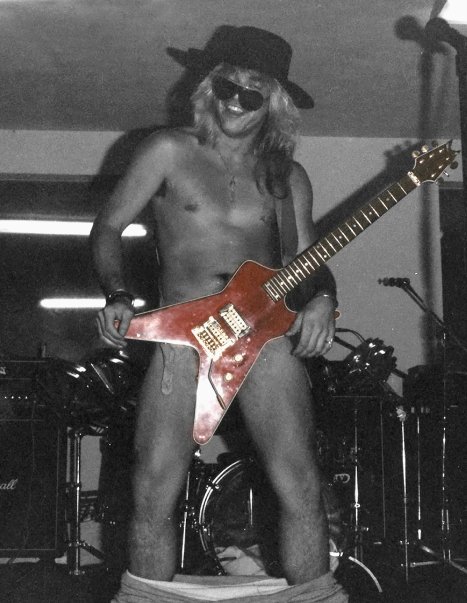
We were traversing this no-man’s-land because Katy had a mission. She had found an old picture of Brian onstage, naked except for a cigarette, a fedora, and a strategically placed guitar. We were driving to the Brazosport Mall to get it transferred onto t-shirts for the show.
“I want a shirt too,” Waylon said from the back. “I want a shirt with Uncle Brian on it.”
“Hmm,” I said. “I’m not sure that would be appropriate.”
“Oh, what the hell,” Katy protested. “He wants a t-shirt of his donor.”
“Well, you can’t wear it to school,” I said, weakly. What the hell. It was a hilarious picture.
We were just coming over the bridge to the mainland, and Katy pulled over at a store called Buc-cee’s, which was a combination convenience store, surf shop, and t-shirt emporium. They sold diesel fuel, bikinis, flip flops, and blow-up rafts, along with hamburgers, chicken wings, chewing tobacco, beer, and homemade fig preserves.
Waylon was immediately drawn to a large display of sand pails and shovels. Katy headed for the children’s clothes and started flipping through the racks for a size 4 black t-shirt. I decided to try on floppy sun hats. If you can’t beat the consumers, I figured, you might as well get something good.
“Mommy, Mommy, can I have this?”
Waylon was dragging an enormous plastic ship through the racks of bathing suits and trunks. When it was clear that he was addressing Katy as “Mommy,” everyone in the store, from the teenage girl in the bikini aisle to the trucker waiting for his food order, did a double take. I couldn’t tell if Katy noticed.
“Sure,” she said automatically. “Check out this t-shirt.” She held up a black t-shirt with an anchor on the sleeve that said “Surfside Beach.” It matched the tattoos on her arms.
“Yes!” Waylon exclaimed. They high-fived.
The line at the cash register was long. One vacationing family was buying snacks for a day on Surfside. But mostly it was chemical plant workers, grabbing coffee and donuts before reporting to shifts at Dow and Shintech. Katy scooped up Waylon and held him while we waited. “My boy,” she said, kissing his head. “My boy is going to get a shirt just like Mommy’s.” Waylon nodded enthusiastically.
“If anybody asks you who’s on the back, what do you say?”
Waylon shrugged.
“You say, ‘that’s my Donor!'”
***
That night, after practice, Brian was even more nervous. He sat silently through dinner, answering his wife’s cheerful queries about band practice with terse, one-word answers. Kathy’s daughter, Jessica, was visiting from college, and I felt bad, because Brian’s nerves were casting a pall over their mother-daughter time.
“We could build a bonfire on the beach tonight?” Kathy asked, hopefully. Brian shrugged and stared at his food. The silence was awkward, unbearable. All of the women, myself included, immediately began to fill it with airy small talk. But when Brian left the room, Kathy scraped his plate with barely contained fury, her lips pressed together in a thin line. After the dishes were done, she wiped the formica table in sharp, precise circles.
I hovered between helping and not helping. The whole scene was like a rerun of the family gatherings of my early adolescence. I knew the script by heart: men set the mood, women set the table…and cook, and clean up. As a teenager, I’d vowed to resist my assigned role in this drama. Now, stuck in the beach house, I felt angsty and oddly irritated with Katy. I didn’t sign on for this much heterosexuality! Why are you making me sit through this? I wanted to hold my hands over Waylon’s eyes. Don’t watch!
My angst was tempered by a guilty sense of sympathy. I guessed Kathy wasn’t used to seeing her husband this nervous. They had met long after he retired from Rokitt. In her world, Brian was a caseworker for people with developmental disabilities. I had seen him with some of his clients when we visited Michigan. He was relaxed, patient, sweet.
After dinner, Brian retired to the back porch to smoke. Everyone else gathered in the living room. It was clear that no bonfire was going to materialize.
“Mom, can I watch one more Thomas?” Waylon asked.
I felt ambivalent. I knew he was bored, but I didn’t want to be rude, hogging the TV with kiddie shows.
“Ask Uncle Brian if he wants to use the TV,” I answered. Just then, Brian walked in the door and started to cross the room. Waylon followed him across the linoleum floor.
“Can I watch TV?” he asked, tugging on Brian’s shorts.
“I don’t know,” Brian said, sullenly. His whole body recoiled from the responsibility that the question implied. “Ask your mom.”
***
The next day, Waylon and I escaped to the beach to jump waves. Every few minutes he yelled, “This is so fun!” as if he couldn’t quite believe his luck. I felt the same way. As a child, I would stay in the surf for so long that my body could feel the rise and fall of the waves in my bed at night. Now Waylon’s excitement was making me feel like we shared a special bond.
When he got winded, I held him on my hip and jumped for him. Waylon told me stories about preschool. I told him stories about childhood vacations. We talked until I ran out of stories, but he still wasn’t ready to go ashore.
“Are you excited for the big rock show tonight?” I asked.
“Uh-huh.” He shook his head. We’d been taking him to shows since he was a month old.
“Are you going to dance for Uncle Brian?” I asked.
“Yes, and I’m going to sing with the band. On the stage.” he informed me.
“Oh.” This was the first time I’d heard of this plan. I didn’t want to smash his dreams, but I also didn’t want him to be disappointed if it didn’t work out.
“Um, Sweetie, Mommy is singing with the band. Did anyone tell you that you were going to sing with the band?”
The sun is setting on the beach as we make our way down Surfside’s narrow, two-lane highway. When we pull into the sandy parking lot of Stahlman Park Recreation center, I’m relieved to see that the parking lot is fairly crowded. It helps that every third vehicle is a puffed-up Ford F150, which takes up one and a half regular parking spaces.
I release Waylon from the back of our Volkswagen. He looks adorable in his black t-shirt with Brian’s picture on the back.
“Are you ready to rock?” I ask.
“Yeah!” he yells.
“We’re going to dance and clap really loud, right?”
“Yeah, and I’m going to sing with Uncle Brian,” he assures me as we walk across the sandy parking lot.
“That’s a sweet idea,” I tell him, taking his hand. “But it’s not very likely, at least not tonight.” I know that I sound like a wet blanket. I just don’t want my baby to get hurt. Waylon breaks away and charges up the wooden ramp to the rec center. Outdoor floodlights illuminate the picture of Brian on his back. “Slow down!” I yell as he disappears through the swinging doors.
The danger of any kind of reunion is finding out that you’re just not that relevant to people’s lives. I have only heard about Rokitt from Katy, and she is Brian’s best friend. I don’t have a good sense of what Rokitt meant to other folks – until I walk into the bright, air-conditioned space of the rec center. The folding chairs are filled with old rockers and their teenage kids, chatting and eating in tidy rows of 10-foot banquet tables. I spot Waylon near the kitchen, where a team of women is setting out cookies. The buffet table is decorated like a high school prom, with plastic picture cubes that displayed Rokitt photos on all six sides.
By the time I cross the room, Waylon has a cookie in hand and is making his escape. He runs straight into his Tía Sandra, Katy’s other best friend, who catches him in a bear hug. As I make my way to where they’re standing, Sandra pretends to devour the “sugars” from Waylon’s neck, which make him laugh and squeal. When she finally hands him back to me, he is content to rest on my hip and eat his cookie.
“Sandra,” I ask, “did you know Brian when he was in Rokitt?” Sandra and I are the same age – nearly a decade younger than most of the people in the rec hall – and I’m curious to hear her perspective on the whole scene.
“I went to see them when I was in high school. Some of my rocker friends took me to their show at the KC Hall. The next day, everyone was wearing Rokitt t-shirts to class. You would have thought fuckin’ Motley Crue had come to town.”
I’ve seen pictures of Sandra from the eighties, when her black, curly hair was styled in a glorious Mexican mullet. Back then, she and Katy were both identified as “butches with hair.” Now she wears it close to her head in a crew cut. She has recently been hired as an operator at one of the plants that line the beach road. One of those big, puffy trucks in the parking lot belongs to her.
A white man with hands and neck like sunburned hams is approaching. Redneck alert! Redneck alert! I pull Waylon closer to me. As the ham man walks past, on his way to the cookie tray, he gives Sandra a subtle nod. “How you doin?” Sandra says, nodding back. I marvel at how my friend has taken her place in a world of men who work in the volatile chemical plants.
Suddenly, the band members take their places. There’s no stage, so they just walk, unceremoniously, to their instruments. A skinny guy with hair like Kenny G is speaking into the microphone. I think he’s the emcee, but the people in the audience don’t seem to notice. Brian is pacing in front of the drum kit, his movements cramped by nervousness. He’s wearing Katy’s tight black jeans and a t-shirt that says “I rock,” with a picture of an antique rocking chair. His face is deathly pale. I’m afraid he might puke before the end of the introduction. Finally, the emcee hands over the mic. The band starts to play. Brian lets out a feeble whoop. The audience stops talking.
From the back of the room, I realize that I’m holding my breath, and I force myself to breathe naturally. They sound okay. Brian’s voice is clear and tuneful. He’s still stiff, but he manages a jaunty kick at the end of the first song. I find an empty folding chair near Kathy. Waylon scoots onto my lap as the band dives into their second number, a Judas Priest cover. I sneak a peek at Kathy’s face. She looks happy and relieved and a little teary. Rokitt is loosening up now, and the crowd gives them hearty applause. In the next row, an elderly lady with white hair turns to her daughter. “Breakin’ the law, breakin’ the law,” she quotes.
Brian is looking less frightened. “I just took some Geritol, and I’m waiting for it to kick in,” he jokes between songs. I wonder if anyone under 35 has ever heard of Geritol. “Feel free to dance, if you can find some room,” he adds. “Any time.”
I’m from Austin, where there’s an unspoken thirteenth commandment: thou shalt dance when thy friend’s band plays. At the Stahlman Park Recreational Center, the folding chairs dominate all but a tiny space in the very front. People are behaving like they’re at a church social – grabbing plates of potato salad and catching up with their neighbors while the band plays. Between the chatter and the bright lights and the absence of an actual stage, the whole thing is lacking a certain intensity. I’m worried about the energy of Brian and the other guys. I just want people in this room to bear proper witness to the miracle of middle aged men making music together.
Katy’s up at the front, bouncing and head-banging, but she’s interrupted every few minutes by someone who wants to catch up on old times. Katy was elected “Howdy Queen” at her high school, an honor bestowed on the friendliest freshman girl. However, even as Howdy Queen, Katy didn’t look like a girl. I’ve seen the coronation photos, and she looks like a football player in half-hearted drag. Throughout high school, Katy’s mom outfitted her daughter with Jane Mansfield-style bras that made Katy’s boobs loom in front of her like alien orbs. Twenty-five years later, she has a surgically flattened chest and can wear her clothing of choice: jeans and a muscle shirt. Her body is still ambiguous. And her warmth and enthusiasm still have the power to charm people who would otherwise be frightened by the mystery.
It doesn’t hurt that she’s the daughter of a football coach. When Katy comes up to sing with Brian, the little old lady in the front whispers something to her daughter. I imagine it’s along the lines of “Who’s that tattooed dyke?” Her daughter answers and the lady shakes her head excitedly. “Oh, that’s Katy Koonce.” She taps her husband on the shoulder. “That’s Katy Koonce!” she yells in his ear. He shakes his head too. People here remember the days when Brazoswood High went to the state championship. Katy ran onto the field with her dad after every game.
I figure the people must have some kind of fond memories of Katy, because the crowd is cheering as Katy humps Brian’s leg through the chorus of “Talk Dirty to Me.” It’s hard to believe that the Stahlman Park Recreation Center is bearing witness to such a queer spectacle. These two old friends feed each other’s energy, and their duet shifts the mood in the room. Waylon, for one, is out of his seat and dancing. As the band makes its way through original numbers like “Sweet Sixteen” and “You Make Love Too Tough,” he bounces and bangs his head. Occasionally he throws in some Kung Fu moves and King Tut poses. Every time he gets too close to the band, I have to run up in front of the folding chairs and drag him out of the spotlight. “That’s Katy Koonce’s lesbian lover,” I imagine the old woman saying to her husband. “And their gay love child!”
After the tenth time that Waylon rushes the band, I pull him aside for a little talk.
“Mommy was singing with the band because they invited her,” I explain. “You can’t keep going up there and getting in their way. It’s Uncle Brian’s big night.”
Waylon nods obediently, and then runs away. An old friend of Katy’s stops to talk to me, but I’m distracted, trying to spot Waylon in the crowd. By the time my eyes find him, he’s already back at the front. He’s somehow managed to take apart one of the plastic picture cubes, and he’s holding a handful of old photos. As the band launches into the final song, Waylon crawls up to the microphone and carefully lays the pictures at Brian’s feet.
“You show us everything you’ve got,” Brian growls into the mic. “And baby, baby that’s quite a lot.”
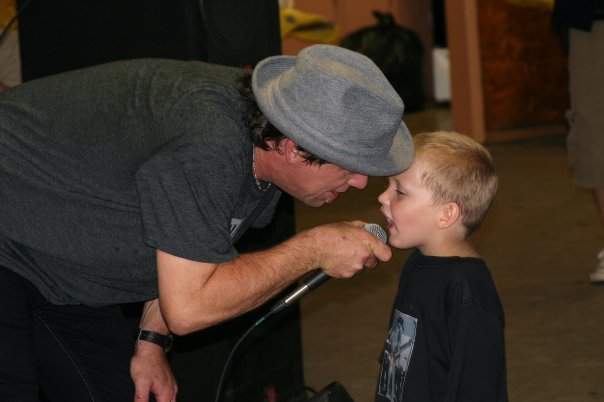
Waylon is jumping up an down, elated. He knows this song! Brian leans down toward him for the chorus.
“I wanna rock and roll all night,” he growls.
He extends the microphone to Waylon. Waylon contemplates it for a beat.
“And party ev-er-y day!” he squeals in his high, four-year-old voice.
Brian leads into the chorus again, and Waylon sings his part. He’s on the beat now, and people in the room are beginning to laugh and look at one another like, “Who is that kid?” By the time the second chorus comes around, the two have fallen into an easy call and response: first phrase low and gravelly, second phrase high and squeaky.
“I wanna rock and roll all night,” Brian calls.
“And party ev-e-ry day!” Waylon answers, looking proud. Every time he hits his line, people in the crowd hoot and clap. It’s a magical moment, the kind that you wish would never end because you can’t quite believe it’s real.
Katy comes up and puts her arms around me. I can feel her tears sliding down my neck. I look around the room and see Sandra against the back wall. She’s smiling and crying big butch tears too. Sandra helped raise two nieces in this community. Now she and her girlfriend are thinking about having a baby of their own.
Brian nods to the band to play the chorus one more time. “I wanna rock and roll all night.”
“And party every day!” They sing the last line together. Then Brian hangs up his microphone and sweeps Waylon into his arms. Waylon throws his arms around Brian’s neck, and they hug for a long time. Brian turns to the audience and makes the devil horns. Waylon painstakingly folds his middle fingers down to imitate Brian’s heavy metal salute.
The crowd is shouting and clapping and calling for an encore. They’re honoring Rokitt and honoring their youth. It feels like they’re honoring our queer family, with all of its twists and unexpected turns. For the moment, I’m so glad that we decided to step into this particular unknown.
Two days before our sperm donor was due to arrive in Texas, my wife walked in the door with a bulging sack of secondhand toys.
“Waylon already has too many toys,” I said, shaking my head. “His birthday was a month ago! He’s barely four and he has enough stuff to fill two closets.”
“I know, I know,” she replied, looking sheepish. “But he’s going to be the only kid at the beach this weekend.”
This is one of our most familiar family dynamics: Katy indulges, Paige worries, Waylon gets the loot. But for once I wasn’t worried about my son’s consumer character. I was more concerned about my wife’s impulse to play Santa in July.
On the surface, her justification for the new toys was entirely plausible. We were about to embark on the kind of trip down memory lane that only the middle-aged can appreciate. Katy’s best friend Brian, Waylon’s sperm donor, was coming to Texas to play a reunion show with Rokitt, his hair metal band from the ’80s. But rather than the gritty Texas blues clubs that they played in their prime, this time Rokitt was planning to electrify their die-hard fans from the fluorescently-lit comfort of the Stahlman Park Recreation Center on Surfside, a tiny island south of Galveston.
Surfside Beach is not exactly the Riviera of the Texas coast. But Waylon wasn’t exactly a beach snob. He played in the sand all day long at his preschool, digging holes and tunnels and rivers. Every night at bath time, he reluctantly parted from a personal reserve of sand. Despite Katy’s worries, there could be no doubt that he was looking forward to a vacation that involved beaches full of unlimited sand.
When it came to the ocean, however, Waylon’s expectations were as murky as the waters off the Texas coast. We had taken him to the Gulf of Mexico a few times before, but it wasn’t clear that he remembered. When I asked if he was looking forward to playing in the waves at Surfside, Waylon remained vague. “Uh huuuuuh,” he murmured, looking off into the middle distance.
It was pretty much the same situation when I asked if Waylon was looking forward to seeing “Uncle” Brian. They had only met once, when Waylon was about 18 months old, and I knew Waylon didn’t remember. Brian called him at Christmas and birthday time, and Waylon communicated with the harassed politeness that children everywhere extend to long-distance relatives.
With the Rokitt reunion on the horizon, Katy had been pulling out old pictures and trying to enlist Waylon’s enthusiasm for the band and its sperm donor front man.
“Waylon,” she said, holding out a picture from an amateur photo shoot circa 1987, “Do you know who this is?”
Waylon looked up from his blocks, scanned the picture of a man in a ripped tank top and lace tights, and shook his head.
“That’s Uncle Brian!” Katy explained, in a sing-song Barney voice. “Remember, he gave us the seed that we needed to make you?”
This line about the seed was what we’d been telling Waylon ever since he was old enough for us to tell him something about the way we made him. I worried at times that it was too euphemistic, but it was technically accurate. Thus far, although Waylon loved to hear stories about how his parents met and decided to have a baby, he hadn’t expressed interest in the mechanics of conception. From what I could tell, it hadn’t yet crossed his radar that his moms couldn’t make a baby on their own. Whatever we were saying about seeds just seemed extraneous.
Regardless of what Waylon understood, Katy’s enthusiasm for her best friend and his erstwhile band was hard to resist. Over the last few days, Waylon had begun to recognize the guy in the pictures and to look forward to seeing Rokitt play. I was getting excited, too. But I was also scared.
Brian wasn’t part of our queer milieu of chosen family. He had a wife, an ex-wife, and a son in high school. The few times that we’d met, I hadn’t been able to decipher his dudely, understated manners. From my vantage point, it wasn’t clear if Brian was really down for new and complicated family ties. I worried that this vacation would prepare Waylon to expect a relationship that would never materialize.
When I wasn’t fretting about too little connection, I worried about too much connection. I imagined Waylon, fifteen and leather-jacketed, leaving home in a storm of adolescent angst. “You just don’t understand me,” he yelled as the backdoor slammed shut. “I’m going to live with my Dad.” Dad. Dad. Dad. In fantasy, the forbidden D-word lingered in the air as Katy and I huddled in the kitchen, broken apron strings dangling limply at our sides. What if Waylon and Brian had some kind of mystical masculine bond? What if Waylon decided to abandon his moms? Could Brian love and support our son without trying to supplant us? Was Katy secretly worried about this, too? Was that the real explanation for her toy store shopping spree?
All of these questions were swirling in my mind when Waylon came home from preschool and gravitated to the big bag of toys. Katy told him he could pick one now and save the rest for the beach, so he closed his eyes and plunged his hand into the bag, feeling around until he located the largest toy: a three-foot plastic robot with a helmet and a ray gun. (Apparently, my feminist, nonviolent shopping criteria were the first casualty of Brian’s visit.) Waylon was in heaven. Grinning, he searched for the “on” switch. And then there was sound:
“I-am-Master,” the robot announced. “I-sense-your-fear.”









 Queer Rock Love